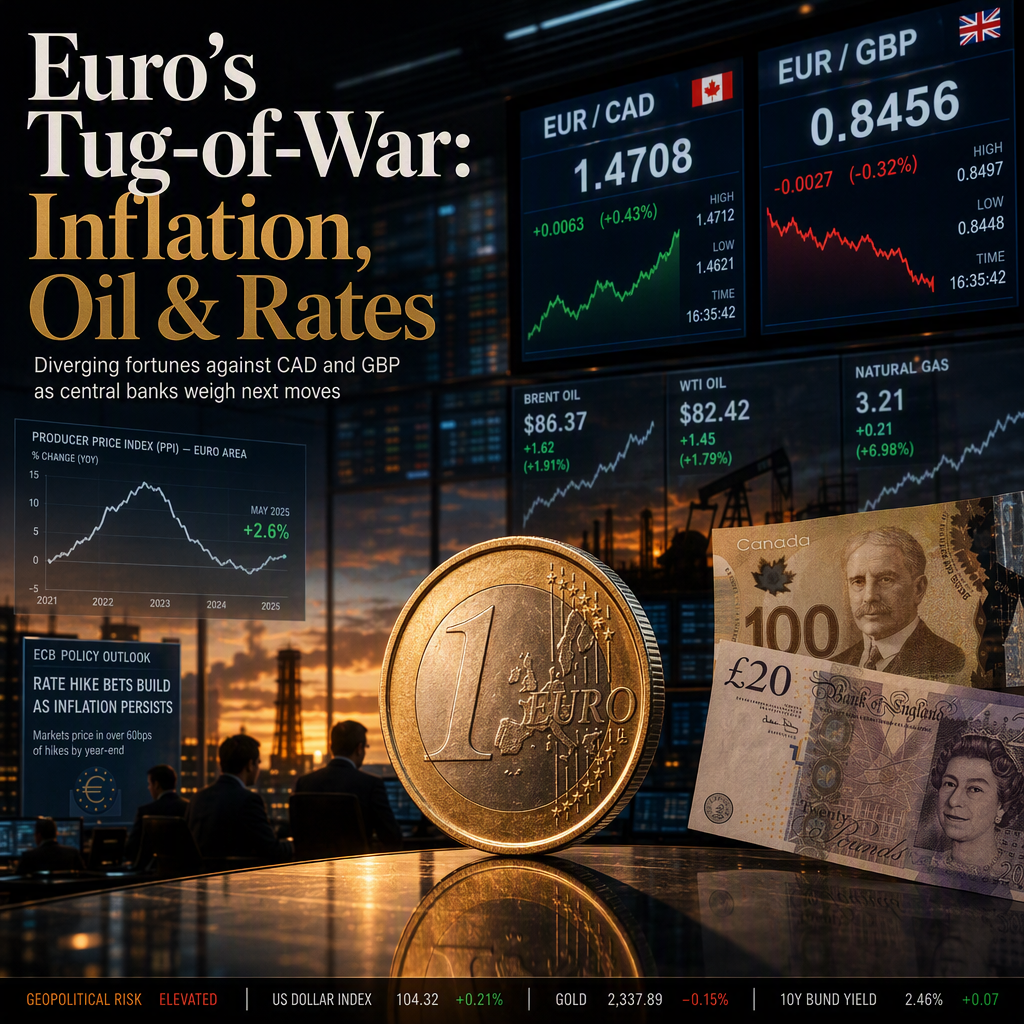
The Euro experienced mixed performance against major currencies on Thursday, with EUR/CAD halting its three-day winning streak and trading around 1.6110, while EUR/GBP held steady near 0.8580 [1][2]. The Euro weakened against the Canadian Dollar as rising crude oil prices, driven by escalating Middle East tensions and stalled US-Iran negotiations, bolstered the commodity-linked CAD. Despite the confrontation spreading to the Strait of Hormuz, US President Donald Trump stated that oil shipments continue, leaving open the possibility of future talks with Tehran [1].
Conversely, the Euro found support from robust Eurozone fundamentals and expectations of further European Central Bank (ECB) rate hikes. Both sources highlight that soaring European natural gas prices, linked to Middle Eastern supply shortages, are keeping inflationary risks elevated and strengthening the case for additional ECB tightening this year [1][2]. The latest German Producer Price Index (PPI) data reinforced this narrative, with July's PPI rising 3.0% year-on-year, surpassing expectations of 2.7% and marking the fastest annual increase since April 2023. Monthly producer prices rebounded by 1.1%, signaling persistent price pressures in the Eurozone's largest economy [1][2].
Economists at UBS acknowledged the upside surprise in German producer prices but downplayed its broader market impact, noting that few economists forecast this data and suggesting it is a secondary indicator for investors [1][2]. Meanwhile, analysts at ING pointed to strong foreign inflows into Eurozone assets, citing ECB data showing that foreign investors have purchased around €1.1 trillion of eurozone securities over the past 12 months, reinforcing the Euro's diversification appeal [1].
Against the British Pound, the Euro's downside was limited by similar monetary tightening expectations from both the ECB and the Bank of England (BoE). UK inflation data showed the Consumer Price Index (CPI) rose 2.9% year-on-year in July, in line with expectations, while core inflation remained at 2.6% [2]. However, recent signs of a cooling UK labor market and the absence of a major inflation surprise have tempered aggressive BoE rate hike bets. Danske Bank analysts noted that the inflation data, combined with weak labor market figures, have moderated BoE pricing for the rest of the year [2]. Money markets still anticipate a BoE rate hike by year-end, potentially raising the Bank Rate from 3.75% to 4%, which supports the Pound and offsets the positive impact of ECB tightening prospects on EUR/GBP [2].
CONCLUSION
The Euro's performance is being shaped by diverging forces: commodity-driven strength in the Canadian Dollar and offsetting rate hike expectations with the British Pound. While robust Eurozone fundamentals and persistent inflation support the case for further ECB tightening, market reactions remain measured, with limited impact from German producer price surprises. The outlook for the Euro will depend on evolving inflation trends and central bank policy decisions in both Europe and its major trading partners.