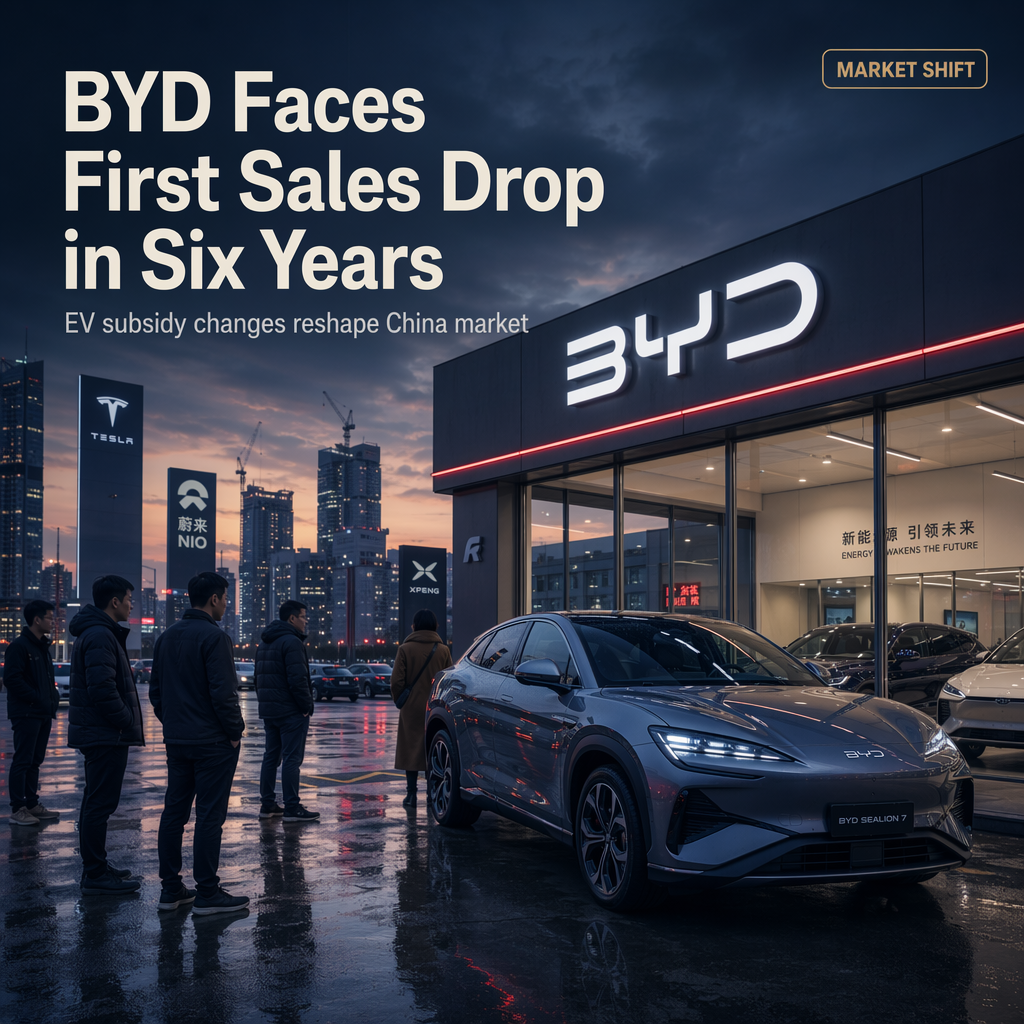
BYD, a leading Chinese automaker specializing in battery-powered and plug-in hybrid vehicles, announced a 16% year-on-year drop in new-vehicle sales for the first half of 2026, totaling 1.8 million units [1]. This marks the first sales decline for the January-June period in six years, highlighting a significant shift in the company's growth trajectory [1]. More than half of BYD's sales are concentrated in the domestic Chinese market, which has experienced a slump in demand following changes to the country's electric vehicle subsidy program [1].
Industry analysts attribute the sales decrease primarily to the reduction and restructuring of government EV subsidies, which have altered consumer incentives and led to weaker demand among price-sensitive buyers [1]. The policy changes have forced manufacturers like BYD to recalibrate their strategies in response to the new market environment [1]. A Guangzhou-based automotive analyst commented, "The subsidy adjustment has directly affected sales momentum," underscoring the immediate impact of policy shifts on the sector [1].
BYD's performance is seen as indicative of broader challenges facing the Chinese EV industry, with several automakers reportedly experiencing similar difficulties in the first half of the year [1]. Increased competition from both domestic and foreign brands has further exacerbated the sales slowdown [1]. Market sentiment remains cautious, with analysts suggesting that further adjustments to subsidy policy or market strategy may be necessary for Chinese EV makers to regain momentum [1].
No detailed technical chart data or specific trading advice was provided in the article [1].
CONCLUSION
BYD's first-half sales decline reflects the significant impact of China's EV subsidy changes and heightened competition in the market. Analysts remain cautious, indicating that further policy or strategic adjustments may be required for recovery. The company's performance serves as a bellwether for the broader Chinese EV sector, which faces similar challenges.