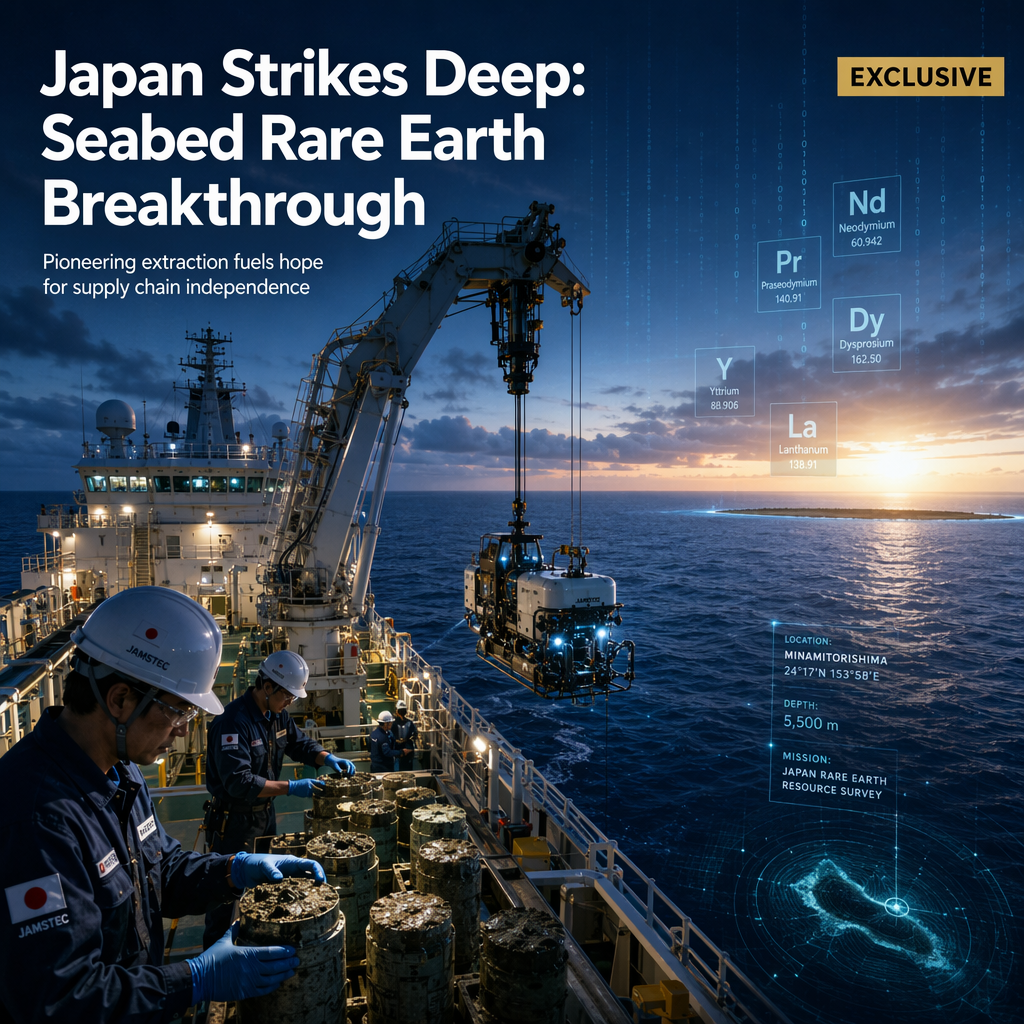
Japan has successfully recovered rare earth elements, including yttrium and dysprosium, from deep-sea mud off the coast of Minamitorishima, a remote Pacific island. This development is significant as Japan aims to reduce its reliance on China for these critical materials, which are essential for high-tech products and the green energy transition [1]. The mud retrieved from the seabed was found to be rich in rare earths, raising expectations for the potential of these deposits [1].
However, the process of extracting and processing these materials from the seabed remains costly, and commercialization is not yet viable. Industry experts emphasize that further technological development is needed to lower costs and scale up operations before Japan can meaningfully reduce its dependence on Chinese rare earths [1]. Market analysts note that rare-earth costs have surged over 20% for Japanese firms, underscoring the urgency for alternative sources [1].
The success of Japan's deep-sea extraction initiative could have global implications for rare earth prices, especially if the country manages to bring material to market at scale. Investors are closely monitoring these developments, as rare earth prices remain sensitive to news about new sources and supply chain shifts [1]. Current market sentiment is cautiously optimistic, with the potential for price volatility as Japan advances its extraction technology [1].
Technical analysis indicates that rare earth prices, particularly for yttrium and dysprosium, are expected to remain elevated due to limited supply and increased demand from electronics and EV manufacturers. Prices are currently supported at levels 20% higher than last year, with resistance anticipated as new sources are brought online [1].
CONCLUSION
Japan's seabed rare earth extraction marks a promising step toward supply chain diversification, but high costs remain a barrier to commercialization. Market sentiment is cautiously optimistic, with investors watching for further technological advancements that could impact global rare earth prices.