
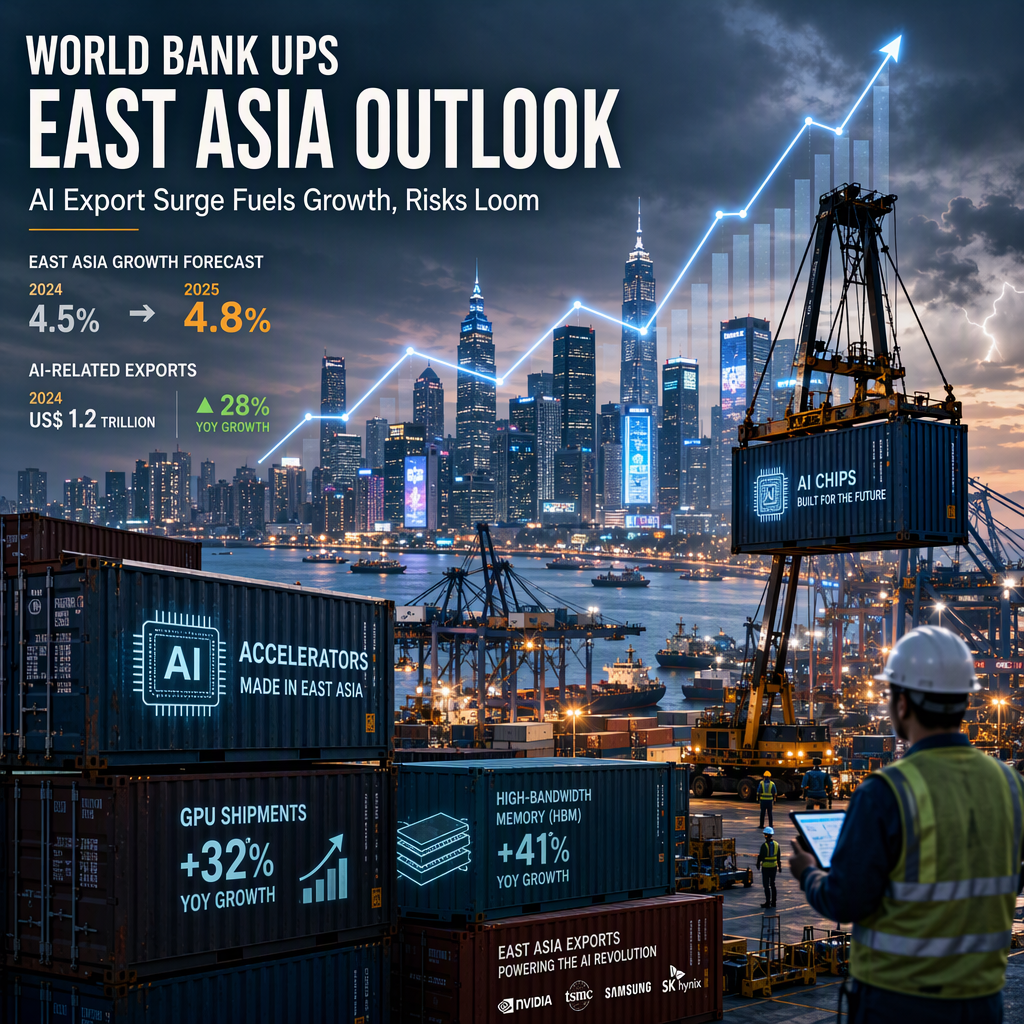
The World Bank has upgraded its growth outlook for East Asia and the Pacific, projecting the region will expand by 4.5% in 2026, which is 0.3 percentage points higher than its previous forecast in April. This revision is attributed to a surge in artificial intelligence-related exports, with Vietnam receiving the largest upgrade among major economies, now expected to grow 7.4% in 2026, up 1.1 percentage points from earlier estimates [1]. However, the World Bank cautions that the region's economic strength is heavily reliant on AI-related manufacturing and exports. Excluding these goods, trade growth has been described as "weak or negative." AI-related products accounted for more than half of export growth in most economies, and over 70% in Malaysia, the Philippines, Thailand, and Vietnam [1].
China, Indonesia, Malaysia, the Philippines, Thailand, and Vietnam collectively shipped $1.4 trillion worth of AI-related goods in the 12 months through April. South Korea's exports grew 83.5% in September to a record $120.9 billion, with chips making up half of those shipments. The dominance of semiconductors is underscored by the fact that Samsung and SK Hynix together accounted for 43% of the Kospi index's value as of end-April [1].
The World Bank report highlights risks associated with the AI boom, particularly on the spending side. AI-related capital expenditure has reached about 6% of U.S. GDP, matching the 2000 peak in information-technology investment. The current cycle is rising faster than previous cycles and is still gaining speed. Of the $2.9 trillion in AI capex planned for 2025-2028, $800 billion is expected to come from private credit. AI-related lending rose to 34% of activity in 2025, up from an 18% average over the prior five years. Private credit portfolios have experienced markdowns, outflows, and defaults this year, and the World Bank warns that these markets are "less visible, and have not been tested by a severe downturn" [1].
The report also notes that the AI boom, supported by abundant liquidity, could slow due to tightening financial conditions as major central banks raise rates. The U.S. Federal Reserve raised rates last month, its first increase in more than three years, and signaled one more hike [1].
CONCLUSION
The World Bank's upgraded growth forecast for East Asia and the Pacific reflects the region's strong performance in AI-related exports, but also highlights significant risks tied to concentration and reliance on global tech spending. Market sentiment is cautiously optimistic, with high impact expected due to both the growth outlook and warnings about potential vulnerabilities. Investors and policymakers should monitor AI-related credit markets and central bank actions closely.