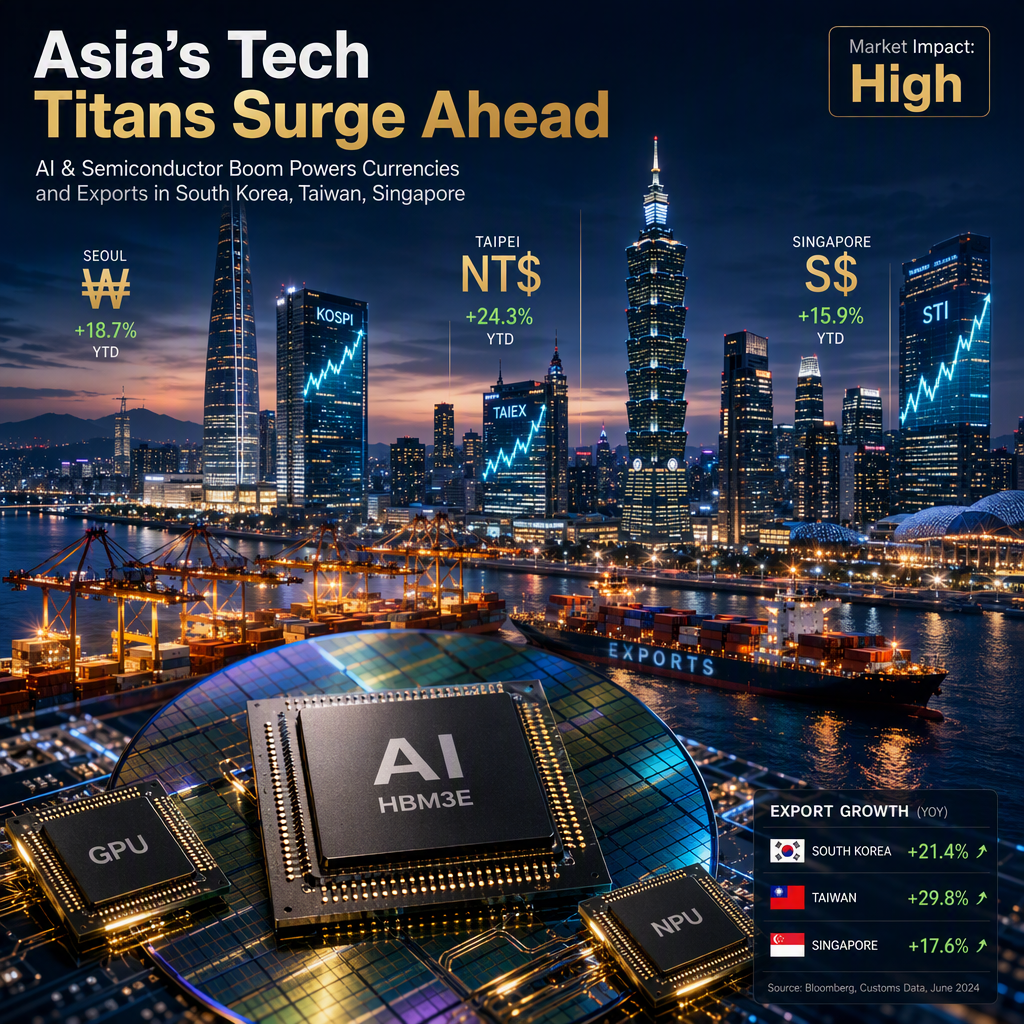
The artificial intelligence and semiconductor boom is significantly impacting Asian financial markets, with South Korea and Taiwan experiencing notable currency strength and Singapore recording its strongest export growth in nearly four decades. According to market analysts, the South Korean won and Taiwan dollar have outperformed other Asian currencies, including the Indian rupee and Philippine peso, despite those countries' efforts to boost their currencies through interest rate hikes. The robust performance of the won and Taiwan dollar is attributed to sustained global demand for semiconductors and AI-related technologies, which has led to strong exports and consistent foreign capital inflows for both economies [1].
Meanwhile, Singapore's exports surged by 46.2% in August compared to the previous year, marking the highest monthly growth in 38 years. Electronics exports, driven by global AI-related demand, soared by 131.8% year-on-year, underscoring Singapore's role as a major hub for high-tech components essential for artificial intelligence and advanced computing. Market analysts credit this dramatic rise to increased unit shipments and higher value-added manufacturing, as Singapore-based companies expand their share of the AI hardware market. The export boom is expected to bolster Singapore's GDP growth outlook for the remainder of the year, although some caution remains regarding global supply chain uncertainties and potential shifts in technology cycles [2].
Both articles highlight the structural advantages of South Korea, Taiwan, and Singapore in the tech sector, with their economies benefiting from the ongoing global appetite for semiconductors and AI products. The positive sentiment among industry observers and policymakers is reinforced by the strong export and currency performance, which far exceeds earlier projections for the quarter [1][2].
While no specific price levels or resistance/support data are provided, the market reaction is described as positive, particularly for the South Korean won, Taiwan dollar, and Singapore's electronics sector. Forward-looking statements suggest continued strength as long as global demand for AI and semiconductor products persists, though analysts note the possibility of future challenges from supply chain disruptions or changes in technology cycles [1][2].
CONCLUSION
The AI and semiconductor boom is driving robust export growth and currency appreciation in key Asian economies, with South Korea, Taiwan, and Singapore emerging as major beneficiaries. Market sentiment remains positive, supported by strong demand and investment in advanced manufacturing, though analysts advise monitoring potential supply chain risks and technology shifts. Overall, the event signals high market impact and continued optimism for the region's tech-driven financial outlook.