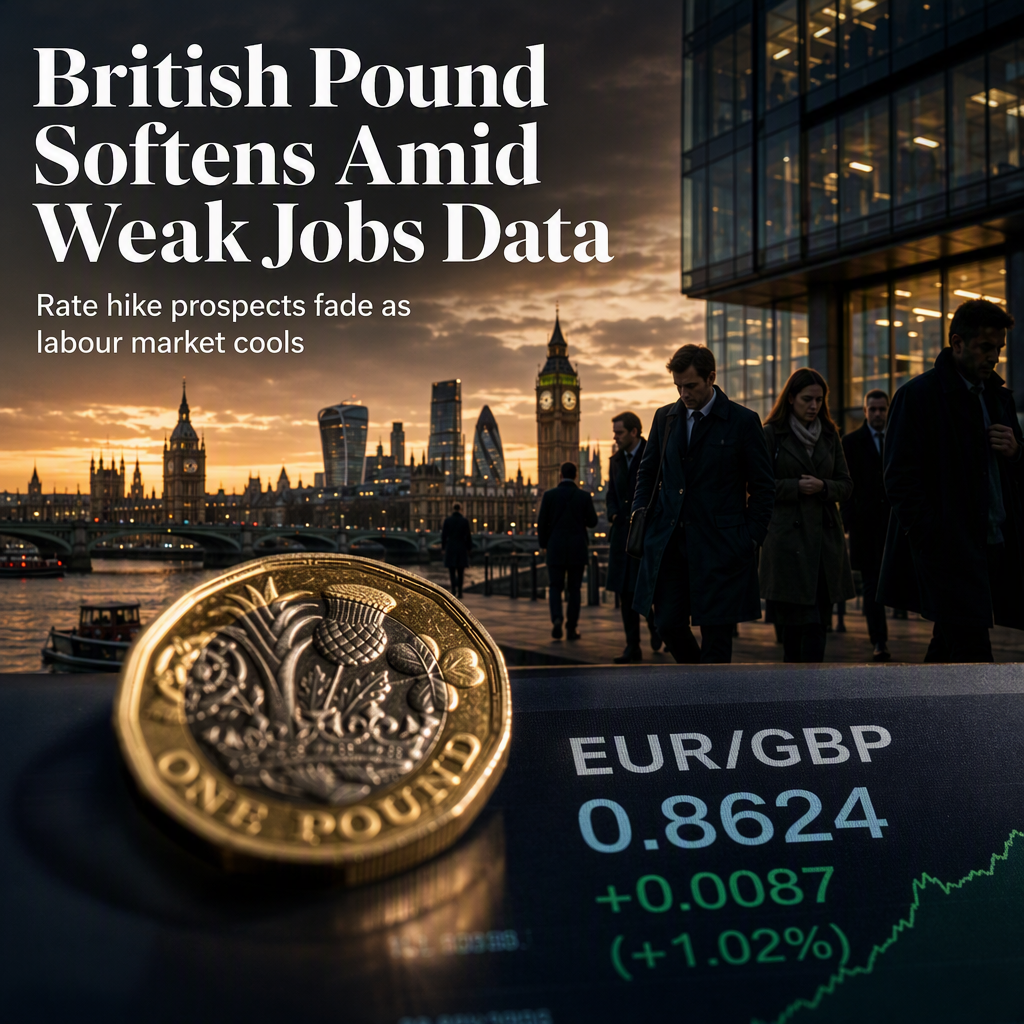
The British Pound weakened following the release of the latest UK jobs data, with ING's Chris Turner noting a firmer EUR/GBP exchange rate in response to the figures [1]. Economist James Smith highlighted that the jobs market remains cool, with minimal wage pressures, suggesting there is little impetus for the Bank of England (BoE) to hike rates this year [1]. Payrolled employment has declined slightly, but this masks significant differences across sectors: government hiring remains active, consumer services are experiencing consistent job losses with an accelerating pace of decline, and the rest of the private sector is flatlining [1].
The unemployment rate has increased marginally, though the Office for National Statistics (ONS) has indicated there are temporary sampling issues with the labour force survey, adding uncertainty to the data's reliability [1]. Despite these nuances, the overall picture points to subdued labour market conditions and limited wage growth, reinforcing expectations that the BoE will not raise rates in the near term [1].
Sterling money markets are still pricing in 60 basis points of BoE tightening into next year, but Turner expects this to be gradually priced out over the next three to six months, with energy prices playing a significant role in the timing [1]. The EUR/GBP exchange rate is seen as biased toward the 0.8570/0.8580 area [1]. Looking ahead, the July CPI release is anticipated, and a lower year-on-year services inflation figure would further support the dovish stance among BoE policymakers [1].
CONCLUSION
The latest UK jobs data has led to a softer British Pound and reduced expectations for Bank of England rate hikes, with money markets likely to gradually price out further tightening. The EUR/GBP exchange rate is expected to remain firm, and upcoming inflation data could reinforce the dovish outlook. Overall, the market is responding to signs of a cooling labour market and minimal wage pressures.