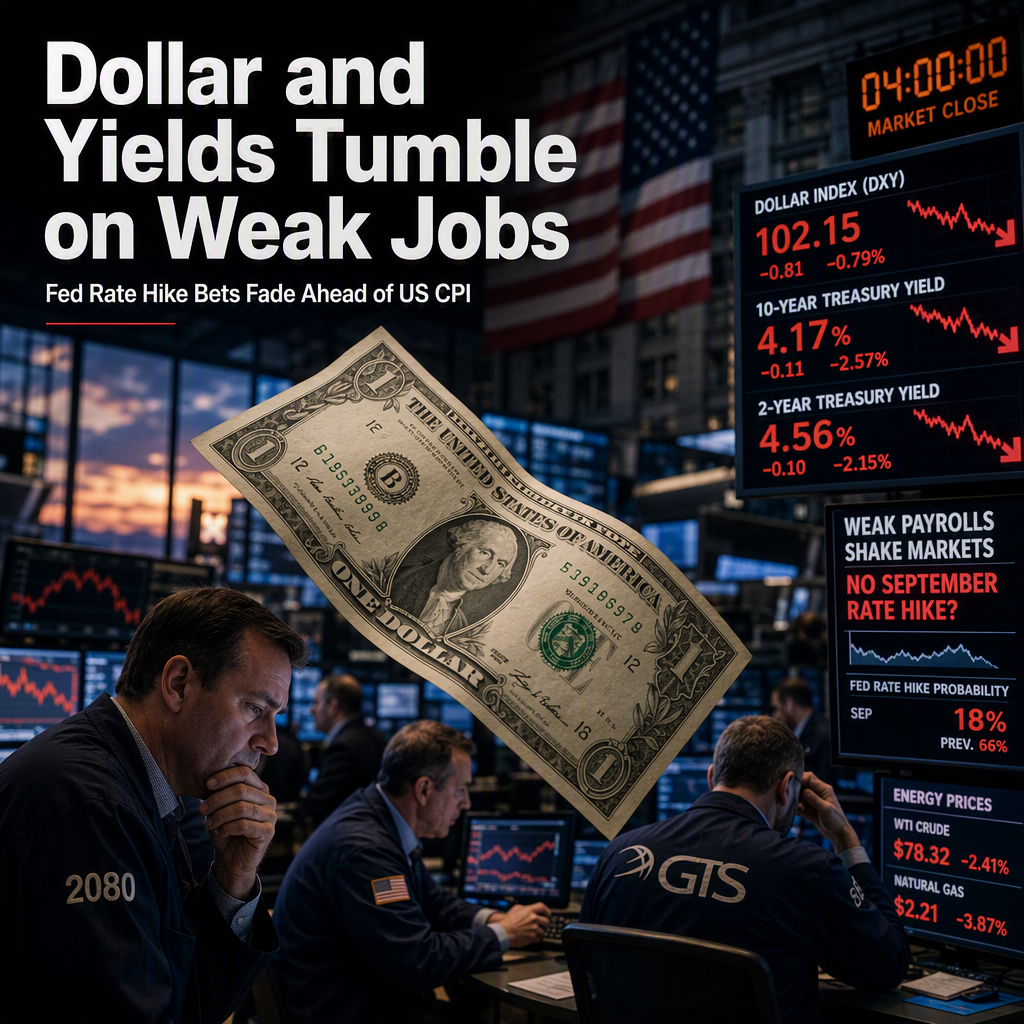
The US Dollar Index (DXY) fell below the 100.00 mark, closing at 99.54 after dropping 0.42% on Friday, following a disappointing July Nonfarm Payrolls (NFP) report that showed the US economy shedding 23,000 jobs, compared to forecasts of an 80,000 gain. Additionally, revisions for May and June reduced the total by 103,000 jobs, further lowering previous estimates. Average Hourly Earnings slowed to 3.2% year-on-year, and the Unemployment Rate decreased slightly from 4.2% to 4.1% [1][2]. These figures led markets, which had previously priced in a hawkish Federal Reserve stance, to reverse course and price out a September rate hike [1][2].
US Treasury yields dropped across the curve, with the 10-year note yielding 4.651%, down nearly three basis points. This decline was attributed to both the weak payrolls data and speculation about a potential Iran-Oman deal that could restore shipping through Hormuz and lower energy prices. West Texas Intermediate (WTI) crude extended its losses by nearly 1%, falling to $77.50 [2]. Money markets now indicate only a 30% probability of a Fed rate hike in September, down from 58% the previous day, with a 70% chance the Fed will keep rates steady [2].
The US Dollar was the strongest against the British Pound, but overall, the currency sold off against most majors, as shown in the heat map of percentage changes. The EUR/USD pair ended the week above the 1.1550 region, near two-month highs [1]. The upcoming week will be pivotal, with Wednesday's Consumer Price Index (CPI) report projected at 3.4% year-on-year headline and 2.5% year-on-year core, which will determine whether the dollar sell-off continues. Additional US data releases include Producer Price Index (PPI), Retail Sales, and the preliminary Michigan Consumer Sentiment survey [1][2].
Forward-looking, two Federal Reserve speakers, Hammack and Barkin, are scheduled for Thursday, and investors will closely watch US inflation data and jobless claims for further clues on monetary policy direction. The market's repricing reflects a shift from labor market concerns to inflation, with the possibility that the Fed may pause rate hikes if inflation remains contained [1][2].
CONCLUSION
Weak US payrolls and downward revisions triggered a sharp sell-off in the US Dollar and a drop in Treasury yields, as markets reduced expectations for a September Fed rate hike. Upcoming US inflation data will be crucial in determining whether this repricing persists, with investors now focused on price stability rather than labor market strength.