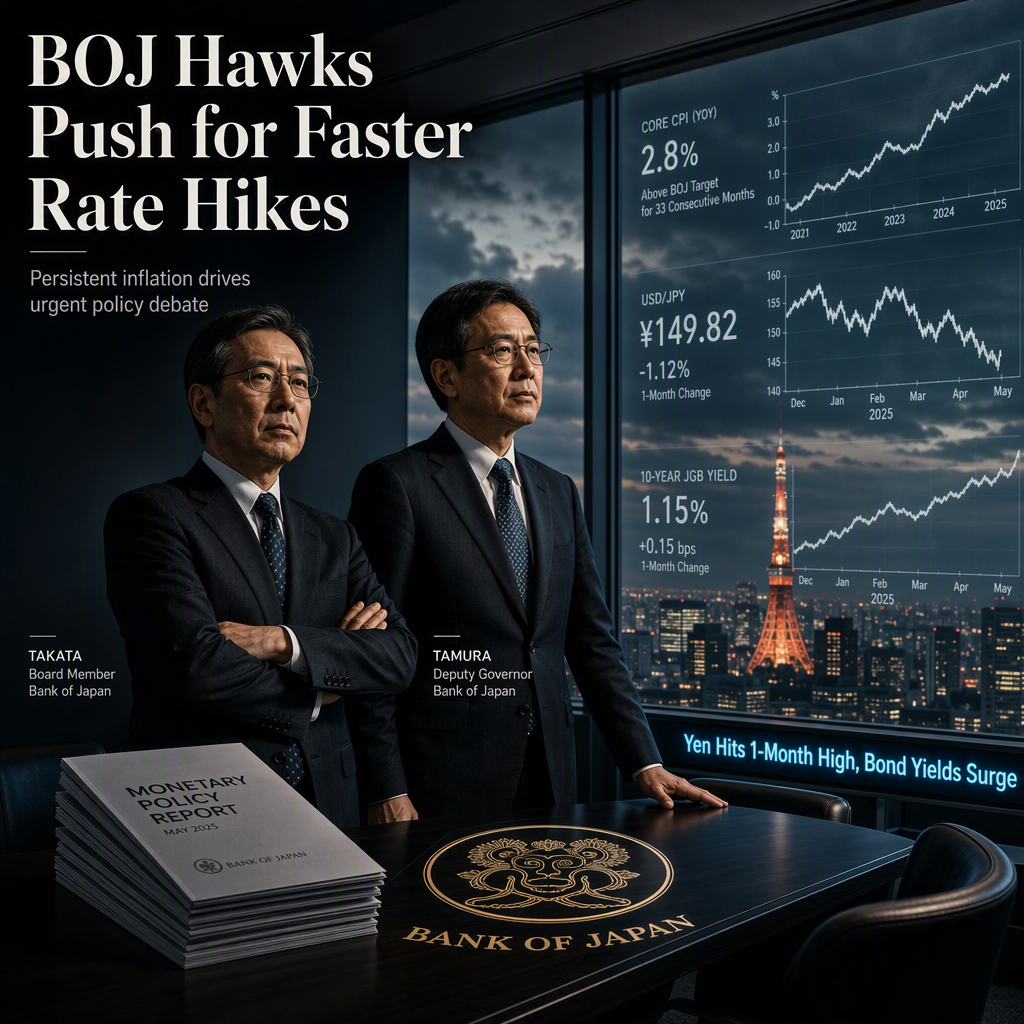
Two hawkish members of the Bank of Japan's monetary policy board, Hajime Takata and Naoki Tamura, are urging the central bank to accelerate its interest rate increases as they approach the end of their terms in July 2027 [1]. Their intensified calls for action are driven by concerns that inflation in Japan remains persistently above the BOJ's 2% target, and that delaying rate hikes could undermine the bank's credibility and reduce its policy flexibility in the future [1]. Both Takata and Tamura have advocated for a faster pace of tightening to address these risks [1].
Market participants are closely monitoring the internal debates within the BOJ, as speculation mounts that the central bank could raise rates sooner and more frequently than previously anticipated [1]. The yen recently reached a one-month high of 155 to the dollar, reflecting expectations of a rate hike, and Japanese government bond yields have also been rising in response to the shifting outlook [1].
One of the hawkish board members stated, "The current situation requires decisive action to ensure that inflation expectations remain anchored and that monetary policy supports price stability. We must not wait too long to normalize policy" [1]. Analysts highlight that the BOJ's policy decisions at upcoming meetings will be critical, with some expecting incremental rate increases as early as this month [1]. The BOJ chief has indicated that rate hikes are possible at every meeting, including this month's, underscoring the urgency among policymakers [1].
The evolving stance of the BOJ's hawkish members is shaping market sentiment, with investors pricing in further adjustments to the central bank's benchmark interest rate and watching for signals about the pace and scale of future moves [1].
CONCLUSION
The intensified calls for rate hikes by BOJ's hawkish board members are driving market expectations of imminent policy tightening. Rising yen and bond yields reflect investor anticipation of further rate increases, with upcoming BOJ meetings seen as pivotal for future monetary policy direction. The market is closely watching for signals on the pace and scale of potential moves.