
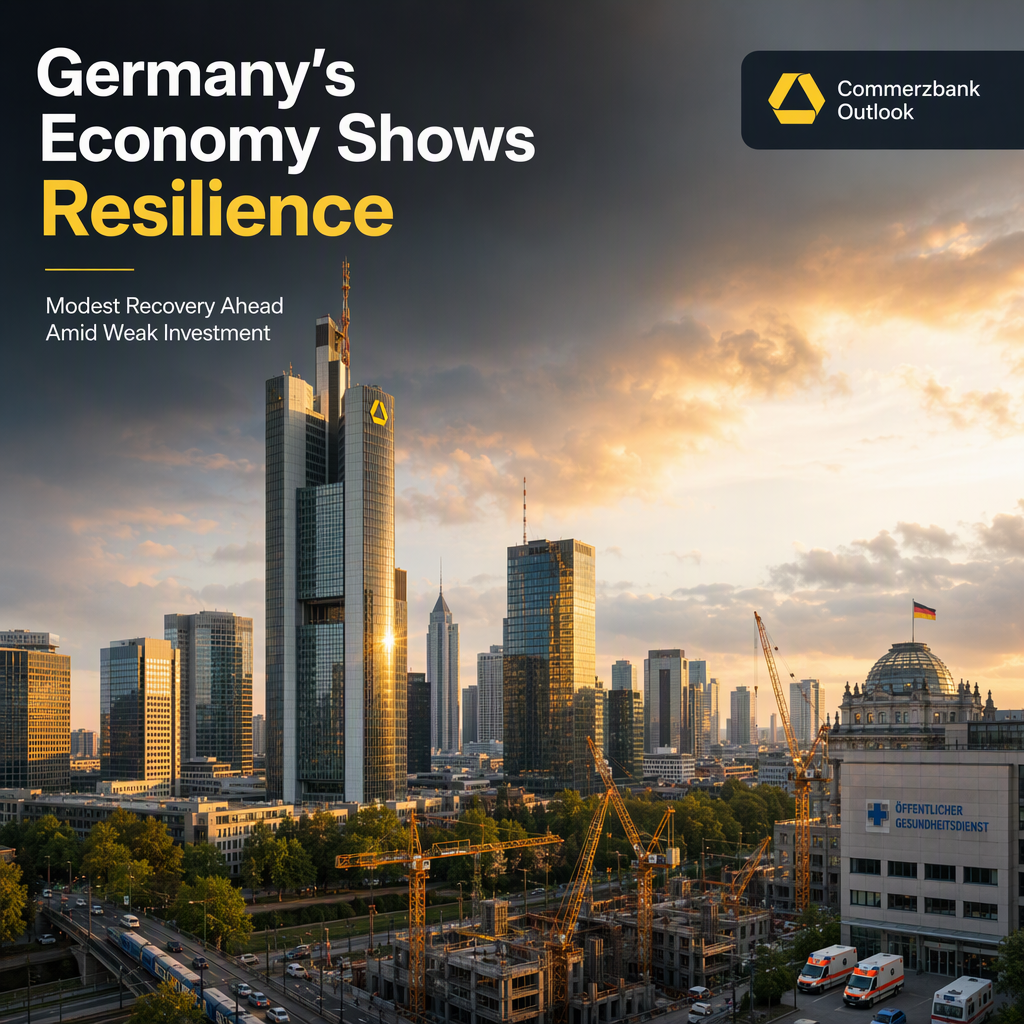
Commerzbank’s Chief Economist Dr. Jörg Krämer reports that leading indicators such as the Ifo business climate index and Purchasing Managers’ Index (PMI) have shown unexpected strength, highlighting the German economy’s resilience in the face of high energy prices and the Iran War [1]. The Ifo business climate index notably increased from 88.8 to 89.9, and the PMIs have also delivered positive surprises in recent months [1].
Despite these encouraging signals, Dr. Krämer forecasts only a moderate recovery for Germany, projecting GDP growth of 1.2% in 2026, which is an upward revision from the previous forecast of 1.0% made two weeks prior [1]. The outlook remains constrained by weak corporate investment and exports, with the lack of significant reforms and Germany’s battered competitiveness cited as key factors limiting domestic investment [1]. Additionally, exports are being hampered by weak demand from China and the impact of Trump’s tariffs [1].
Since early 2024, when German GDP passed its trough, corporate investment has continued to decline, and the absence of profound reforms suggests that a strong rebound in investment is unlikely during this upswing [1]. As a result, the economic recovery is expected to rely more heavily than usual on increased government spending, particularly in areas such as public-sector employment, healthcare, and defense investment [1].
Dr. Krämer concludes that while the German economy has demonstrated resilience, it remains far from achieving a self-sustaining upswing, with the recovery dependent on government intervention rather than a robust private sector rebound [1].
CONCLUSION
Commerzbank’s analysis points to a resilient but only moderately recovering German economy, with growth prospects limited by weak investment and exports. The recovery is expected to depend heavily on government spending, and a self-sustaining upswing appears distant. Market participants may interpret these findings as a sign of cautious optimism, tempered by structural challenges.