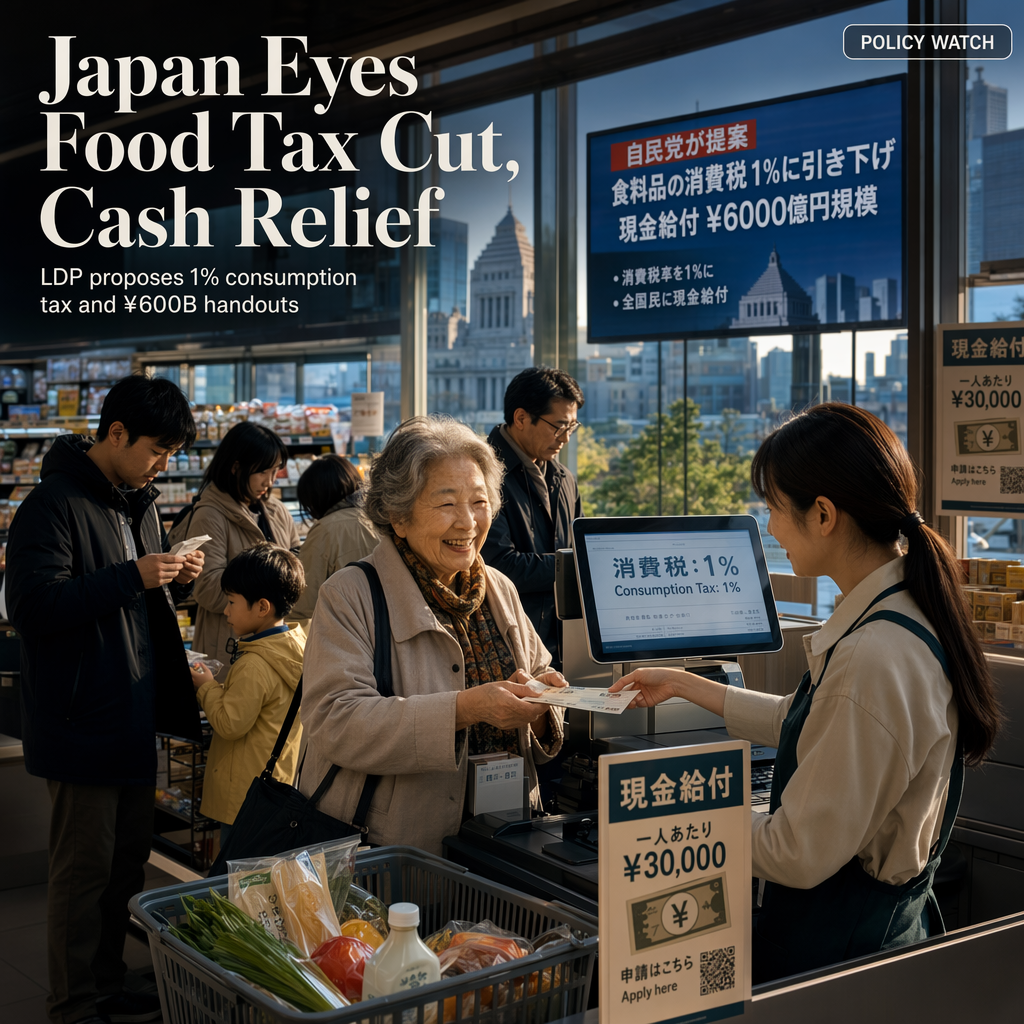
Japan's ruling Liberal Democratic Party (LDP) has proposed reducing the consumption tax rate on food and beverages from the current 8 percent to 1 percent for two years starting April 2027, instead of cutting it to zero as previously pledged during the last general election campaign [1]. The proposal, presented by LDP tax policy chief Itsunori Onodera at a cross-party national council meeting on taxation and social security, is intended as a draft for an interim report to be compiled later this month after extensive discussions [1].
To effectively offset the remaining 1 percent tax, the LDP also proposed annual cash handouts totaling 600 billion yen ($3.7 billion), equivalent to the expected revenue from the 1 percent tax on food, to begin around fall next year and distributed based on income [1]. This cash handout scheme is expected to serve as a precursor to a future refundable tax credit system targeting tax-exempt, low-income working households, with the LDP aiming to refine the system from fiscal 2029 for more precise recipient selection [1].
The proposal comes amid prolonged inflation and follows campaign promises by the LDP, led by Prime Minister Sanae Takaichi, and other parties to cut the consumption tax on food products to zero for two years [1]. However, the 1 percent plan was chosen due to the logistical challenges of adjusting retailers' cash register systems to accommodate a zero tax rate [1]. The government hopes to enact related legislation by this fall to allow retailers sufficient time—about six months—to update their systems [1].
The plan's implementation faces political hurdles, as it is unclear whether the eight parties participating in the council, including the Democratic Party for the People and Team Mirai (both opposed to a consumption tax cut), can reach an agreement. Some opposition parties have not been invited to the council [1]. The government is also considering subsidies for farmers and restaurant operators who may be affected by the tax reduction [1].
Despite these measures, concerns remain about Japan's fiscal health, with government bond yields at their highest levels in decades and the yen remaining weak. The proposed tax cut could further exacerbate worries about the nation's fiscal position, which is already the worst among the Group of Seven economies [1].
CONCLUSION
Japan's LDP is moving forward with a significant proposal to cut the food consumption tax to 1% and introduce targeted cash handouts, aiming to address inflation and support low-income households. However, the plan faces political opposition and raises concerns about fiscal sustainability amid already high government debt and weak currency conditions. The market will be watching closely for legislative progress and the final shape of the tax relief measures.