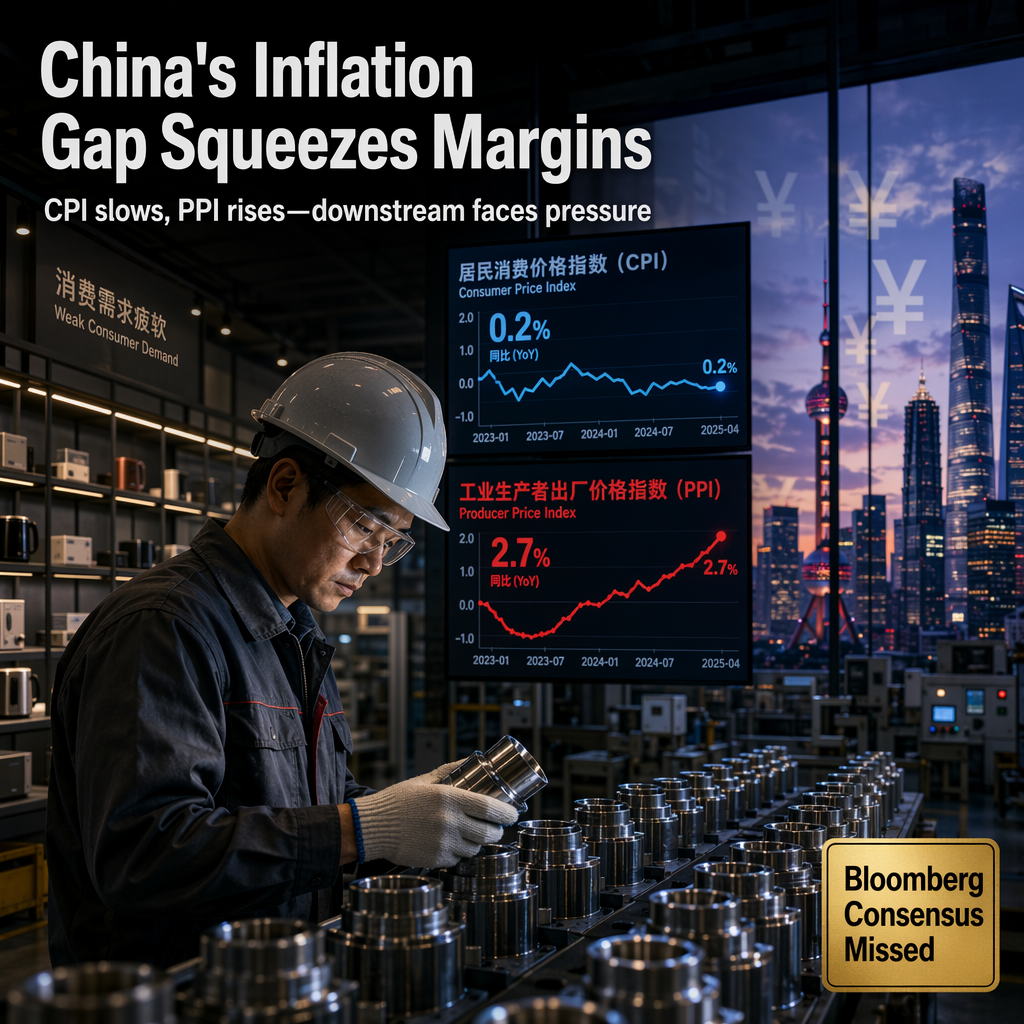
Commerzbank analysts report that China's June Consumer Price Index (CPI) slowed to 1.0% year-on-year, missing the Bloomberg consensus of 1.1% and down from 1.2% in both April and May, marking the slowest CPI print in three months. This deceleration in CPI reinforces concerns about structurally weak domestic demand, even as the broader economy shows signs of stabilization. Core CPI, which excludes food and energy, also registered at 1.0% year-on-year, below the expected 1.1%, indicating that underlying demand-side price pressures remain subdued and have yet to broaden significantly [1].
In contrast, the Producer Price Index (PPI) rose 4.1% year-on-year in June, matching consensus expectations and accelerating from 3.9% in May. This increase is attributed to elevated upstream input costs, particularly in metals and energy. The widening gap between factory-gate inflation (PPI) and subdued consumer prices (CPI) is compressing margins for downstream producers, who are unable to pass on higher costs to end consumers [1].
Despite these domestic challenges, the Chinese yuan showed some strength, with USD/CNY falling 140 pips to 6.79 and the offshore USD-CNH dropping 100 pips to 6.80. This currency movement occurred even as domestic demand remains weak. Industrial profit growth also exhibited early signs of fatigue, with the year-on-year gain softening for the first time since November, suggesting that strong exports and price gains are no longer sufficient to offset weak domestic demand [1].
The People's Bank of China (PBoC), in its quarterly monetary policy committee statement released Wednesday, introduced new language acknowledging 'structural divergence' within the economy. This term, not previously used by the central bank, highlights the growing imbalance between the outperformance of the AI-driven high-tech sector and tepid consumer spending [1].
CONCLUSION
China's latest inflation data underscores a widening gap between producer and consumer prices, squeezing downstream margins and highlighting persistent weakness in domestic demand. The PBoC's acknowledgment of 'structural divergence' signals official recognition of sectoral imbalances, while the yuan's modest appreciation suggests limited immediate market concern. However, the softening in industrial profit growth points to ongoing challenges for China's economic recovery.