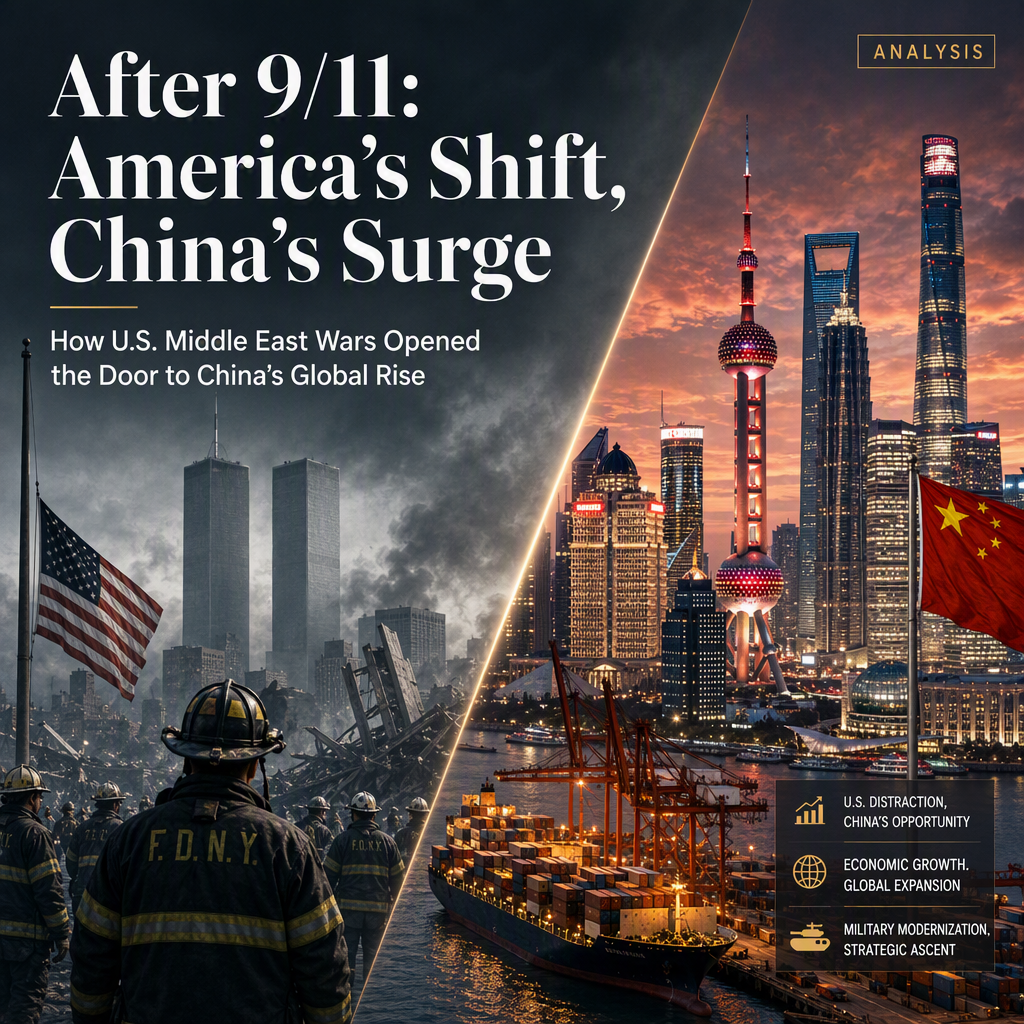
The terrorist attacks on September 11, 2001, marked a pivotal moment in global history, accelerating the decline of American unipolar dominance and facilitating China's rise as an economic and military power [1]. In the aftermath of 9/11, the United States launched wars in Afghanistan and Iraq, which diverted its attention and resources away from Asia. This strategic shift allowed Beijing to expand its influence and capabilities with less scrutiny from Washington [1].
During the 2000s, while the U.S. was focused on counterterrorism and nation-building in the Middle East, China implemented reforms, attracted foreign investment, and built up its manufacturing base, eventually becoming the world's second-largest economy [1]. China made significant investments in infrastructure, technology, and military modernization during this period. Market analysts highlight that the redirection of American strategic focus weakened Washington's position in Asia and enabled China to pursue regional initiatives such as the Belt and Road Initiative. China's growing share of global trade and investment flows further evidenced the shift in global economic power [1].
The financial cost of the post-9/11 wars is estimated in the trillions of dollars, contributing to U.S. fiscal constraints and limiting future defense spending. In contrast, China's defense budget expanded at double-digit rates for much of the past two decades, supporting the development of advanced military capabilities [1]. The aftermath of 9/11 also saw the U.S. reputation as a global leader tested by prolonged conflicts and controversial policies, creating new opportunities for China to shape global institutions and set standards in emerging markets [1].
Analysts warn that the strategic landscape forged in the two decades since 9/11 continues to challenge U.S. interests and will remain a defining issue for policymakers and investors [1].
CONCLUSION
The post-9/11 era saw the U.S. embroiled in costly Middle East conflicts, enabling China to accelerate its economic and military growth and reshape global power dynamics. Analysts caution that the resulting strategic landscape will continue to pose challenges for U.S. interests and remain a critical concern for investors and policymakers.