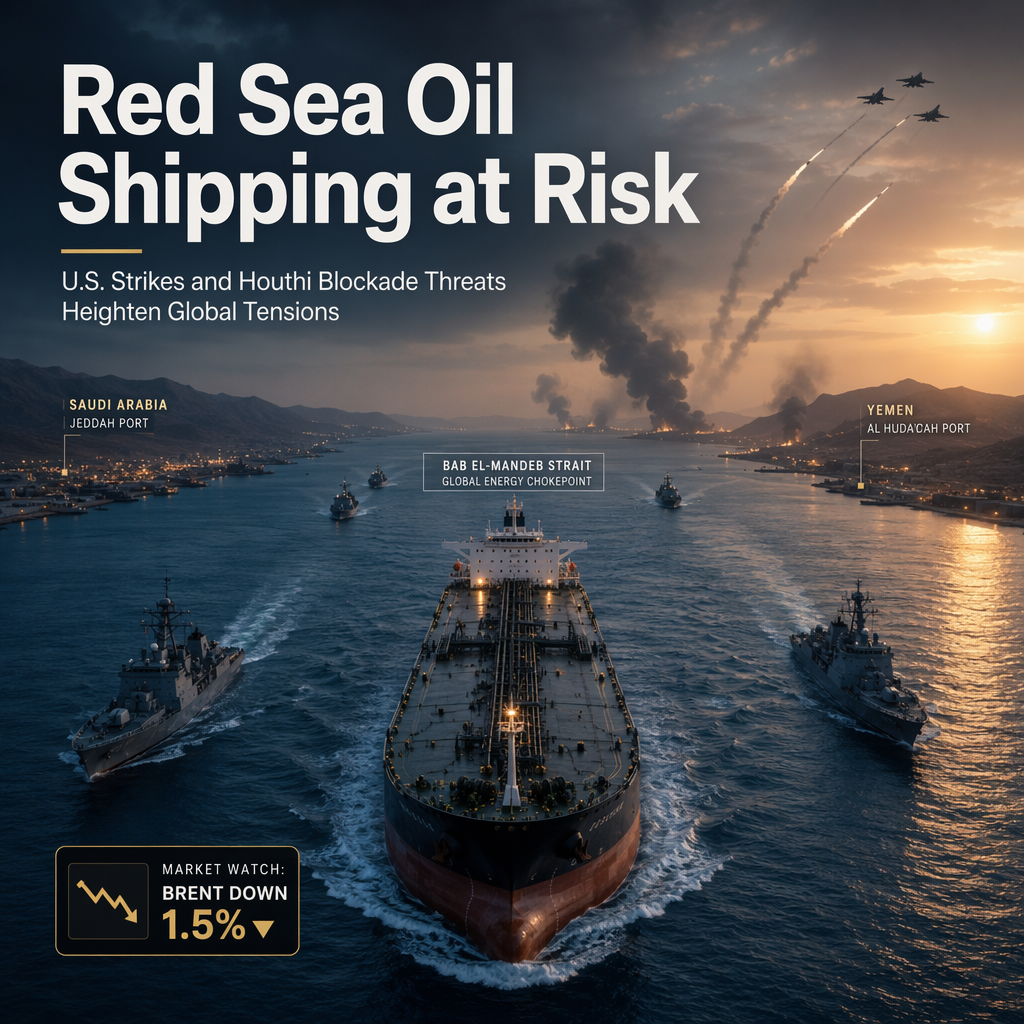
Recent developments in the Middle East have intensified risks to global oil flows, as the U.S. conducted its tenth consecutive evening of strikes against Iran while Yemen's Iran-backed Houthi militants threatened to impose a maritime blockade on Saudi Arabia, potentially disrupting vital shipping routes in the Red Sea and Bab el-Mandeb Strait [2]. The Houthis declared a maritime embargo against Saudi Arabia effective immediately, citing what they described as an 'aggressive siege' by the Saudis and recent bombings of Sanaa International Airport [2]. In response, the Saudi-led coalition in Yemen announced operational measures to protect ships in the Bab el-Mandeb Strait and vowed to respond forcefully to any blockade, labeling such threats as a 'blatant violation of international law' [1][2].
The ongoing disruptions in the Strait of Hormuz have already shifted more Middle East oil flows toward the Red Sea and Bab el-Mandeb, with approximately 4 million barrels per day of Saudi oil now shipped through the Red Sea via the East-West pipeline [1]. Any effective disruption in this region could significantly impact Asian countries dependent on Middle East oil supplies [1]. On Tuesday, Iran attacked a tanker in the Strait of Hormuz, forcing its crew to abandon the vessel, further highlighting the vulnerability of these critical maritime chokepoints [2].
Despite these heightened risks, oil prices have not returned to previous conflict highs. International benchmark Brent crude futures for September delivery were last seen trading 1.5% lower at $87.95 per barrel, after briefly surpassing $90 in the prior session. U.S. West Texas Intermediate (WTI) futures for August delivery were down 1.2% at $82.25 [2]. MUFG analysts believe that, even if disruptions occur, they are unlikely to be sustained due to the Houthis' limited capabilities and ongoing diplomatic efforts, including mediation and talks involving the U.S. [1]. ING strategists noted that mediators are pushing for a 10-day ceasefire, though they cautioned that 'large divisions remain between the US and Iran' and that the situation remains volatile [2].
The U.S. Central Command (Centcom) reported that commercial vessel transits through the Strait of Hormuz are continuing, with Centcom forces facilitating the passage of around 900 commercial vessels and 450 million barrels of crude oil since early May [2]. However, the possibility of rerouting tanker and cargo traffic via the Suez Canal and the Cape of Good Hope could increase transport costs and container freight rates if the Red Sea route is further disrupted [1].
CONCLUSION
The escalation of threats and military actions in the Middle East has raised significant risks to oil shipping routes, particularly through the Red Sea and Bab el-Mandeb. However, ongoing diplomatic efforts and the limited capabilities of the Houthis have helped ease oil prices from recent highs, with markets closely watching for signs of a ceasefire or further escalation.