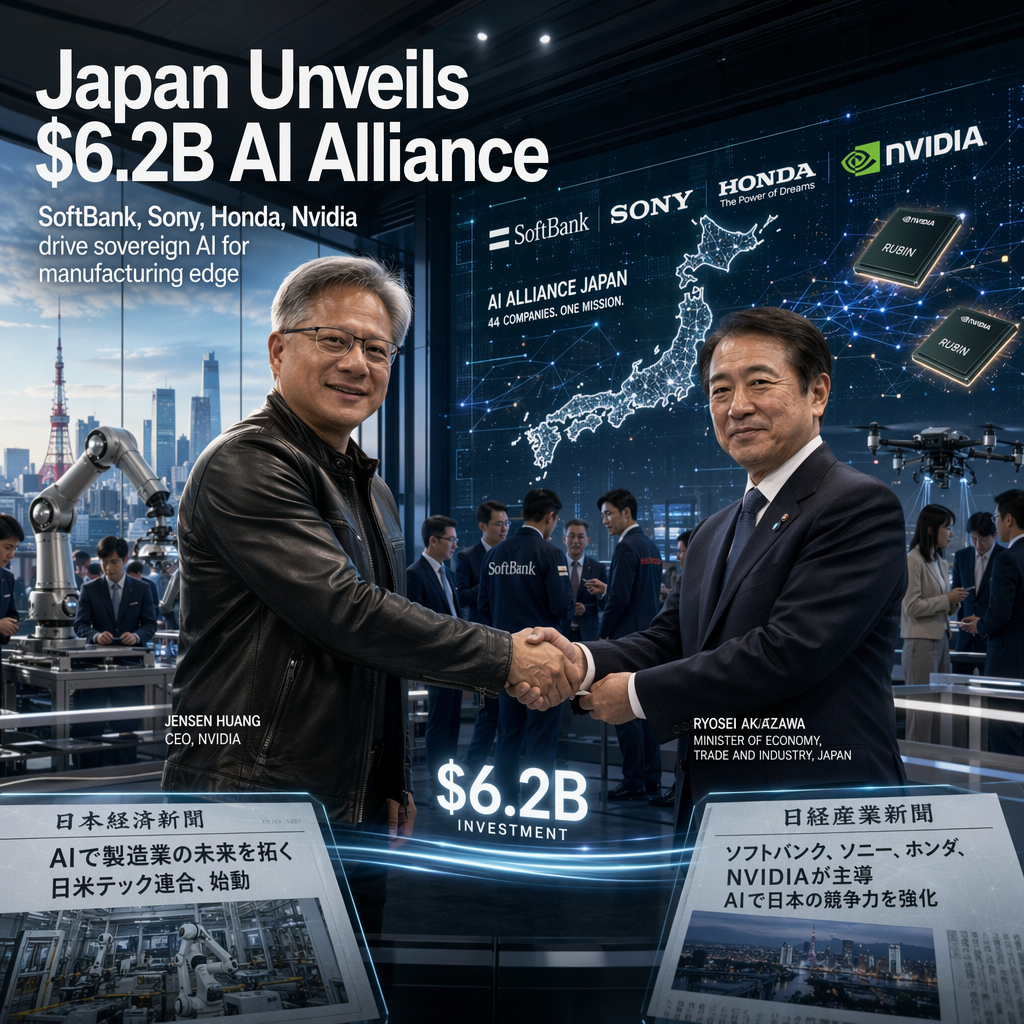
On July 16, 2026, a consortium of 44 Japanese companies, including SoftBank, Sony, and Honda, announced a major initiative to develop a sovereign artificial intelligence foundation model using proprietary data, with the goal of strengthening Japan's manufacturing competitiveness as the U.S. and China advance in AI technology [1]. The project will utilize 27,500 Nvidia Rubin chips, which will be purchased by the Japanese government to support the development of advanced 'physical AI' capabilities, particularly in manufacturing and robotics [1].
The initiative was unveiled in Tokyo by Nvidia CEO Jensen Huang and Japanese Minister of Economy, Trade and Industry Ryosei Akazawa, highlighting the collaboration between the Japanese government and leading corporations [1]. Financial support is significant, with the government committing up to $6.2 billion to SoftBank-led AI models, signaling Japan's determination to catch up with global AI leaders [1]. SoftBank CEO Masayoshi Son emphasized the scale of the global AI boom, estimating that as much as $5 trillion in annual investment may be required worldwide [1].
Participating companies are incentivizing employees to drive AI development, with Honda and others offering compensation for contributions to AI projects [1]. The consortium's efforts are expected to accelerate the deployment of factory robots and warehouse automation, with companies like Taisei and Fanuc already developing AI-powered systems that double space efficiency [1].
Industry observers believe that the partnership with Nvidia and the large-scale procurement of Rubin chips could provide Japanese manufacturers with a technological advantage, especially in integrating physical AI into production processes [1]. The focus on sovereign AI models is intended to ensure data security and autonomy, reducing reliance on foreign technology [1]. Market sentiment is optimistic, with analysts suggesting that the investment in AI infrastructure could enhance competitiveness and innovation in Japan's industrial sector [1].
CONCLUSION
Japan's $6.2 billion AI consortium, backed by major corporations and government funding, marks a significant step to strengthen the country's manufacturing sector and reduce reliance on foreign technology. The large-scale partnership with Nvidia and focus on sovereign AI models are expected to drive innovation and competitiveness, with market sentiment remaining optimistic about Japan's AI ambitions.