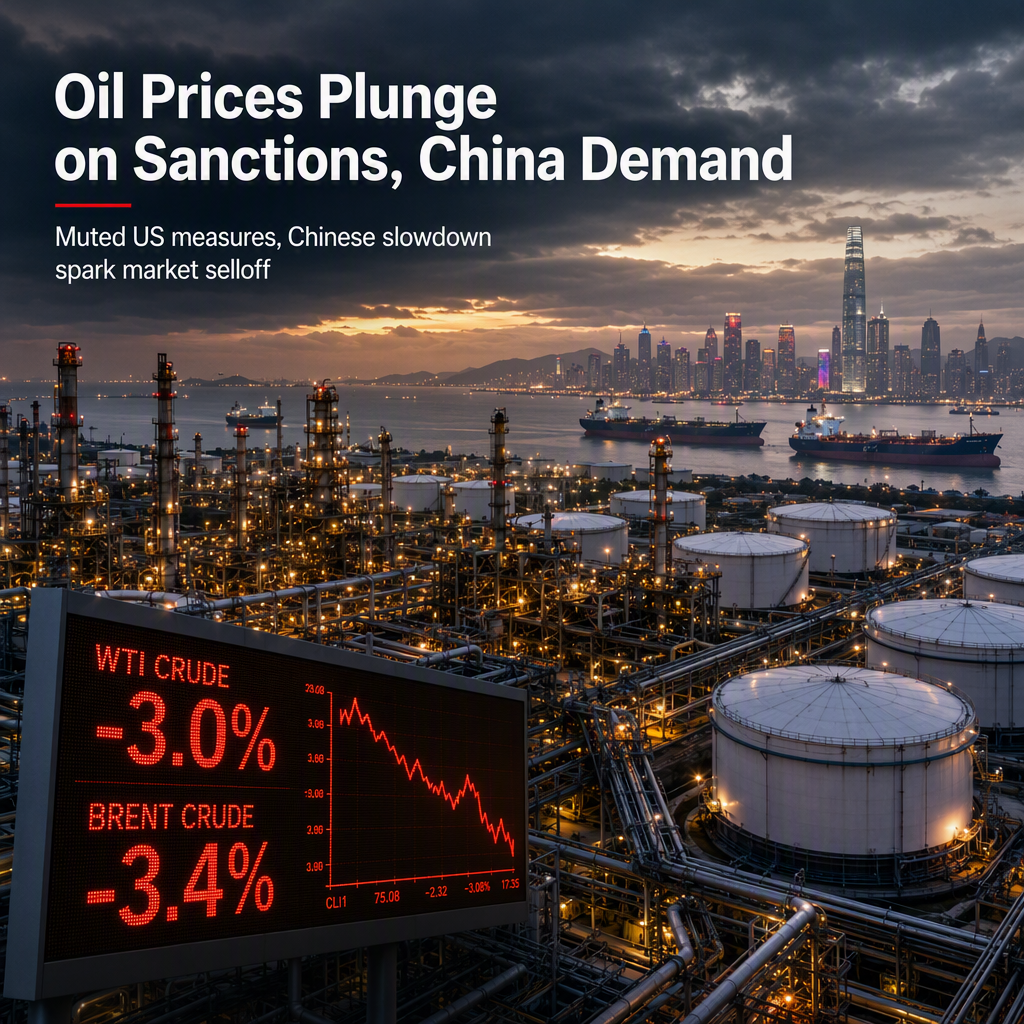
Oil prices experienced a sharp decline, with West Texas Intermediate (WTI) futures dropping 3% to around $82.00 and Brent crude falling 3.4% to $89.05 per barrel, marking the lowest levels since August 13 [2][3]. The selloff extended losses from the previous day, when Brent prices also fell by 3% [3]. The downward pressure on oil was attributed to a combination of softer-than-expected US sanctions on Iran and signals of peaking Chinese demand [1][2][3].
US Treasury Secretary Scott Bessent announced an 'economic D-Day' against Iran, describing it as 'the single greatest financial offensive ever,' but analysts from Danske Bank and BBH noted that the measures amounted to a broad warning rather than a decisive escalation, with few concrete details on timing or enforcement [2][3]. The sanctions were seen as a warning shot, resulting in a muted immediate market reaction, as the US stopped short of imposing secondary sanctions on countries like China that continue to trade with Iran [2][3]. Meanwhile, Iran's Economy Minister Ali Madanizadeh stated that Tehran is 'fully prepared' to withstand further US sanctions, citing a two-year plan to manage such events [3].
China, Iran's largest trading partner, reiterated its opposition to unilateral US sanctions, with Foreign Ministry Spokesperson Lin Jian emphasizing that China's cooperation with Iran is within international law and should not be disrupted [2][3]. China also signaled it would 'firmly safeguard its rights and interests' in response to any US pressure [3].
On the demand side, Commerzbank's Carsten Fritsch highlighted that China's largest refiner believes national oil demand peaked last year, with crude processing possibly also having reached its peak, suggesting lower import requirements going forward [1]. This shift in Chinese demand, combined with the potential normalization of Middle East supplies, could contribute to an oversupplied market and further downside in oil prices [1]. The CEO of China's largest refiner expects only a slight recovery in demand next year, contingent on easing US-Iran tensions, but does not foresee a return to last year's levels [1].
Technical analysis of WTI shows the price holding just under the 20-day EMA at $82.31, with the broader uptrend still intact but near-term tone slightly bearish. The RSI at 50.60 suggests a consolidative phase, with key support at $77.76 and resistance at $82.31 [2].
CONCLUSION
Oil prices have fallen sharply as US sanctions on Iran were perceived as less impactful than anticipated and Chinese oil demand appears to have peaked. The combination of muted geopolitical escalation and weakening demand from China has heightened concerns of an oversupplied market, leading to a bearish outlook for oil in the near term.