
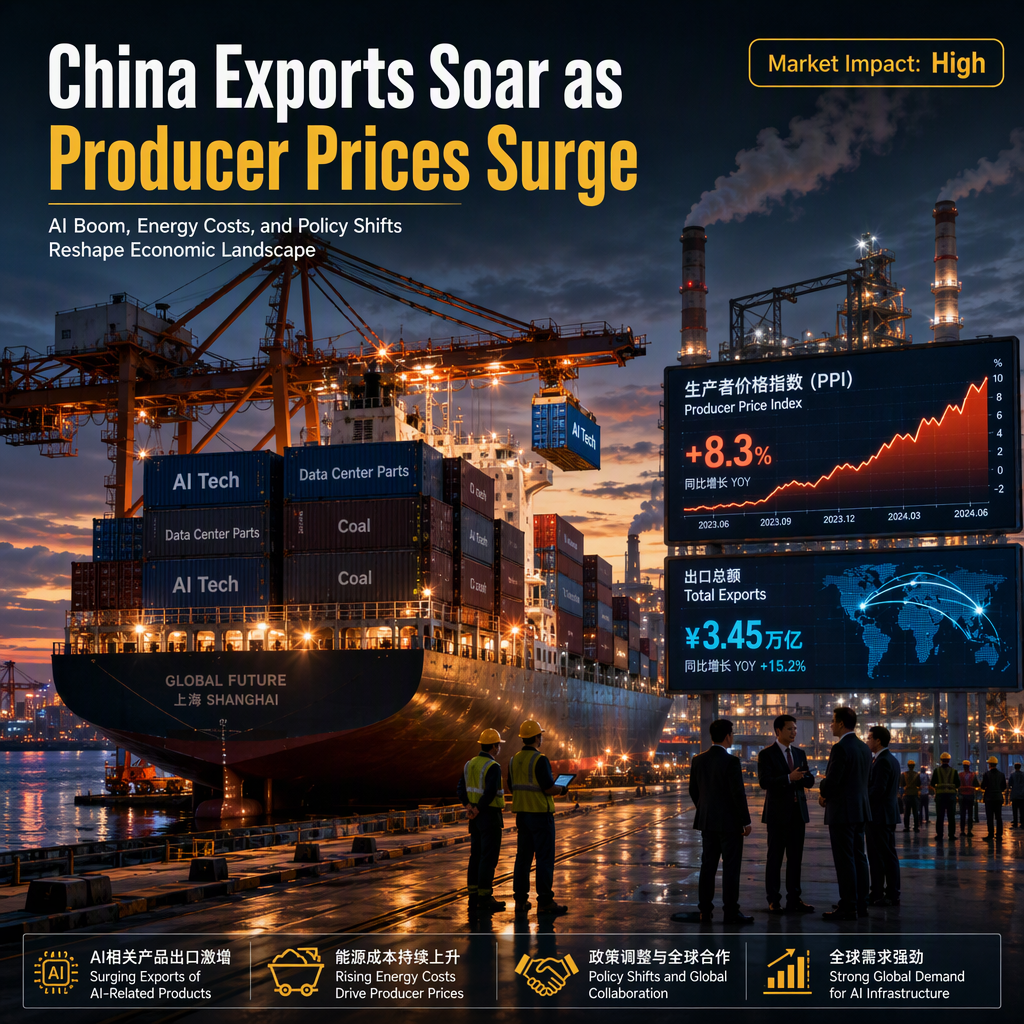
China's producer price index (PPI) rose by 5% year-on-year in September, marking the fastest increase since June 2022 and surpassing economists' expectations of a 4.5% rise, driven primarily by higher fuel costs and increased demand for coal for winter heating. This acceleration in producer prices was accompanied by a 0.9% rise in consumer prices, slightly below the 1% forecast, with gasoline prices climbing 16.6% and food prices falling 1.7% [1]. The core CPI, excluding food and energy, increased by 1% [1].
At the same time, China's exports likely grew by 25.5% in September compared to a year ago, according to a Reuters poll, with imports forecast to rise by 24.5% year-on-year, though slowing from August's 28.2% growth [2]. The surge in exports has been attributed to strong global demand for AI-related goods, particularly China-made parts for data centers, and a stabilization in trade relations with the U.S. [2]. Earlier in the year, both exports and imports grew at their fastest pace in five years [2].
Policy developments have also played a role in shaping the economic landscape. On September 28, China's State Council indicated that more policy support could be forthcoming to address emerging economic challenges, emphasizing the need for intensified counter-cyclical macro policy adjustments [1]. Lynn Song, chief economist for Greater China at ING, noted a shift in policy tone and anticipated further policy support to achieve both short- and long-term growth targets, including the 4.5%-5.0% GDP growth target for 2026 and the goal to double GDP from 2020 to 2035 [1].
International trade relations have seen notable developments: the U.S. and China announced plans last month to roll back tariffs on $30 billion worth of goods from each country and to extend a broader trade truce by two months to January [2]. Additionally, the European Union reported that China agreed to halve its exports of hybrid-powered cars to the bloc following high-level trade talks in Beijing [2].
Despite these positive trade figures, China's economy continues to face challenges, with GDP growth for the second quarter missing expectations at 4.3% and retail sales in August expanding more slowly than anticipated, though industrial output exceeded forecasts [1].
CONCLUSION
China's economy is experiencing robust export growth, particularly in AI-related sectors, and a sharp rise in producer prices driven by energy costs. While policy support is expected to intensify, and trade relations with major partners are stabilizing, domestic demand remains sluggish and GDP growth has underperformed expectations. The combination of strong external demand and proactive policy signals suggests continued volatility and high market impact.