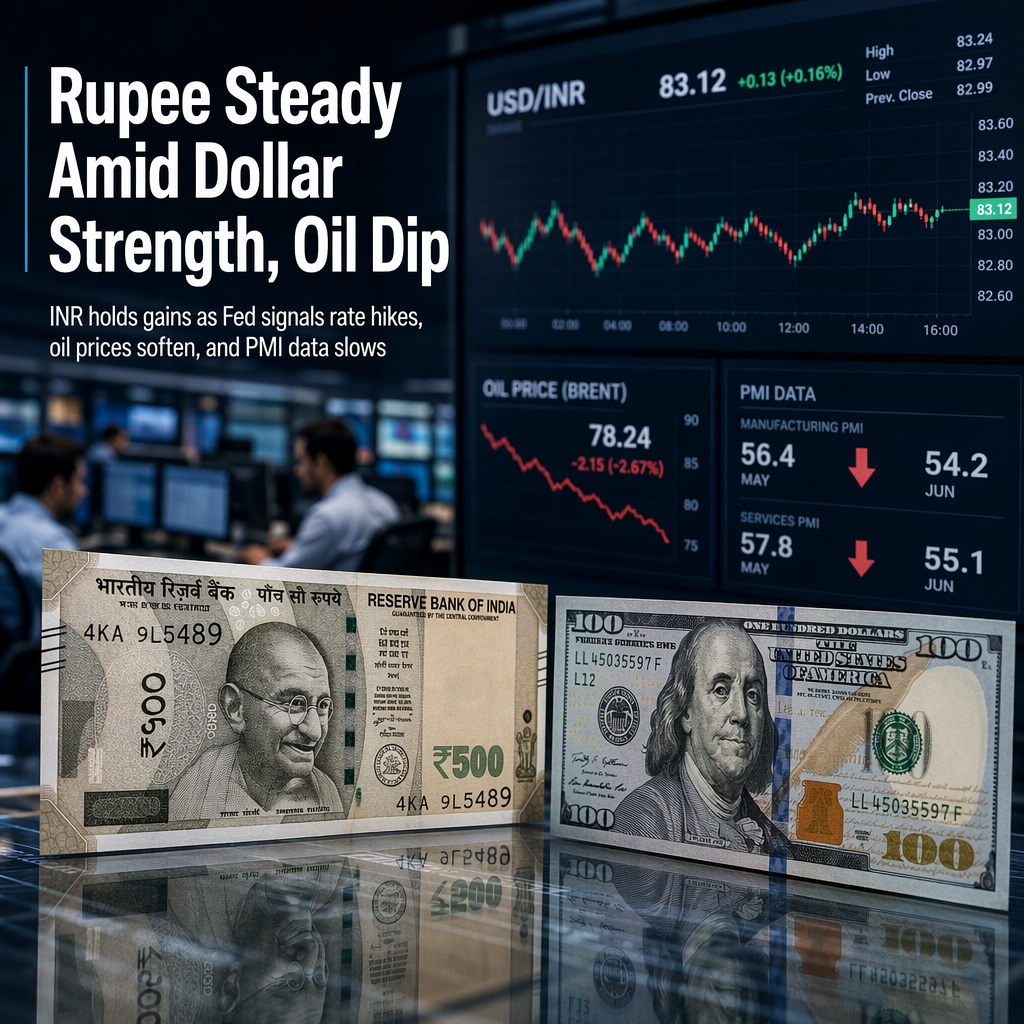
The Indian Rupee (INR) opened flat against the US Dollar (USD) on Tuesday, with the USD/INR pair trading around 94.70 and holding onto Monday’s gains [1][2]. The currency pair remained in a limited range, influenced by a firm US Dollar—buoyed by hawkish Federal Reserve (Fed) expectations—and lower oil prices, which are supportive for oil-importing economies like India [1]. The US Dollar Index (DXY) traded near 101.00, its highest level in over a year, reflecting continued outperformance amid market confidence that the Fed will deliver multiple interest rate hikes this year [1]. Bank of America analysts expect three 25 basis point hikes in September, October, and December, a reversal from earlier expectations that the Fed would hold rates steady in 2026 [1]. The Fed’s recent dot plot indicated rates could reach 3.8% by year-end, while last week’s policy announcement left rates unchanged at 3.50%-3.75% [1].
On the domestic front, India’s preliminary HSBC Manufacturing PMI eased to 54.5 in June from 55.0 previously, while the Services PMI declined to 57.3 from 59.8, and the Composite PMI fell to 57.4 from 59.3 [2][1]. The moderation in PMI growth signals a slowdown in both manufacturing and services sector activity [1][2]. Despite this, the INR showed little to no immediate reaction to the PMI data, with USD/INR holding positive ground near 94.65, marginally up from Monday’s close [2]. Analysts note that stronger-than-expected PMI readings are typically bullish for the INR, while weaker data can weigh on the currency by raising concerns about growth and the potential for a more accommodative Reserve Bank of India (RBI) stance [2].
Lower oil prices also played a role in supporting the INR. The MCX Crude Oil contract for July was 0.4% higher in early trade but remained close to a three-month low, reflecting progress in US-Iran technical talks [1]. US Vice President JD Vance highlighted significant progress in negotiations, including Iran’s agreement to allow International Atomic Energy Agency (IAEA) inspectors back into the country, which was described as a “major milestone” [1]. Lower oil prices are generally positive for the INR, given India’s reliance on oil imports [1].
Technical analysis indicates that USD/INR maintains a constructive near-term tone, trading above the 100-day Simple Moving Average at 93.5420 and above the lower Bollinger Band near 94.16, suggesting the recent decline is more of a consolidation within a broader uptrend [2]. The US Dollar’s strength is further underscored by its performance against major currencies, with the USD showing the strongest gains against the Australian and New Zealand Dollars in recent sessions [2][3].
CONCLUSION
The Indian Rupee remains stable against the US Dollar, as hawkish Fed expectations and lower oil prices offset the impact of weaker PMI data. Market sentiment is neutral to slightly positive for the USD/INR pair, with technicals supporting a continued uptrend. Investors will likely monitor upcoming US economic data and further developments in oil markets for the next directional cues.