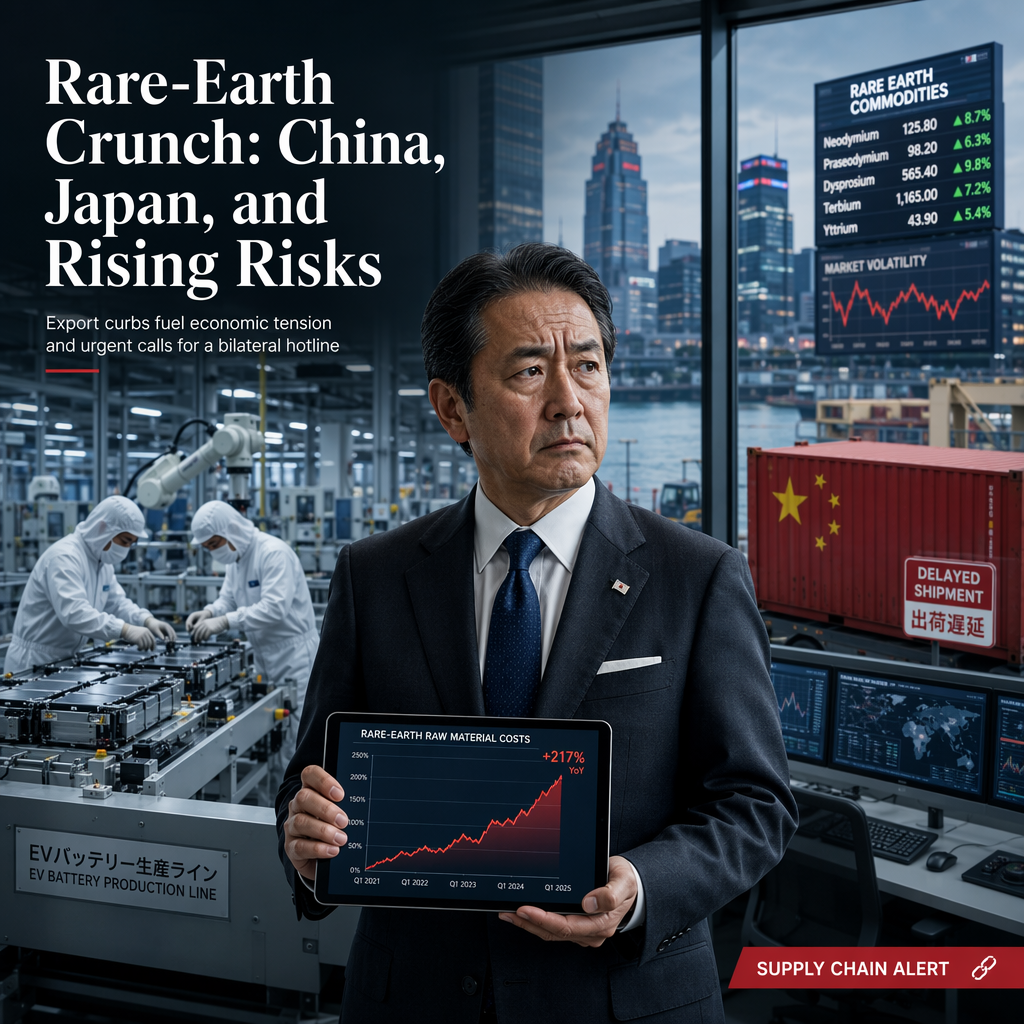
China's recent tightening of export controls on key rare-earth elements has heightened economic tensions with Japan, which relies on China for approximately 60% of its rare-earth imports [1]. The move, justified by Beijing on national security grounds, has led to a surge of over 20% in rare-earth costs for Japanese firms, according to a recent survey [1]. This development underscores Japan's vulnerability, despite ongoing efforts by Japanese companies and policymakers to diversify supply chains, invest in alternative sources, and develop recycling technologies since the unofficial embargo in 2010 [1].
The International Energy Agency estimates that China's rare-earth restrictions could threaten up to $6.5 trillion of Western industry, highlighting the significant global economic risks associated with supply disruptions [1]. The article emphasizes that while military and security issues often dominate Japan-China relations, economic tensions—particularly around critical materials like rare earths—are equally pressing [1].
To mitigate the risk of escalation and manage disputes more effectively, the article advocates for the establishment of a bilateral economic hotline between Japan and China, similar to their existing defense hotline [1]. Such a mechanism could facilitate rapid communication during crises and help stabilize critical supply chains [1].
Looking forward, the article notes that as global demand for rare earths continues to rise—driven by sectors such as electric vehicles, renewable energy, and advanced electronics—the stakes in the Japan-China economic relationship will only increase [1]. The analysis concludes that the more China uses rare earths as an economic lever, the greater the incentive for its trading partners to accelerate diversification and reduce dependence, potentially diminishing Beijing's leverage over time [1].
CONCLUSION
China's rare-earth export controls have significantly increased costs for Japanese firms and raised concerns about the stability of critical supply chains. The situation highlights the urgent need for enhanced economic dialogue and diversification strategies to mitigate future risks. Market participants should closely monitor policy responses and supply chain developments as the global demand for rare earths continues to grow.