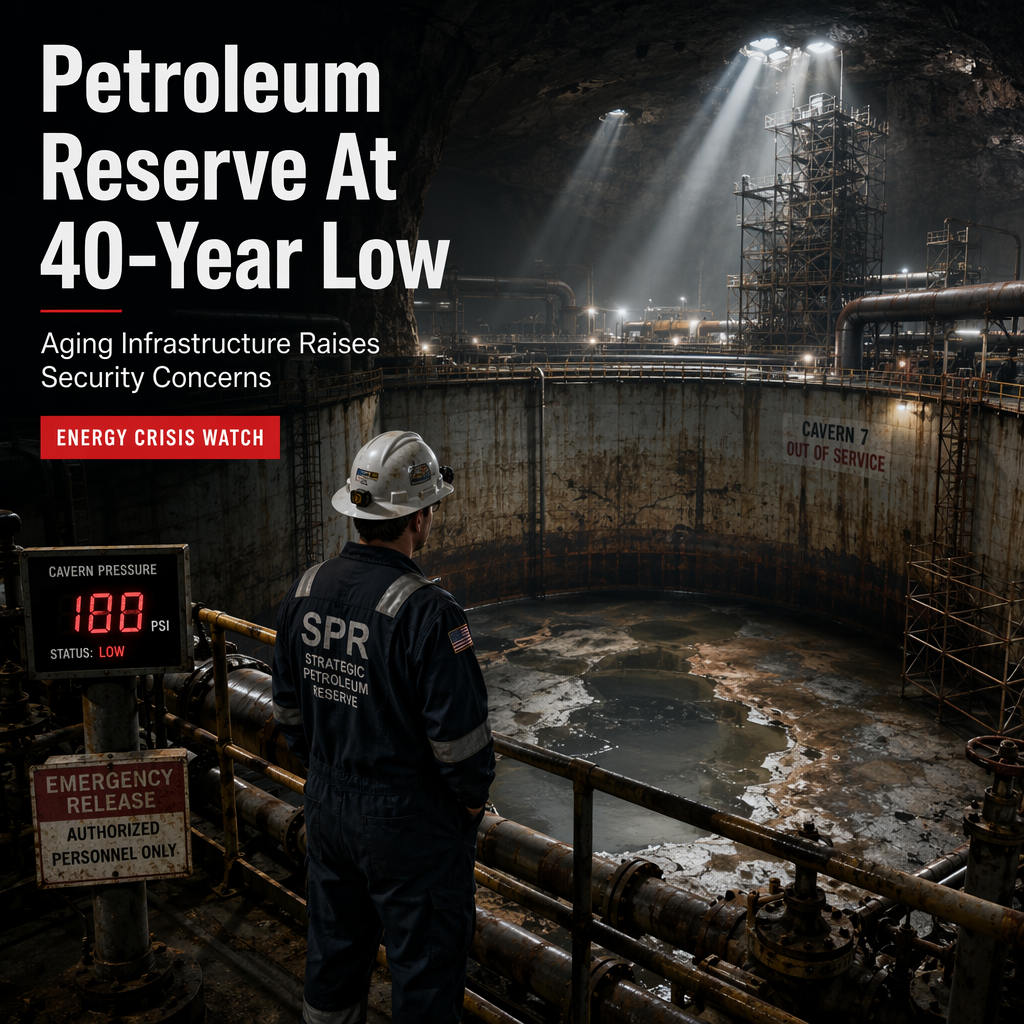
The U.S. Strategic Petroleum Reserve (SPR) has fallen to its lowest level since March 1983 following the withdrawal of 352 million barrels of crude oil over four years, a response to supply disruptions caused by the war with Iran and Russia's invasion of Ukraine in 2022 [1]. The SPR's current inventory stands at about 308 million barrels after a recent weekly decline of 3.7 million barrels, with projections indicating it will drop further to approximately 243 million barrels once the latest emergency release, ordered by President Donald Trump in March, is fully executed [1]. The SPR's authorized storage capacity is 714 million barrels, but more than a quarter of the reserve—at least 103 million barrels—is currently unavailable for drawdown due to construction and cavern outages, according to a July analysis by Rapidan Energy [1].
Federal auditors and the Government Accountability Office have raised concerns about the SPR's ability to respond to future emergencies, citing aging infrastructure and ongoing major construction as significant risks [1]. Department of Energy officials described the reserve's network of pipelines, caverns, and storage tanks as being held together with 'Band-Aids,' expressing uncertainty about how long the infrastructure will remain operational [1]. The Energy Department is implementing a $1.4 billion repair plan, but the scope has been narrowed to stay within budget constraints [1].
Despite these challenges, some analysts remain cautiously optimistic. David Goldwyn, a former State Department special envoy for international energy affairs, stated that the SPR still has enough inventory to address another crisis and expressed confidence in the reserve's stability and drawdown capability [1]. Additionally, a Department of Energy spokesperson clarified that federal law does not require a minimum operating level for the SPR, and the operational minimum needed to safely manage the caverns is around ten percent of capacity, or about 70 million barrels [1].
The ongoing strain on the SPR, combined with the largest supply disruption in history triggered by Iran's actions in the Strait of Hormuz, underscores the critical importance of maintaining and modernizing the reserve's infrastructure to ensure future energy security [1].
CONCLUSION
The U.S. Strategic Petroleum Reserve is at its lowest level in over four decades due to emergency releases and aging infrastructure, raising concerns about its future reliability. While some analysts believe the SPR remains capable of handling another crisis, federal auditors warn that urgent repairs and upgrades are needed to safeguard U.S. energy security.