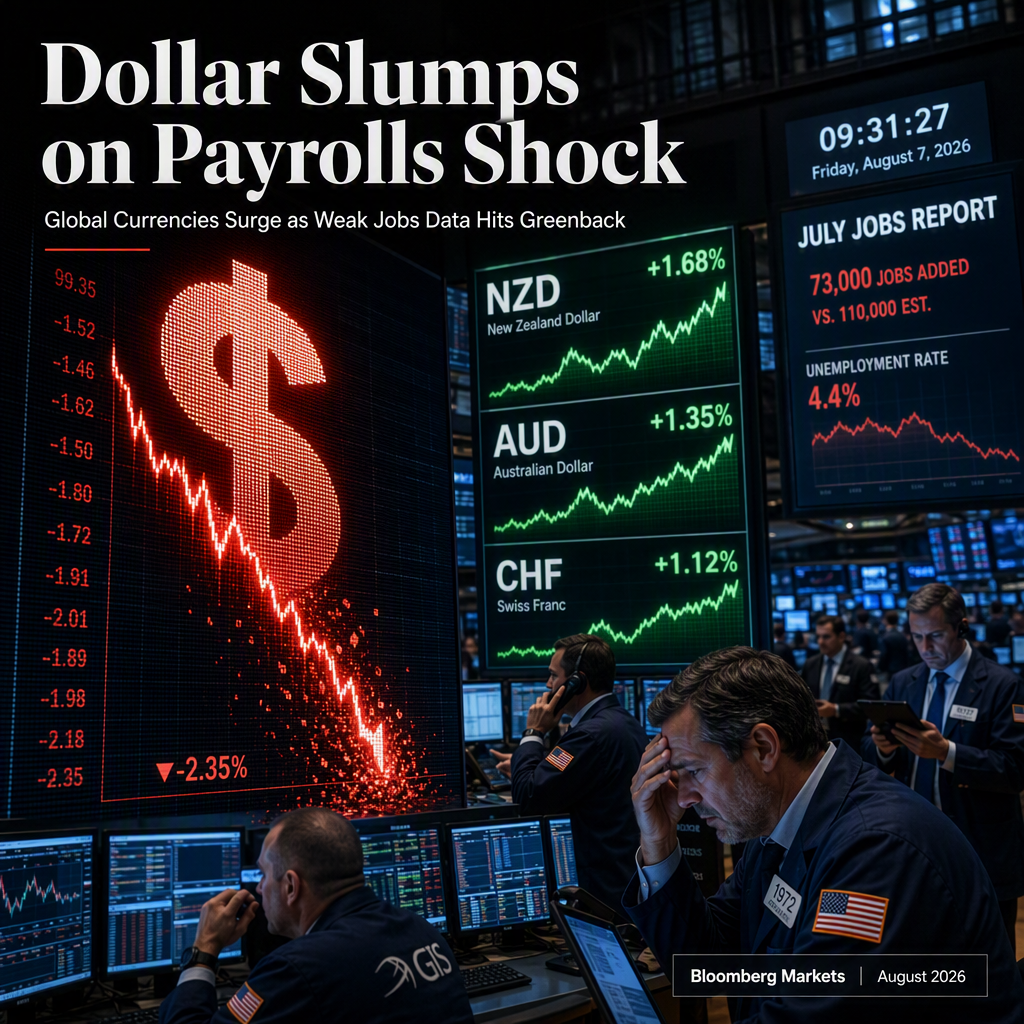
A sharp and unexpected contraction in US Nonfarm Payrolls (NFP) for July triggered a broad selloff in the US Dollar, with major currencies such as the New Zealand Dollar, Australian Dollar, and Swiss Franc posting significant gains against the Greenback [1][2][6]. The Bureau of Labor Statistics reported a loss of 23,000 jobs in July, far below the consensus expectation of an 80,000 increase, marking the first outright contraction since February [1][2][5][6]. Previous months' figures were also revised sharply lower, with June's payrolls cut from 57,000 to 20,000 and May's from 129,000 to 63,000, resulting in a combined downward revision of 103,000 jobs [1][5][6]. Despite the weak headline, the US unemployment rate edged down to 4.1% from 4.2%, attributed to a drop in labor force participation to multi-decade lows, which some analysts interpret as a sign of cyclical labor market weakness [1][5][6].
The disappointing jobs data led investors to scale back expectations for further Federal Reserve (Fed) rate hikes. The probability of a 25-basis-point hike at the September meeting fell to 42%, down from 54% immediately before the release and 67% a week ago, according to the CME FedWatch Tool [1][6]. The US Dollar Index (DXY) dropped to around 99.60, down nearly 0.33% on the day, after touching an intraday low of 99.41 [3][6]. The USD weakened broadly, with the AUD/USD surging to near two-month highs above 0.7070 and NZD/USD rising to 0.5890, up 0.36% on the day [1][2]. The Swiss Franc also gained, with USD/CHF falling to 0.8080, down 0.53% [6]. Gold and silver rallied, and USD/JPY reversed the previous day's gains [2][3].
Richmond Fed President Thomas Barkin commented that the jobs data reflected a labor market in 'weak balance,' characterized by 'low hiring and low firing,' rather than a significant deterioration [1][2][6]. He also noted that corporate earnings remain strong and that the Fed remains committed to bringing inflation down to 2% [1][2][6]. The New York Fed Survey of Consumer Expectations showed one-year inflation expectations eased to 3.6% in July from 3.7% in June, while three- and five-year expectations remained unchanged at 3.3% and 3.0%, respectively [1][3].
Analysts at TD Securities and ABN AMRO highlighted that the weak payrolls report has shifted market focus toward employment, with the Fed now likely to remain on hold in the coming months unless inflation surprises to the upside [4][5]. TD Securities noted that further downside in the USD may depend on next week's Consumer Price Index (CPI) data, with the bar for a EUR/USD breakout above 1.16 remaining high without a soft CPI print [4]. ABN AMRO's Chief Economist Nick Kounis argued that the data could re-balance the Fed's dual mandate concerns toward the labor market, though inflation risks still skew toward a potential hike [5].
Despite the USD's broad weakness, some analysts see limited further downside against G10 currencies unless US inflation data also disappoints, while the USD could lose more ground against select emerging market currencies [4][6]. The Swiss Franc, despite its gains on the day, is still seen as the worst-performing G10 currency against the USD so far in Q3 2026, with analysts expecting CHF weakness to persist due to carry trade funding pressures and the Swiss National Bank's apparent comfort with a weaker currency [6].
CONCLUSION
The surprise contraction in US payrolls for July has triggered a sharp selloff in the US Dollar, boosting major global currencies and prompting markets to reassess the likelihood of further Fed rate hikes. While the immediate reaction has been negative for the USD, analysts caution that further downside may hinge on upcoming inflation data, with the Fed expected to remain on hold unless inflation risks re-emerge. The market's focus now shifts to next week's CPI report for further direction.