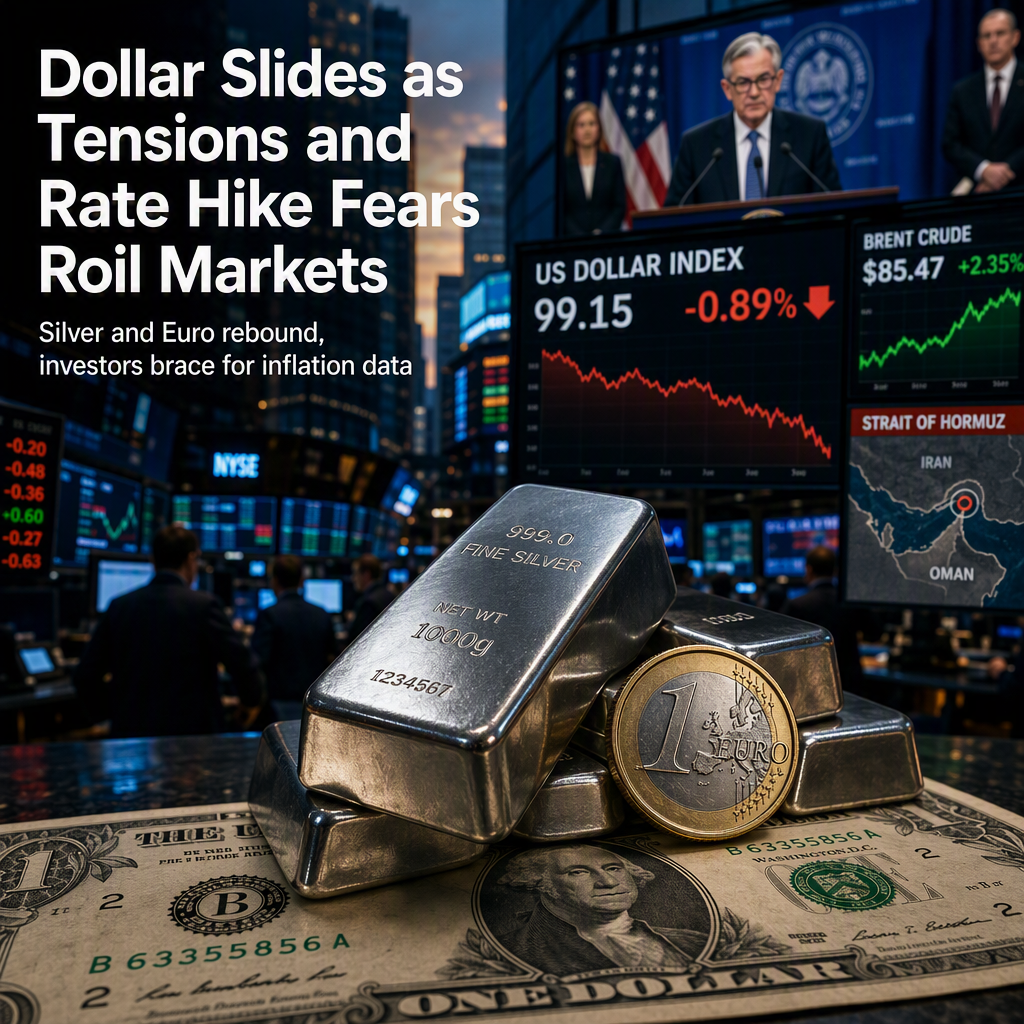
On Wednesday, the US Dollar experienced broad-based weakness, with the US Dollar Index (DXY) trading around 98.61–98.65, near its lowest level since August 21, 2023 [1][2]. This decline was notably driven by a sharp appreciation in the Japanese Yen (JPY), with USD/JPY hovering near 153.35 and falling about 4% so far this month [2]. The weaker US Dollar supported both Silver (XAG/USD) and the Euro (EUR/USD), with Silver rebounding to around $67.50, up 2.64% on the day [1], and EUR/USD trading around 1.1647, up 0.20% [2].
Despite the Dollar's weakness, the environment for precious metals like Silver remains challenging due to surging energy prices and heightened geopolitical tensions. Oil prices have risen sharply, with West Texas Intermediate (WTI) trading around $93.50 per barrel, near its highest level since June 8 [2]. Tensions between the US and Iran escalated after the US military destroyed five Iranian oil tankers, prompting retaliatory actions from Tehran and raising concerns over the security of the Strait of Hormuz [1]. Elevated energy prices are reviving inflation concerns and strengthening expectations of higher interest rates globally [1][2].
In the US, the CME FedWatch Tool indicates a 62% chance of a 25-basis-point rate hike at the Federal Reserve's September 15-16 meeting, supported by resilient labor market data, with US private employers adding an average of 12K jobs per week during the period ending August 22 [1][2]. The benchmark 10-year US Treasury yield is trading around 4.80%, near its highest level since November 2023, reflecting these tightening expectations [1][2]. Investors are closely watching upcoming US inflation data, with the Producer Price Index (PPI) due Thursday and the Consumer Price Index (CPI) on Friday. Analysts at Brown Brothers Harriman emphasize that a 'hot' CPI print would likely seal a September rate hike and support a firmer USD, while a 'cooler' reading could lead to a dovish repricing [2].
In Europe, the ECB is widely expected to raise interest rates by 25 basis points at its Thursday meeting, marking its second increase this year, as headline HICP inflation accelerated to 3.3% YoY in August from 2.9% in July [2]. However, as this hike is already priced in, market participants are focusing on ECB President Christine Lagarde's press conference for signals on future policy moves. Nomura analysts do not forecast further ECB rate hikes after September but acknowledge that ongoing Middle East tensions could tilt risks toward additional tightening [2].
Overall, the interplay of a weaker US Dollar, rising energy prices, and heightened rate hike expectations is creating volatility across currency and commodity markets. While Silver and the Euro have benefited from Dollar weakness, the prospect of further monetary tightening and persistent inflationary pressures continue to pose headwinds.
CONCLUSION
The US Dollar's decline, driven by Yen strength and geopolitical tensions, has provided short-term support to Silver and the Euro. However, persistent inflation concerns and expectations of further rate hikes by both the Federal Reserve and the ECB are likely to keep markets volatile. Investors are now focused on upcoming inflation data and central bank communications for further direction.