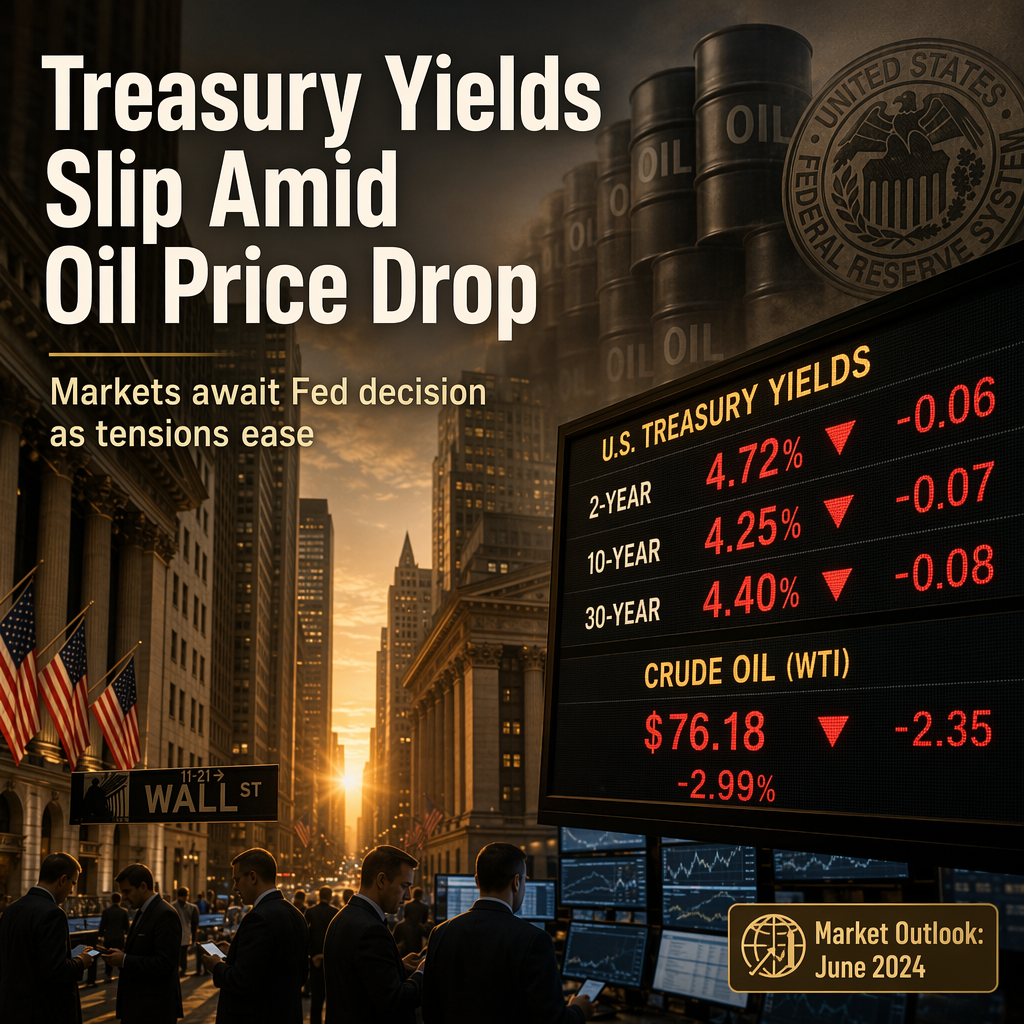
On Tuesday, Treasury yields edged lower as investors awaited the Federal Reserve's upcoming interest rate decision, while a pause in U.S.-Iran hostilities contributed to a decline in oil prices [1]. The yield on the 10-year Treasury note, a key benchmark for consumer loans, fell by 2 basis points to 4.622% [1]. Similarly, the 2-year Treasury note yield, which is closely tied to short-term Fed policy, dropped by 2 basis points to 4.301% [1]. The 30-year Treasury yield, often sensitive to geopolitical developments, decreased by more than 1 basis point to 5.111% [1].
The Federal Open Market Committee is expected to keep rates unchanged at 3.75% during its Wednesday meeting, but market participants are pricing in a 56% probability of a rate hike in September, according to CME Group's FedWatch tool [1]. This anticipation is influencing trading activity and contributing to the retreat in yields.
Geopolitical developments also played a role, as President Donald Trump reported "good talks" with Iran on Monday, leading to a continued pause in hostilities [1]. This easing of tensions has pushed oil prices lower, with West Texas Intermediate futures down 1.6% to $81.27 per barrel and Brent crude falling 2% to $86.63 per barrel [1].
Investors are closely monitoring both the Fed's rate decision and developments in the Middle East, as these factors are impacting market sentiment and asset prices [1].
CONCLUSION
Treasury yields declined and oil prices fell as investors awaited the Federal Reserve's rate decision and monitored easing tensions between the U.S. and Iran. The market is pricing in a possible rate hike in September, while lower oil prices reflect optimism about a sustainable ceasefire. Overall, the event has generated cautious optimism and moderate market impact.