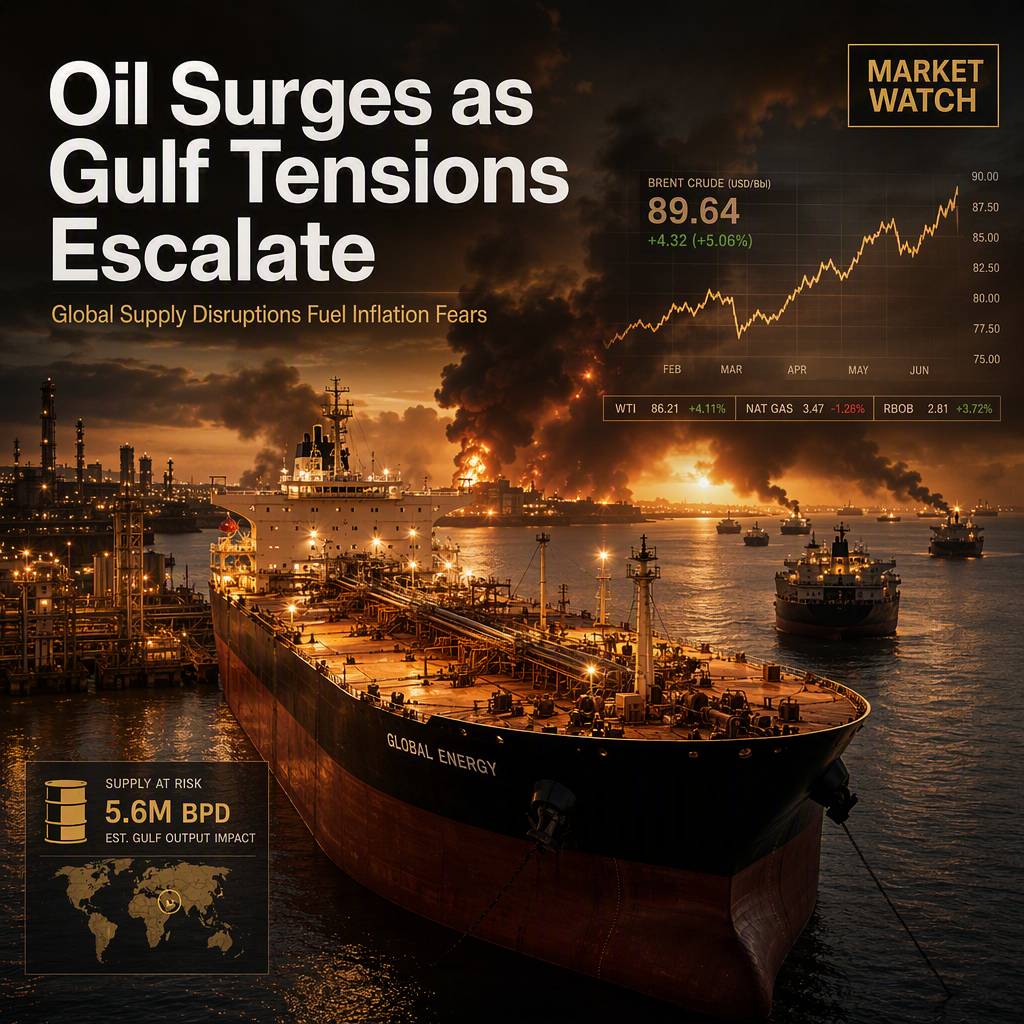
Oil prices surged on Wednesday as military hostilities in the Gulf region intensified, raising concerns over global supply disruptions and inflationary pressures. The US benchmark West Texas Intermediate (WTI) crude retraced earlier losses to reach fresh three-month highs at $92.70, with early-June highs of $94.87 in sight [1]. In early Wednesday trading, WTI futures for October delivery were reported to be holding around $94 a barrel, while Brent crude futures approached $100 a barrel [2].
The escalation follows a series of retaliatory strikes: Iran's Revolutionary Guard claimed responsibility for hitting two U.S. vessels and eight oil tankers in the Gulf, in response to U.S. Central Command's destruction of five Iranian crude oil tankers on Tuesday [2]. Additionally, Iran-backed Houthi militias from Yemen attacked oilfields in Saudi Arabia, prompting Saudi retaliatory strikes on targets in Yemen [1]. These developments have heightened fears of a broader regional conflict that could further disrupt oil flows.
Shipping disruptions are compounding the situation, with attacks on vessels in the Strait of Hormuz limiting oil traffic through a waterway that previously carried about 20% of global supply before the conflict [1]. Rabobank analysts highlighted that global shipping rules are under strain, with rerouting evident as tankers avoid Hormuz and the Suez Canal sees increased traffic, while the Panama Canal faces deeper transit cuts due to drought [1]. These factors, combined with already tight energy markets, are increasing stress on global supply chains and raising the risk of renewed cost pressures.
Market analysts are warning of further price spikes. Dean Struyven, co-head of global commodities research at Goldman Sachs, stated that oil prices could reach $120 per barrel if shipping disruptions broaden and intensify [1]. Daan Struyven, also from Goldman Sachs, echoed this sentiment on CNBC, saying prices above $120 are "definitely plausible" [2]. The inflationary impact is already being felt globally, with Chinese wholesale inflation exceeding expectations in August and the Bank of England warning of further upside risks to inflation due to higher energy prices [2].
The negative sentiment has spilled over into equity markets, with the Dow Jones Industrial Average closing 600 points lower in consecutive sessions, and U.S. and European futures showing little direction [2].
CONCLUSION
Escalating military actions in the Gulf have driven oil prices to multi-month highs, with analysts warning of the potential for further sharp increases if disruptions persist. The situation is fueling global inflation concerns and contributing to negative sentiment in equity markets. Ongoing tensions and supply chain strains suggest continued volatility in both energy and financial markets.