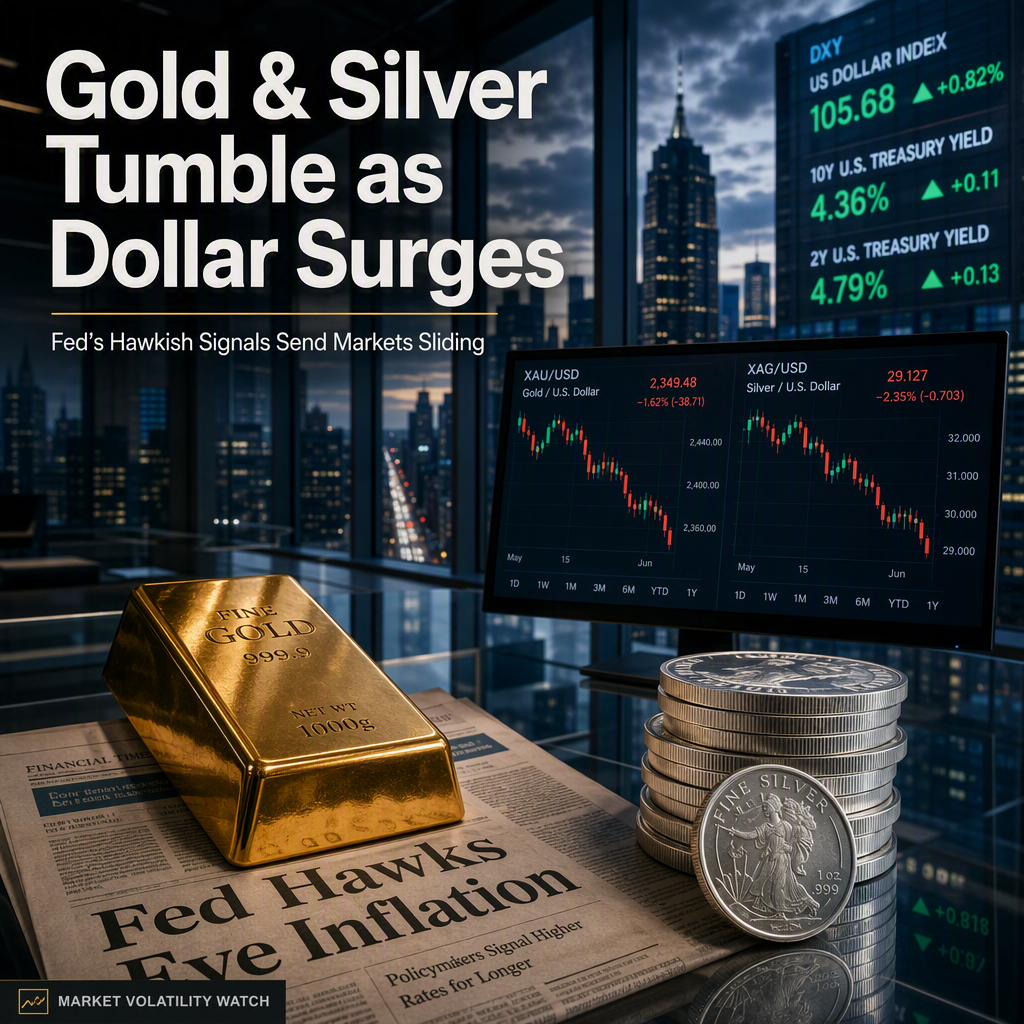
Both silver (XAG/USD) and gold (XAU/USD) experienced notable declines during Friday's European trading session, driven by a rebound in US Treasury yields and the US Dollar, alongside persistent hawkish sentiment from the Federal Reserve. Silver fell 1.7% to near $58.00, while gold dropped 1.22% to around $4,055.3 after failing to sustain gains above $4,100 [1][2]. The US Dollar Index (DXY), which measures the Greenback against six major currencies, rose 0.35% to near 100.30 according to [1], and 0.21% to around 100.20 according to [2], reflecting renewed strength after a three-day losing streak and suspected foreign exchange intervention by Tokyo to support the Japanese Yen [1][2].
US Treasury yields surged, with the 10-year yield up 0.45% to near 4.68% after a weak opening, as fears of prolonged inflationary pressures intensified [1]. Elevated oil prices, stemming from Middle East energy supply concerns and Iran's intention to monetize the Strait of Hormuz, further supported higher yields [1][2]. The Federal Reserve left interest rates unchanged in the 3.50%-3.75% range on Wednesday, but policymakers expressed mounting concerns about inflation remaining above the 2% target [1][2]. Three Fed policymakers voted for an immediate rate hike, and Chair Kevin Warsh reiterated the central bank's commitment to controlling inflation, though he did not provide clear forward guidance [2]. According to the CME FedWatch Tool, traders currently price in a 66% probability of a 25-basis-point rate hike in September [2].
TD Securities warned that hawkish comments from FOMC members, once the Fed's communication blackout ends, could restore some of the Fed's inflation-fighting credibility and potentially trigger renewed volatility in US rates, with significant risk of 10-year Treasuries breaking key technical levels [1]. Technical analysis for gold indicates stabilization around the $4,000 mark, with subdued momentum as the Relative Strength Index (RSI) sits near 46 and the Average Directional Index (ADX) at 28, suggesting the earlier downtrend is losing strength [2]. Immediate support for gold is at $4,000, with resistance at the 21-day Simple Moving Average (SMA) at $4,072, and further upside targets at the 50-day SMA ($4,185) and 100-day SMA ($4,426) [2].
Market participants are awaiting the final University of Michigan Consumer Sentiment and Consumer Expectations data, as well as the one-year and five-year Consumer Inflation Expectations, due later on Friday [2]. In the near term, gold is expected to remain range-bound as traders monitor developments in the Middle East and the Fed's interest-rate outlook [2].
CONCLUSION
The rebound in US Treasury yields and the US Dollar, combined with hawkish Fed signals and elevated inflation concerns, have pressured both silver and gold prices. Market volatility is expected to persist as traders await further Fed commentary and key economic data releases. Technical indicators suggest stabilization for gold, but upside remains capped amid ongoing uncertainty.