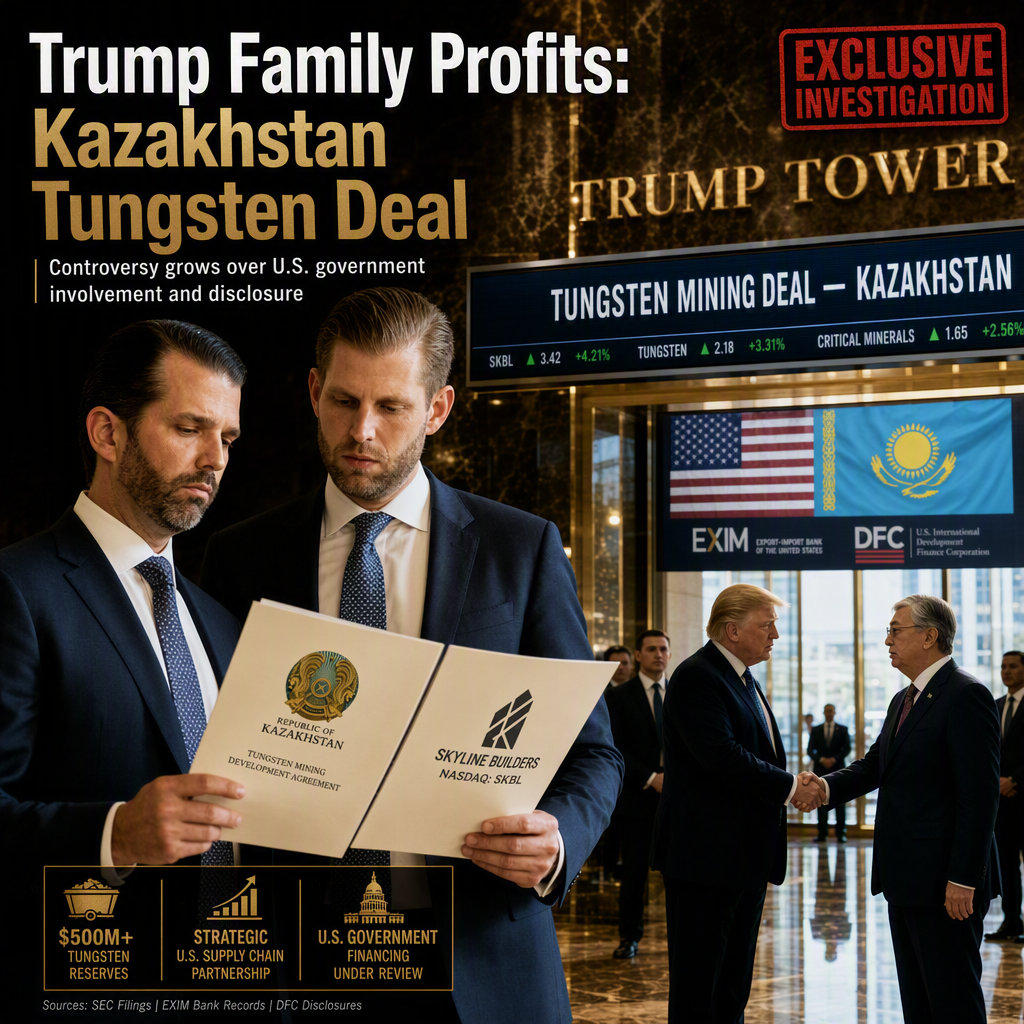
The Trump Organization, led by Donald Trump Jr. and Eric Trump, has profited from a controversial investment in a construction company connected to a rare earth minerals deal in Kazakhstan, which has received funding from the U.S. government [1]. The core of the controversy centers on a tungsten mining deal in Kazakhstan, primarily involving U.S.-based investment company Cove Capital and its affiliate, Cove Kaz Capital Group. Between 2023 and 2024, Cove Capital negotiated with the Kazakh government to secure a 70% share in the country's state-owned tungsten mining deposits [1].
Tungsten is a critical mineral for military equipment, and the majority of the global supply is controlled by China and Russia. Since returning to office, President Trump has prioritized securing a long-term supply of tungsten as a strategic national security objective [1]. In August 2025, through an investment vehicle created by Dominari Securities (located in Trump Tower, New York), the Trump brothers purchased a minority interest in Skyline Builders, which was publicly traded on the NASDAQ under the ticker SKBL at the time [1].
In June 2025, Cantor Fitzgerald, founded by Commerce Secretary Howard Lutnick, underwrote a $46.8 million loan to ASP Isotopes, a company owned by Paul Mann. ASP Isotopes, which had acquired voting control of Skyline Builders, is now controlled by Lutnick's sons, Brandon and Kyle Lutnick, following their father's appointment as a government official [1]. The Trump brothers' investment in Skyline Builders coincided with these developments [1].
On November 6, 2025, Kazakhstan President Kassym-Jomart Tokayev met with President Trump and announced that Kazakhstan had awarded a tungsten mining contract to the United States. The Export-Import Bank of the United States (EXIM) and the U.S. International Development Finance Corporation (DFC) provided government financing for the project [1]. Despite suspicions and backlash regarding potential conflicts of interest, securities attorney Andrew Stoltmann stated that evidence of wrongdoing is likely impossible to find, noting that as private investors, the Trump brothers have no real duties to disclose such investments unless they choose to do so [1].
CONCLUSION
The Trump family's involvement in the Kazakhstan tungsten deal has sparked controversy due to the intersection of private investments and U.S. government financing. While critics raise concerns about potential conflicts of interest, legal experts cited in the article suggest that proving any wrongdoing would be difficult. The deal underscores the strategic importance of securing rare earth minerals for U.S. national security.