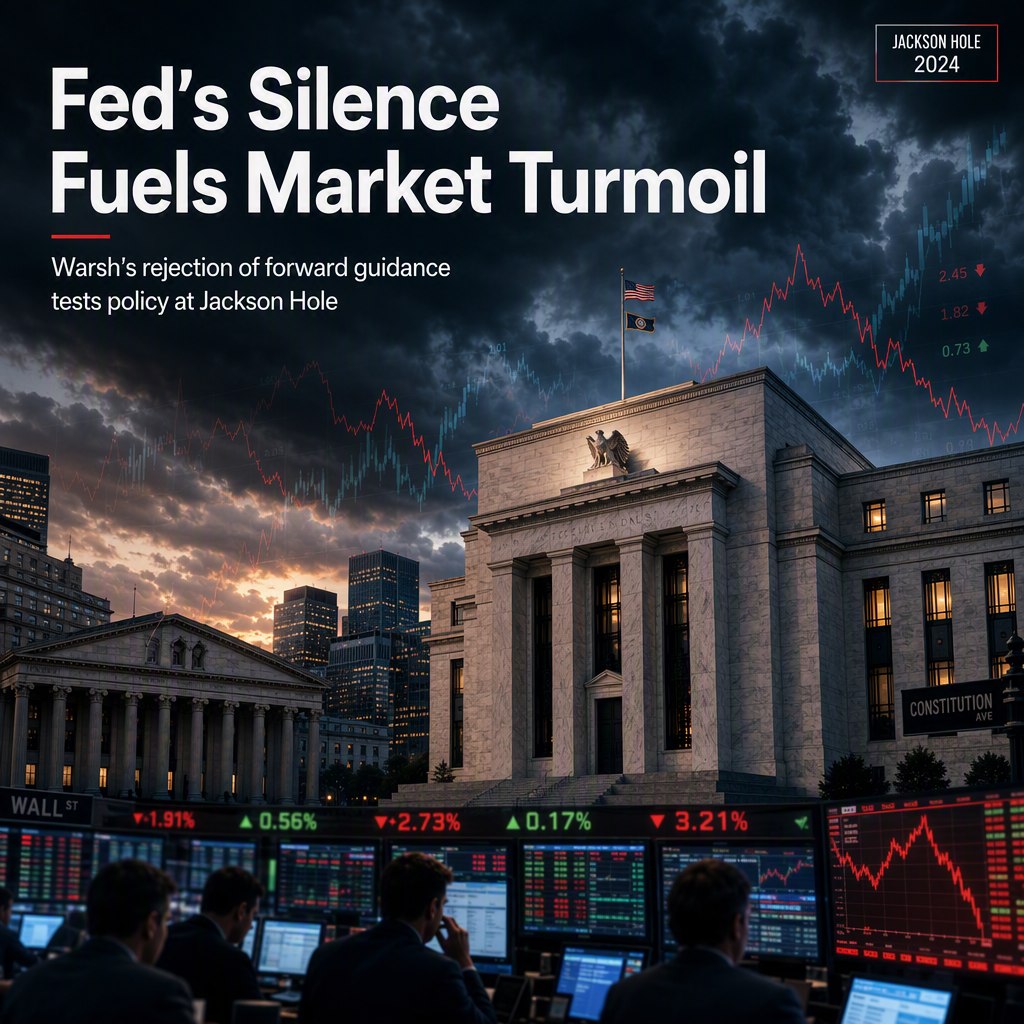
DBS Bank strategist Philip Wee highlights that Federal Reserve Chairman Kevin Warsh’s decision to reject forward guidance has led to increased market volatility and complicated the policy mix with the Treasury [1]. According to Wee, the upcoming Kansas City Fed’s Jackson Hole Economic Policy Symposium, scheduled for August 27-29, will serve as a critical test for Warsh’s approach [1]. The strategist emphasizes that Warsh must clarify how the Fed, in the absence of forward guidance, plans to anchor market expectations, determine the extent of tightening it is willing to tolerate through long-term yields, and delineate the policy boundary between the Fed and the Treasury [1].
Wee warns that without a clear and coherent policy framework, the reduction in forward guidance could be perceived not as a return to market-driven price discovery, but rather as a source of uncertainty for financial conditions and the independence of the Federal Reserve [1]. He further notes that while Warsh and Bessent need to collaborate to stabilize financial markets, their actions must avoid creating the impression that the Treasury is becoming overly activist or dominant, which could undermine confidence in the Fed’s independence [1].
The article does not provide specific market data, analyst forecasts, or immediate market reactions, but it underscores the heightened uncertainty and volatility resulting from the current communication strategy [1]. The focus remains on the need for Warsh to articulate a clear framework at the upcoming Jackson Hole symposium to reassure markets and preserve the credibility of the Federal Reserve [1].
CONCLUSION
The rejection of forward guidance by Fed Chairman Warsh has increased market volatility and raised concerns about policy clarity and Fed independence. The upcoming Jackson Hole symposium is seen as a pivotal moment for Warsh to address these issues and provide the market with much-needed direction.