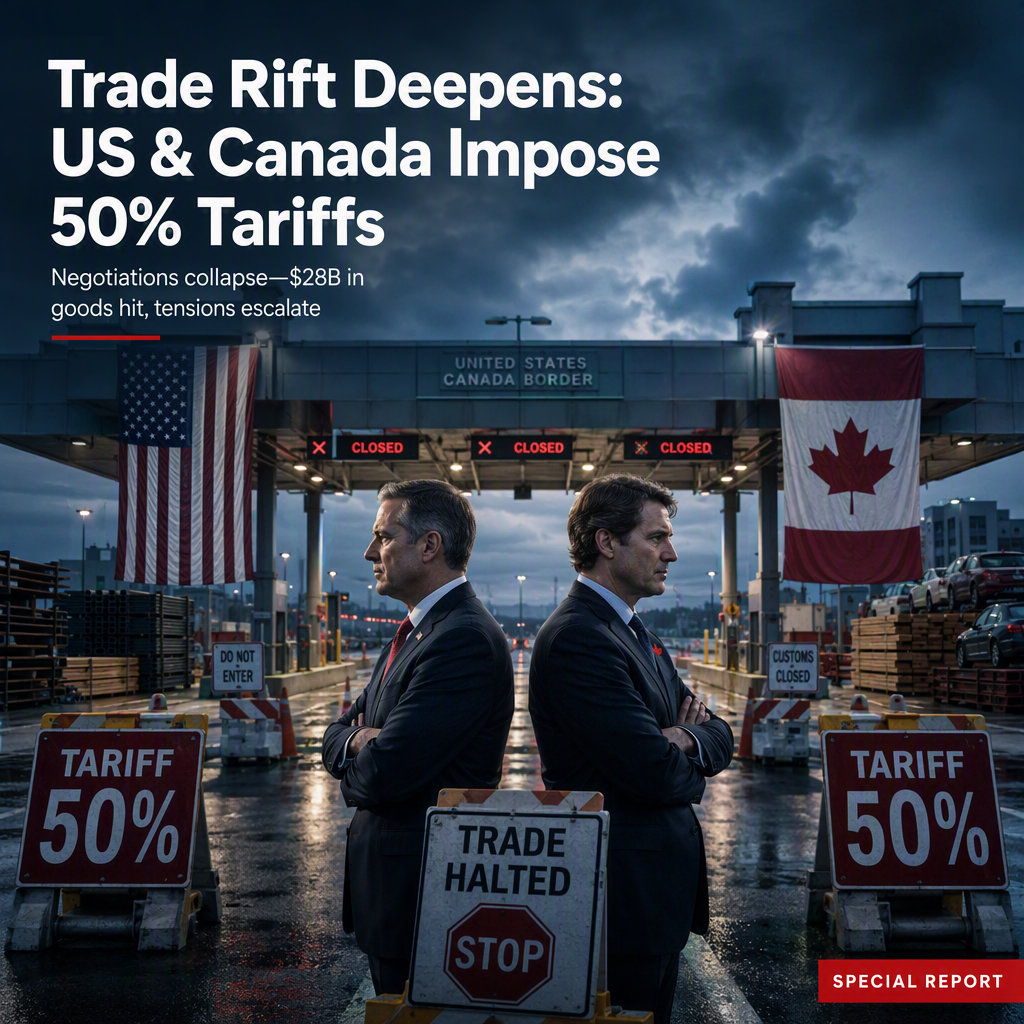
Trade negotiations between the United States and Canada were suspended late Friday, following a breakdown in talks over last-minute changes to the proposed terms from Washington. Canadian Prime Minister Mark Carney announced the suspension, citing 'unfair, uneconomic' last-minute changes by the U.S. and questioning the reliability of any deal under the new terms [1]. As a result, Carney directed Canadian negotiators to return to Ottawa and declared that Canada would impose retaliatory tariffs matching the U.S.'s 50% tariffs on approximately $28 billion in Canadian goods, set to take effect at midnight [1].
The breakdown occurred just days after President Donald Trump paused the 50% tariffs for three days and announced that the U.S. and Canada had, subject to final documentation, reached a 'DEAL!' [1]. However, Carney stated that despite recent progress, the two sides could not finalize an agreement that met Canada's objectives [1].
The U.S. Trade Representative, Jamieson Greer, provided a contrasting account, stating that Canada declined to finalize terms that had been agreed upon earlier in the week. Greer emphasized that the U.S. had offered Canada significant tariff reductions on steel, aluminum, autos, and lumber, as well as a broader economic and national security partnership covering digital trade, critical minerals, aerospace, and export controls [1]. Greer described the outcome as a 'missed opportunity' for Canada to partner with the U.S., which he called the fastest growing economy in the G7 [1].
Carney also announced that, in addition to the retaliatory tariffs, the Canadian government would introduce further measures to support Canadian workers and businesses, building on nearly $25 billion in support provided over the past 18 months [1]. No specific market reactions or analyst opinions were included in the article, but the imposition of large-scale tariffs and the suspension of trade talks signal significant potential disruption to cross-border trade [1].
CONCLUSION
The suspension of US-Canada trade negotiations and the announcement of reciprocal 50% tariffs on $28 billion in goods mark a major escalation in trade tensions. Both sides blame each other for the breakdown, and Canada is preparing additional support for affected industries. The situation is highly fluid and could have significant market and economic consequences.