
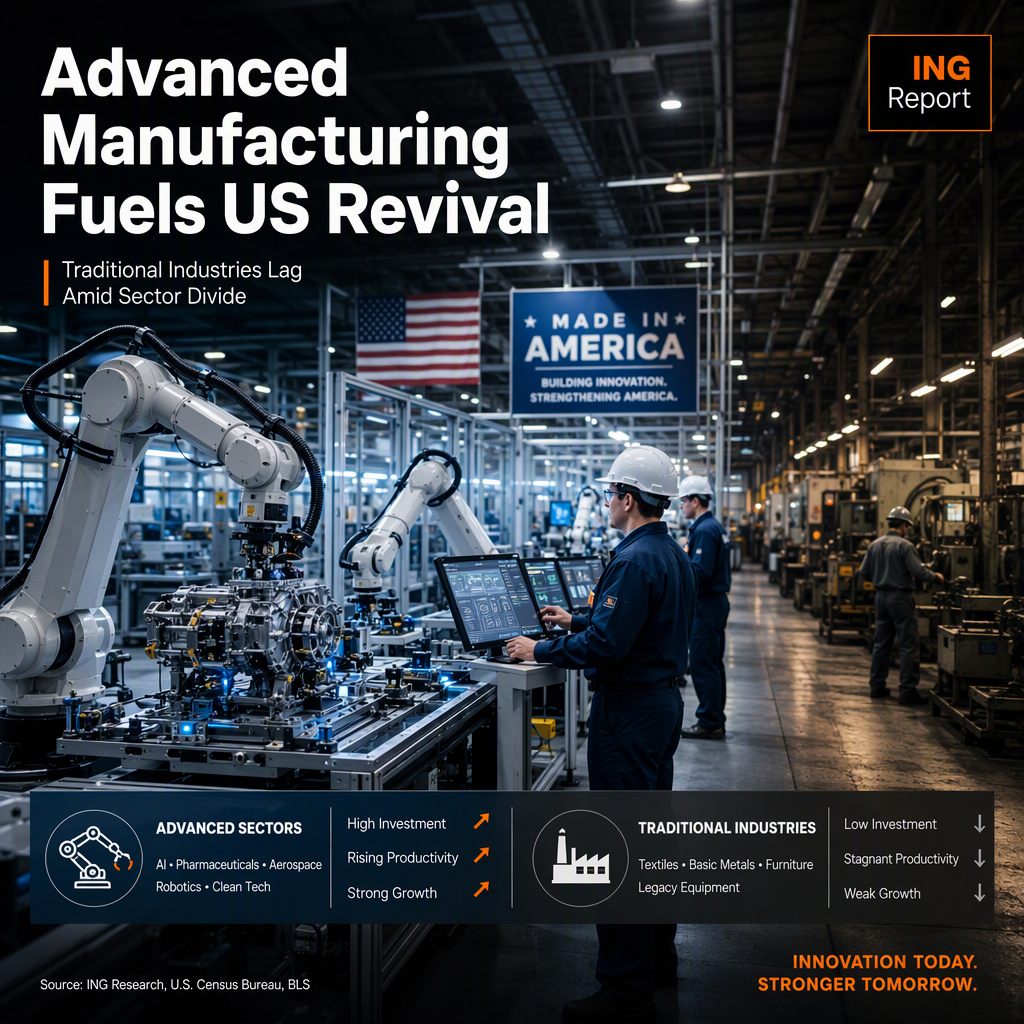
According to ING analysts James Knightley and Coco Zhang, US manufacturing is experiencing a revival after years of stagnation, driven by factors such as reshoring, AI-driven investment, and increased defense spending [1]. The analysts forecast that US manufacturing volume will grow by 1.5–2% per year over the next three years, a notable improvement compared to the sluggish activity of the past two decades [1]. However, this growth is not uniform across the sector. Advanced, highly automated industries—particularly those involved in AI, technology, pharmaceuticals, transport, aerospace, electrical, and power-related sectors—are expanding rapidly and are considered national champions by the government [1]. These sectors are able to absorb higher US wage costs and are expected to benefit from ongoing productivity-enhancing initiatives [1].
In contrast, traditional, labor-intensive manufacturing industries are expected to continue shrinking unless they can leverage a 'made in America' premium to offset higher labor costs [1]. Heavy industries such as steel are positioned somewhere in the middle, with cost increases being less severe than in other regions [1]. The report also highlights that tariffs, energy security, and the US economy's outperformance compared to other key markets further boost the attractiveness of US manufacturing [1]. Specifically, between 2023 and 2026, the US economy has grown at an average rate of 2.5% year-on-year in volume terms, compared to just 0.9% in Europe [1].
Business surveys cited in the report indicate strong order books, supporting the view that the manufacturing revival is likely to continue [1]. The ISM production index has shifted from contraction territory (below 50) to signaling robust growth ahead, reinforcing the positive outlook for advanced manufacturing sectors [1].
While the overall sentiment is positive for advanced manufacturing, the report underscores a growing bifurcation within the sector, with traditional industries facing ongoing challenges [1].
CONCLUSION
ING analysts project a moderate but meaningful revival in US manufacturing, led by advanced, highly automated sectors, while traditional industries continue to lag. The overall market sentiment is cautiously optimistic, with strong order books and economic outperformance supporting the sector's outlook. However, the uneven nature of the recovery suggests ongoing challenges for labor-intensive manufacturing.