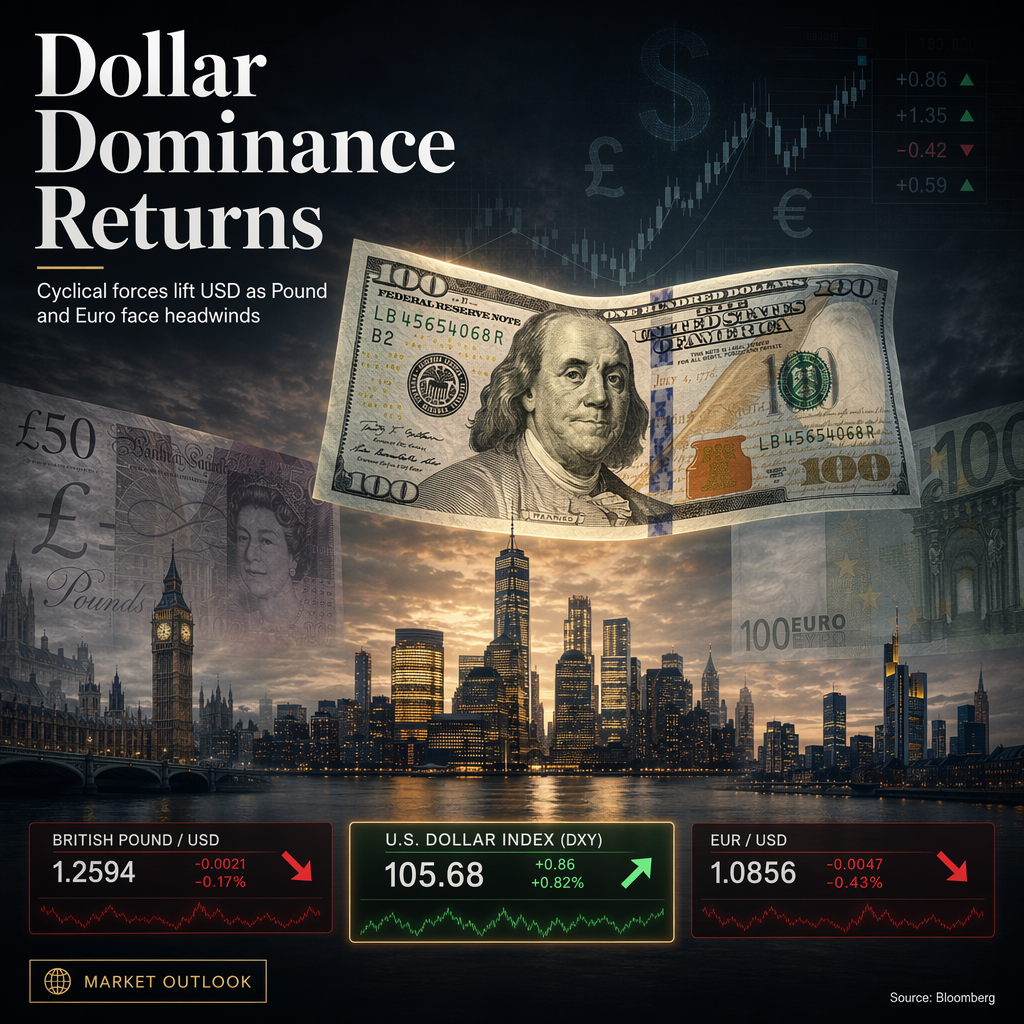
Recent analysis from multiple financial institutions highlights a resurgence in US Dollar strength, driven by cyclical factors and relative economic performance. ING strategists emphasize that cyclical drivers have reasserted themselves in the foreign exchange market, underpinning a stronger Dollar outlook over the coming months. They attribute this bullishness to the credible threat of potential Federal Reserve tightening later in the year, which has prompted a reassessment of the Dollar's prospects and delayed expectations for any meaningful downturn in its value [1].
In contrast, the British Pound has shown softness, with GBP/USD trading directionless around its 200-day moving average of 1.3417. Brown Brothers Harriman notes that UK Gilts are outperforming European bonds, but softer-than-expected UK May CPI data has delayed market expectations for Bank of England tightening from November to December. Specifically, headline CPI remained at 2.8% year-on-year (versus a consensus of 3.0% and a BOE projection of 3.3%) for a second consecutive month, while core CPI rose to 2.6% year-on-year (below the 2.7% consensus and up from 2.5% in April). As a result, analysts expect GBP/USD to edge lower and stabilize closer to 1.3100, reflecting stronger US growth prospects and ongoing uncertainty in the UK political landscape [2].
Meanwhile, the Euro is also struggling to gain ground despite hawkish signals from the European Central Bank. ING’s FX team points out that a rate hike by the ECB is already fully priced into EUR/USD, which limits the potential for further Euro appreciation. They stress that even additional hawkishness from the ECB may not translate into gains for the Euro, as markets have already discounted tighter policy [3].
Overall, the US Dollar is benefiting from cyclical bullishness and relatively stronger economic fundamentals, while both the British Pound and Euro face challenges from domestic economic data and central bank policy expectations.
CONCLUSION
The US Dollar is currently supported by cyclical factors and the prospect of Fed tightening, while the British Pound and Euro are weighed down by softer economic data and fully priced-in central bank actions. Market participants are likely to favor the Dollar in the near term, given its relative strength and ongoing uncertainties in the UK and Eurozone.