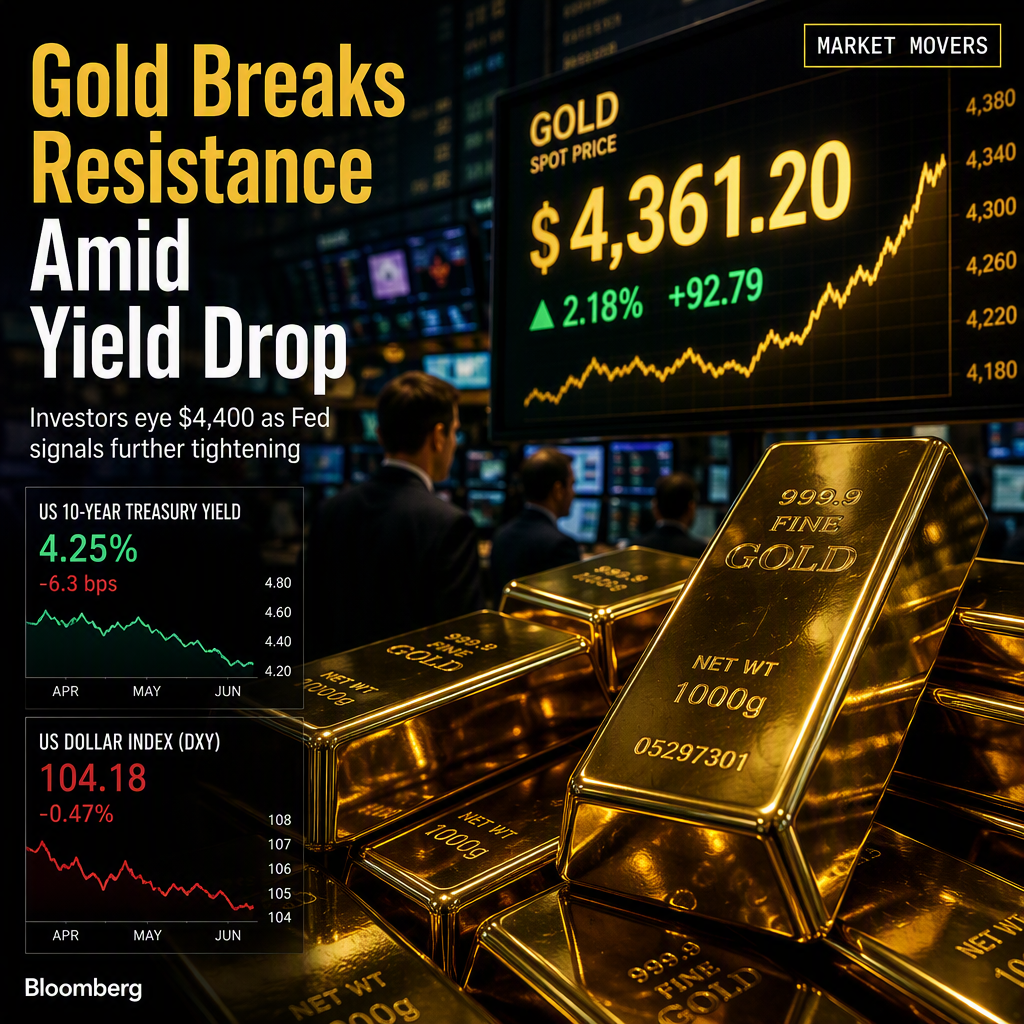
Gold (XAU/USD) rallied by more than 2% on Thursday, trading at $4,361 after clearing a key technical resistance at the 100-day Simple Moving Average (SMA) of $4,320. This surge came as investors digested the Federal Reserve's latest rate hike and responded to falling oil prices, which pushed both the US Dollar and US Treasury yields lower. The US Dollar Index (DXY) dropped 0.12% to 100.22, while US Treasury yields fell 7 basis points to 4.949% [1].
The Federal Reserve raised rates by 25 basis points to a range of 3.75%-4%, marking the first hike in three years and signaling the possibility of further tightening. Fed Chair Kevin Warsh emphasized that inflation remains too high, and the Fed's dot plot projects the Fed funds rate at around 4.10% by the end of 2026. The Personal Consumption Expenditures (PCE) price index is expected to stay at 3.7% this year and gradually move toward the Fed's 2% target by 2028. Money markets have priced in a 53% chance of another rate hike at the October meeting [1].
Supporting gold's rally, a potential de-escalation in the Middle East conflict and a 0.16% decline in West Texas Intermediate (WTI) oil prices undermined the US Dollar. Additionally, US jobless claims for the week ending September 12 fell from 206,000 to 196,000, beating expectations of 208,000. Upcoming US economic data includes the Fed’s August Industrial Production report and a speech by Fed Governor Michelle Bowman [1].
Technical analysis indicates that if gold closes above the September 16 high of $4,366, it could confirm a bullish recovery, with buyers targeting $4,400 and potentially higher levels at $4,450 and $4,500. The Relative Strength Index (RSI) is trending higher but remains below the neutral 50 level, suggesting neither buyers nor sellers are in full control yet. If the RSI clears 50, further upside is anticipated. On the downside, a failure to hold current levels could lead to another leg lower for gold [1].
CONCLUSION
Gold's strong rally above key resistance levels reflects investor optimism despite the Fed's hawkish stance, driven by falling yields and a weaker US Dollar. Technical indicators suggest further upside is possible if momentum continues, with market participants closely watching upcoming US economic data and Fed communications.