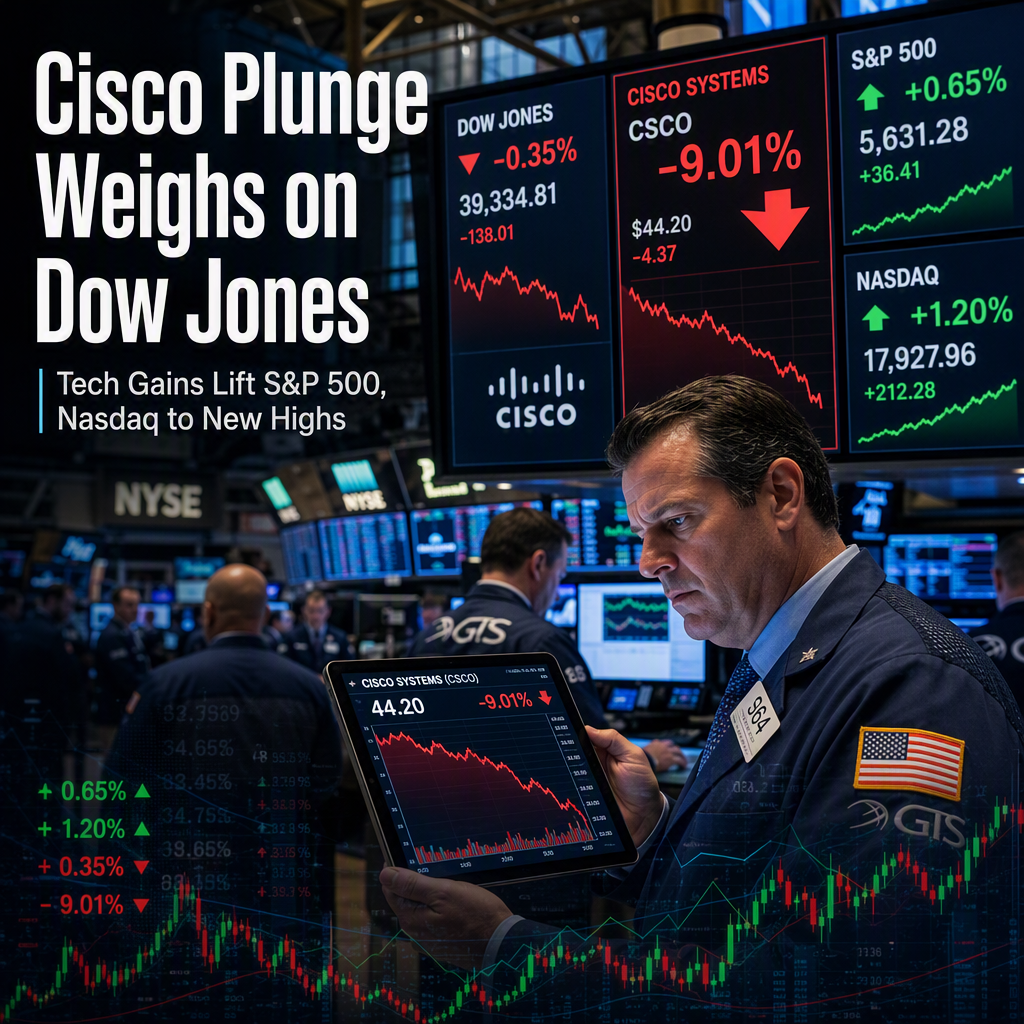
On Thursday, the Dow Jones Industrial Average traded near 53,700, down roughly 75 points or a tenth of a percent, while the S&P 500 reached a fresh record intraday high and the Nasdaq Composite climbed close to 1% higher. The primary driver of the Dow's decline was Cisco (CSCO), which fell approximately 9% after reporting its fiscal fourth quarter results. The market's disappointment centered on margins rather than revenue. Cisco's share price, which was near $124 before the report, dropped by about $11, accounting for nearly 65 of the Dow's 75-point decline. This highlights the impact of the Dow's price-weighted methodology, as other major movers like Cerebras (CBRS), Meta Platforms (META), Micron (MU), and Netflix (NFLX) are not Dow components and thus did not affect the index's performance [1].
In the broader market context, futures indicated a 68.3% probability of at least one rate increase by December 9, compared to a fully priced December hike earlier in the week. The odds for a September 16 hike dropped to 34.4% from nearly 50%, and October 28's probability fell to 48.9% from over 75%. Despite these shifts, the likelihood of two increases by December remained nearly unchanged at 23.3%, and the probability of a rate cut stayed at zero for all 2026 meetings, not exceeding 1% until the second half of 2027. This suggests the market is uncertain, pricing in either no increase or two, rather than a clear path forward [1].
Additionally, a voting regional Federal Reserve president advocated for an immediate rate hike at 12:15 GMT, scoring 8.2 on a hawkishness scale (compared to a 7.3 average for speakers). Shortly after, the July Producer Price Index (PPI) was reported as unchanged month-over-month, against a 0.2% consensus, while core PPI came in at 0.2% versus a 0.3% expectation. Another Fed speaker, who does not have a vote this year, spoke at 12:40 GMT [1].
CONCLUSION
Cisco's significant post-earnings decline was the main factor behind the Dow Jones' underperformance, while other major indices benefited from technology sector gains. Market expectations for rate hikes have become more uncertain following recent inflation data and Fed commentary, reflecting a cautious outlook.