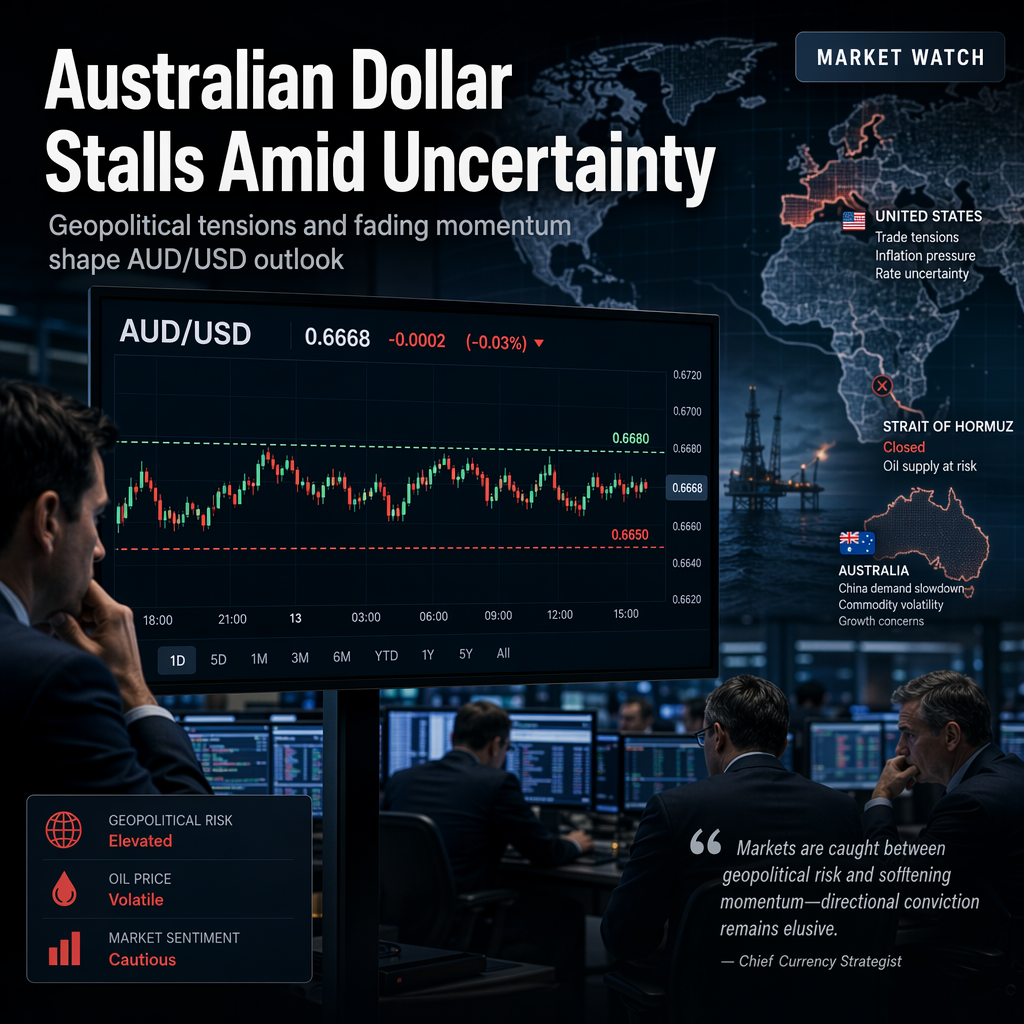
The Australian Dollar (AUD) has been trading in a tight range against the US Dollar (USD), with momentum fading after a tentative upside earlier in the week. According to UOB analysts Quek Ser Leang and Lee Sue Ann, the AUD/USD pair traded within a higher-than-expected range of 0.6934 to 0.6969 on Friday, closing at 0.6950 with a modest gain of 0.12%. However, the pair opened on a softer note on Monday, with expectations for continued range-bound trading between 0.6920 and 0.6960 in the short term. Over the next 1–3 weeks, UOB projects the pair will remain between 0.6890 and 0.6975, maintaining a negative outlook for the next 1–3 months with a focus below 0.6835 toward 0.6707 [1].
Meanwhile, the AUD/USD pair posted marginal losses on Monday, reversing from Friday's highs near 0.6970 but finding support above 0.6923. The broader market context is influenced by rising geopolitical tensions, particularly between the US and Iran, with Tehran announcing the closure of the Strait of Hormuz. This development has boosted crude oil prices and increased pressure on central banks to consider interest rate hikes to contain inflation amid sluggish global growth. Despite these risk-off factors, the US Dollar's weakness has prevented the Aussie from retreating further [2].
Technical analysis indicates that AUD/USD is trading at 0.6941, maintaining a constructive near-term bias after breaking above a descending trendline from early June highs. The four-hour Relative Strength Index is fluctuating around 50, and the MACD is near the zero line, signaling a lack of clear directional bias. For a bullish reversal, the pair would need to break above Friday's highs near 0.6970 and the 38.2% Fibonacci retracement at 0.7020, with further resistance at the mid-June highs around 0.7085. On the downside, support is seen at session lows of 0.6923, the broken trendline at 0.6880, and the June 30 low at 0.6865 [2].
Looking ahead, investors are awaiting the US Consumer Price Index (CPI) release scheduled for Tuesday and the testimony of Federal Reserve Chairman Kevin Warsh to the US Congress, both of which could influence the direction of the AUD/USD pair [2].
CONCLUSION
The Australian Dollar remains range-bound against the US Dollar, with fading momentum and no clear directional bias in the near term. Geopolitical tensions and upcoming US economic data releases are key factors to watch, as they could shift market sentiment and impact the AUD/USD trajectory.