
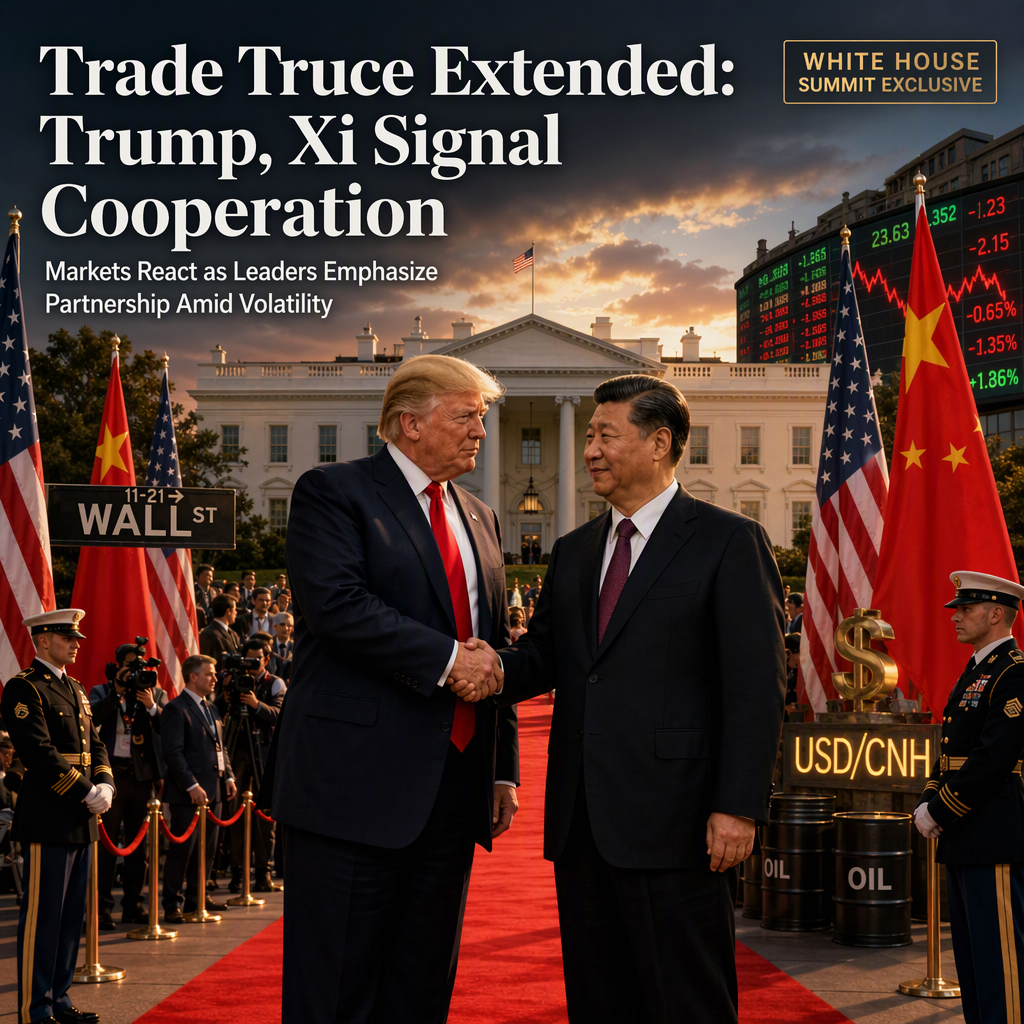
U.S. President Donald Trump and Chinese President Xi Jinping convened their second summit of the year at the White House, focusing on strengthening cooperation between the world's two largest economies amid ongoing tensions over tariffs, rare earth materials, and artificial intelligence. The summit featured elaborate welcoming ceremonies and a state dinner, with both leaders publicly emphasizing the importance of partnership, mutual respect, and trust. Trump highlighted 'tremendous strides' in discussions on security, technology, and 'super intelligence' (AI), as well as efforts to balance trade and provide new market access for American farmers. Xi echoed these sentiments, stressing the need for cooperation and communication, and stating, 'Without our cooperation between the U.S. and China, it'd be hard to solve many of the world's problems' [1][2].
A key outcome of the summit was the extension of the US-China trade truce, which had been set to expire on November 10. According to U.S. Treasury Secretary Bessent, the truce now runs until January 10, falling short of the six months or more that some had anticipated. This extension prevents tariffs on Chinese goods from increasing, offering exporters holding U.S. dollars less incentive to convert them into yuan before January [1][2].
Financial markets remained tense ahead of the summit, with the 10-year U.S. Treasury yield reaching a post-financial-crisis high of 5.12% and the 30-year yield climbing to 5.44%, its highest since 2004. Oil prices also rose above $105 a barrel, contributing to market unease. The USD/CNH currency pair rose for three consecutive sessions, with the largest move occurring on the day the truce extension was announced, reaching 6.7200, its highest since early September. The People's Bank of China halted its daily midpoint firming after ten sessions, and the dollar reached its highest level in nearly two months on expectations of further Federal Reserve rate hikes [1][2].
Xi's remarks at the White House included a pledge to invite 100,000 young Americans to visit China over the next five years, and calls for fair treatment of Chinese firms in the U.S. He also expressed willingness to enhance cooperation on artificial intelligence, counter-narcotics, and law enforcement, and advocated for peaceful coexistence and regular military dialogue. Both leaders acknowledged the broad space for cooperation and the need for positive competition with clear boundaries [2].
CONCLUSION
The Trump-Xi summit resulted in a two-month extension of the US-China trade truce, providing temporary relief from tariff escalation but falling short of longer-term expectations. While both leaders emphasized cooperation and mutual benefit, financial markets remained volatile, reflecting ongoing uncertainty. The summit underscored the importance of continued dialogue but left many substantive issues unresolved.