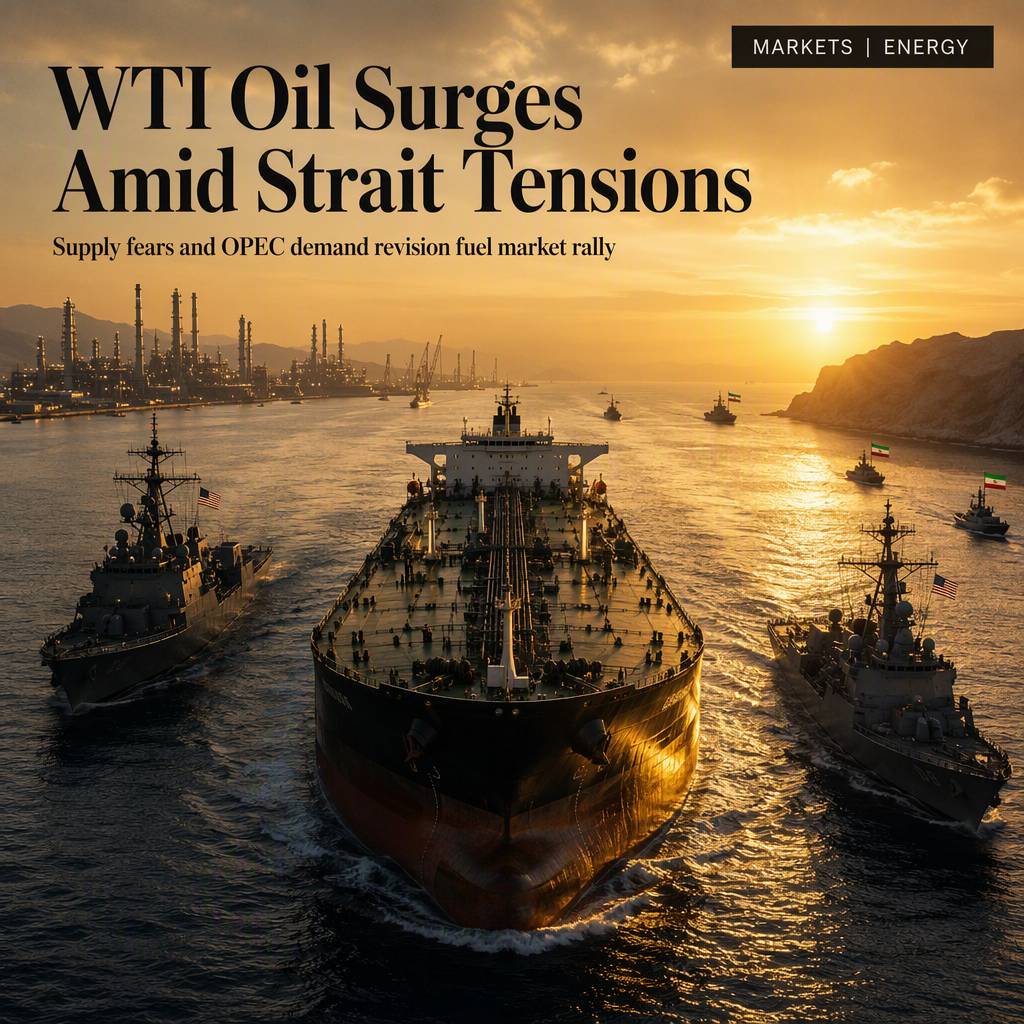
West Texas Intermediate (WTI) crude oil futures on NYMEX traded 0.5% higher at approximately $82.10 during the European session on Thursday, driven by ongoing fears of prolonged energy supply disruptions. These concerns are primarily linked to the situation in the Strait of Hormuz, a critical chokepoint responsible for one-fifth of global energy supply. Both the United States and Iran have claimed control over the Strait, resulting in significantly reduced shipping traffic. According to Kpler data, only six vessels passed through the Strait on August 10, compared to a recent 10-day average of about 11, and a dramatic decline from pre-war levels of 130 to 140 ships daily, as reported by Reuters [1].
US President Donald Trump stated on Truth Social that the US has 'total control' over the Strait of Hormuz, describing the American naval presence as a 'wall of steel' [1]. Meanwhile, OPEC has revised its global oil demand forecast for the current year downward to 580,000 barrels per day (bpd) from a previous estimate of 780,000 bpd [1].
From a technical perspective, WTI is trading above its 20-day Exponential Moving Average (EMA) at $80.07, maintaining a constructive near-term bias. The Relative Strength Index (14) is at 52.55, indicating steady, moderate bullish momentum. Resistance levels are identified at the 38.2% Fibonacci retracement at $82.54 and the 23.6% retracement at $86.11, where profit-taking could occur. On the downside, immediate support is at the 20-day EMA ($80.07), with stronger demand at the 50.0% retracement ($79.65). A break below these levels could expose further supports at $76.75 and $72.64, with $67.40 as a major bearish target if the current bullish structure fails [1].
CONCLUSION
WTI oil prices are being supported by ongoing supply concerns related to the Strait of Hormuz and a downward revision in OPEC's global oil demand forecast. Technical indicators suggest a steady, moderately bullish outlook, though key resistance and support levels could influence near-term price action. Market participants remain focused on geopolitical developments and OPEC's demand outlook for further direction.