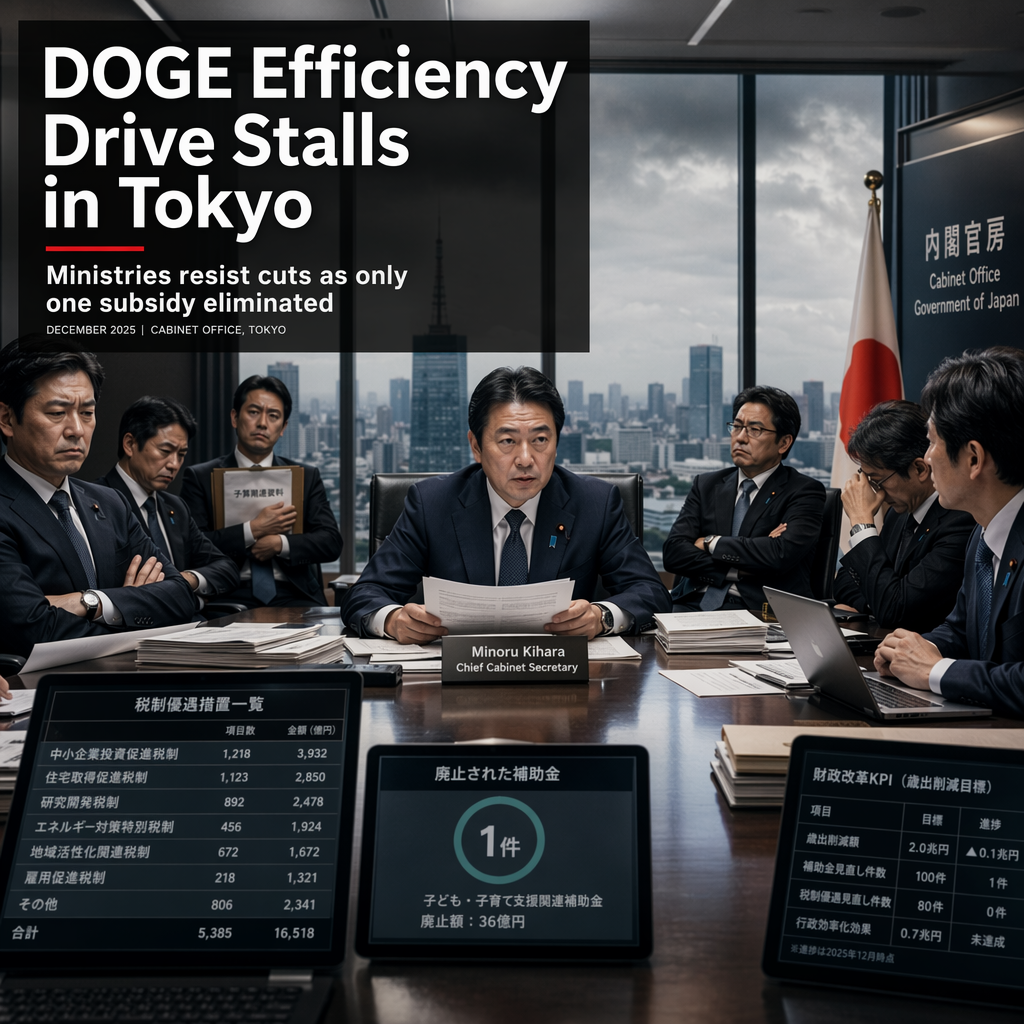
Japan's government efficiency initiative, modeled after the Trump administration's DOGE program, is encountering significant resistance from various ministries as it attempts to eliminate tax breaks and subsidies considered to have limited effectiveness [1]. Out of 120 tax breaks and subsidies under review, only one has been identified for elimination so far, highlighting the slow pace of progress [1]. Chief Cabinet Secretary Minoru Kihara, who is leading the DOGE initiative, participated in a December 2025 meeting focused on reassessing tax measures and subsidy programs [1].
The DOGE initiative's primary objective is to curb Japan's rising public expenditures by cutting or scaling back government programs that are seen as having limited economic or social impact [1]. However, ministries are reportedly defending their budgets, making it difficult to achieve substantial reductions in spending [1]. This resistance from entrenched interests and bureaucratic structures is cited as a major obstacle to the initiative's success [1].
The limited progress to date has raised concerns about the DOGE team's ability to meet its stated goals of streamlining government spending [1]. No market reactions or analyst opinions are discussed in the article [1].
CONCLUSION
Japan's DOGE government efficiency initiative has made minimal headway, with only one out of 120 targeted tax breaks and subsidies slated for elimination. Persistent resistance from ministries underscores the challenges of reducing public spending, casting doubt on the initiative's ability to achieve its objectives.