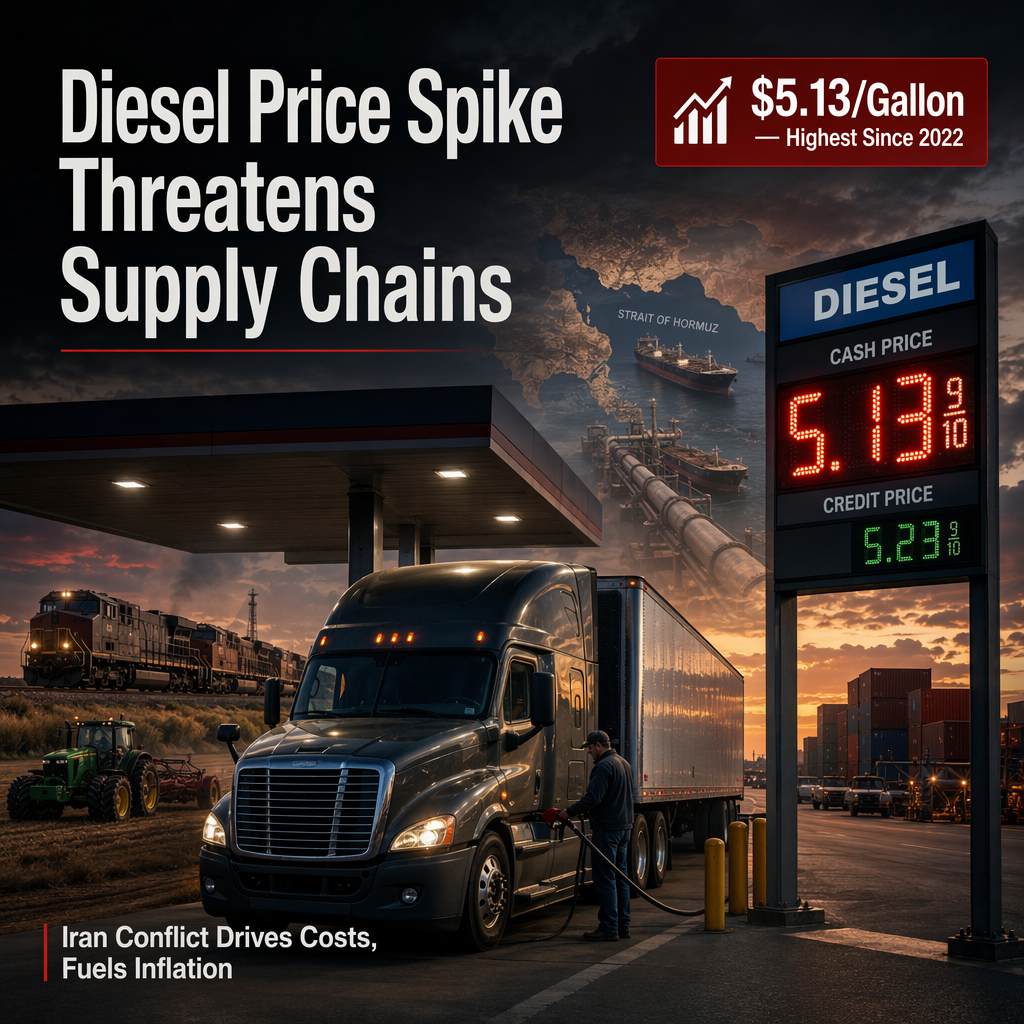
The recent conflict in Iran has led to a significant surge in diesel prices, which have risen from an average of $3.56 per gallon in January 2025 to $5.13, according to the U.S. Energy Information Administration [1]. Diesel, often overlooked compared to gasoline, is critical to the U.S. economy as it powers trucks, farms, freight trains, and heavy equipment essential for the supply chain [1]. The increase in diesel prices is expected to raise transportation costs for businesses, which economists warn could ripple through the economy and push up the cost of everyday goods, particularly food and groceries [1].
Bernard Yaros, lead U.S. economist for Oxford Economics, emphasized the inflationary risks posed by rising diesel prices, noting that diesel is integral to every layer of food production, from powering irrigation pumps and tractors to transporting food to grocery stores [1]. An anonymous energy industry source attributed the majority of the diesel price movement over the past five months directly to the Iran conflict and the closure of the Strait of Hormuz, a critical energy chokepoint through which roughly 20 million barrels of oil pass daily [1].
The source further explained that disruptions in the Strait of Hormuz can quickly tighten fuel supplies and drive diesel prices higher, with the effects persisting due to the lag in refinery processing and distribution [1]. Even if Middle East tensions ease, diesel prices may not return to pre-conflict levels quickly, meaning higher costs could continue to affect consumers for some time [1].
CONCLUSION
The surge in diesel prices following the Iran conflict is having a pronounced impact on U.S. supply chains and inflation, with economists and industry sources warning of continued elevated costs for businesses and consumers. The situation underscores the vulnerability of global energy markets to geopolitical disruptions, particularly at key chokepoints like the Strait of Hormuz.