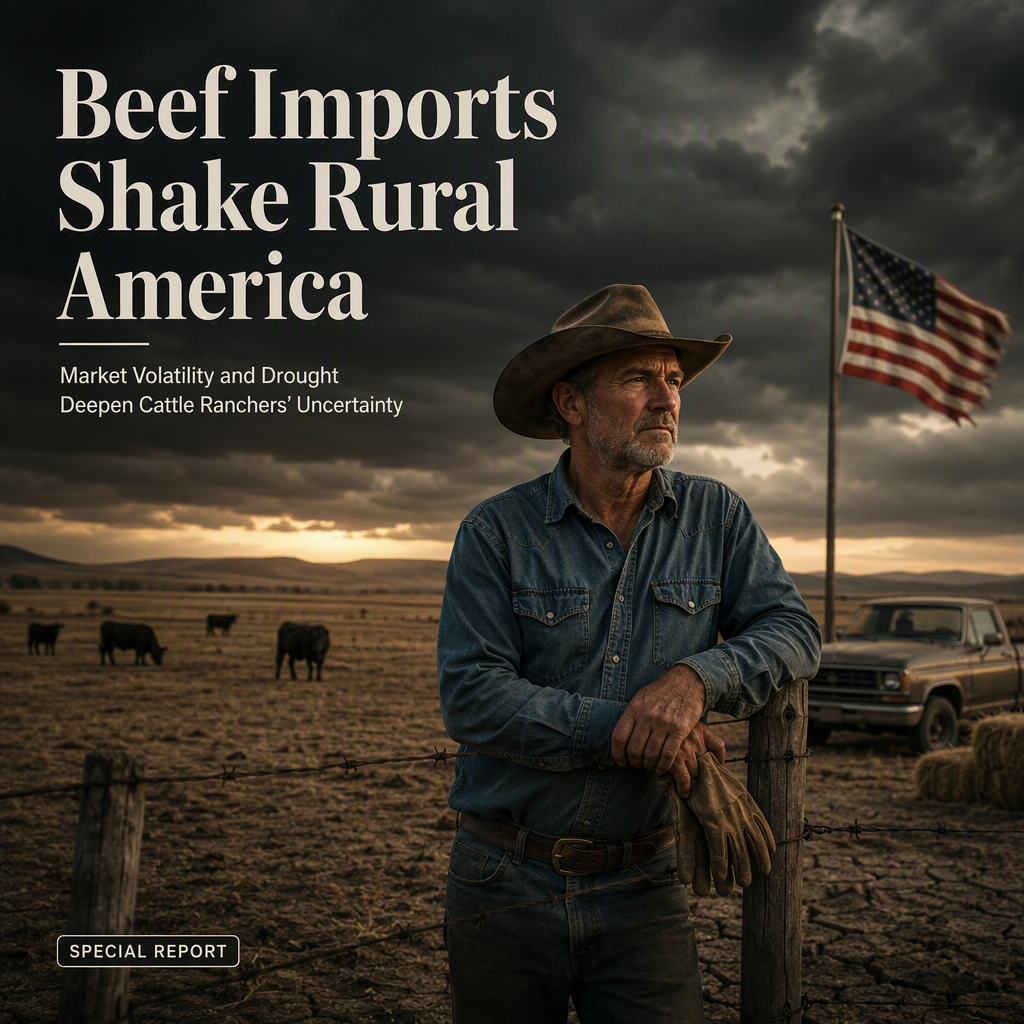
President Donald Trump announced in August that the U.S. would import 300,000 metric tons of foreign beef trim, which amounts to over half a billion pounds, from various countries. This move is intended to help cut grocery store costs for Americans ahead of the November midterm elections, but it has caused significant unrest among cattle ranchers, particularly in red states that typically support the president's agenda [1].
Secretary of Agriculture Brooke Rollins acknowledged the market volatility caused by the beef import decision, expressing sympathy for ranchers affected by the policy. Greg Gunthorp, a cattle farmer in Indiana, stated that ranchers have lost substantial equity and that markets are down significantly over the past month. He described the current uncertainty as making it difficult for ranchers to decide whether to retain heifers for breeding or sell them as feeder cattle [1].
The situation is further complicated by the fact that U.S. cattle herds are at their lowest levels in 75 years, partly due to a prolonged drought that has reduced herd populations in the Midwest. Rising diesel costs, attributed to the war in Iran, have also squeezed ranchers' margins, forcing them to raise prices. Jaclyn Wilson, a rancher in Nebraska, emphasized that the actual amount of beef imported will be critical in determining the full impact on the industry. She noted that market volatility increases whenever the administration makes significant announcements about beef prices, which can be devastating for producers currently selling calves or yearlings [1].
Additionally, Curtis Schroder, a rancher in Colorado, has been forced to reduce planted acreage due to drought, and the state has activated Phase 2 of its Drought Response Plan as of March 2026. These compounding factors have left ranchers facing heightened uncertainty and financial pressure [1].
CONCLUSION
The Trump administration's decision to import large quantities of foreign beef has triggered significant market volatility and concern among U.S. cattle ranchers, especially as they contend with historically low herd levels and rising operational costs. The policy's full impact remains uncertain, but ranchers and industry stakeholders are bracing for continued instability in the months ahead.