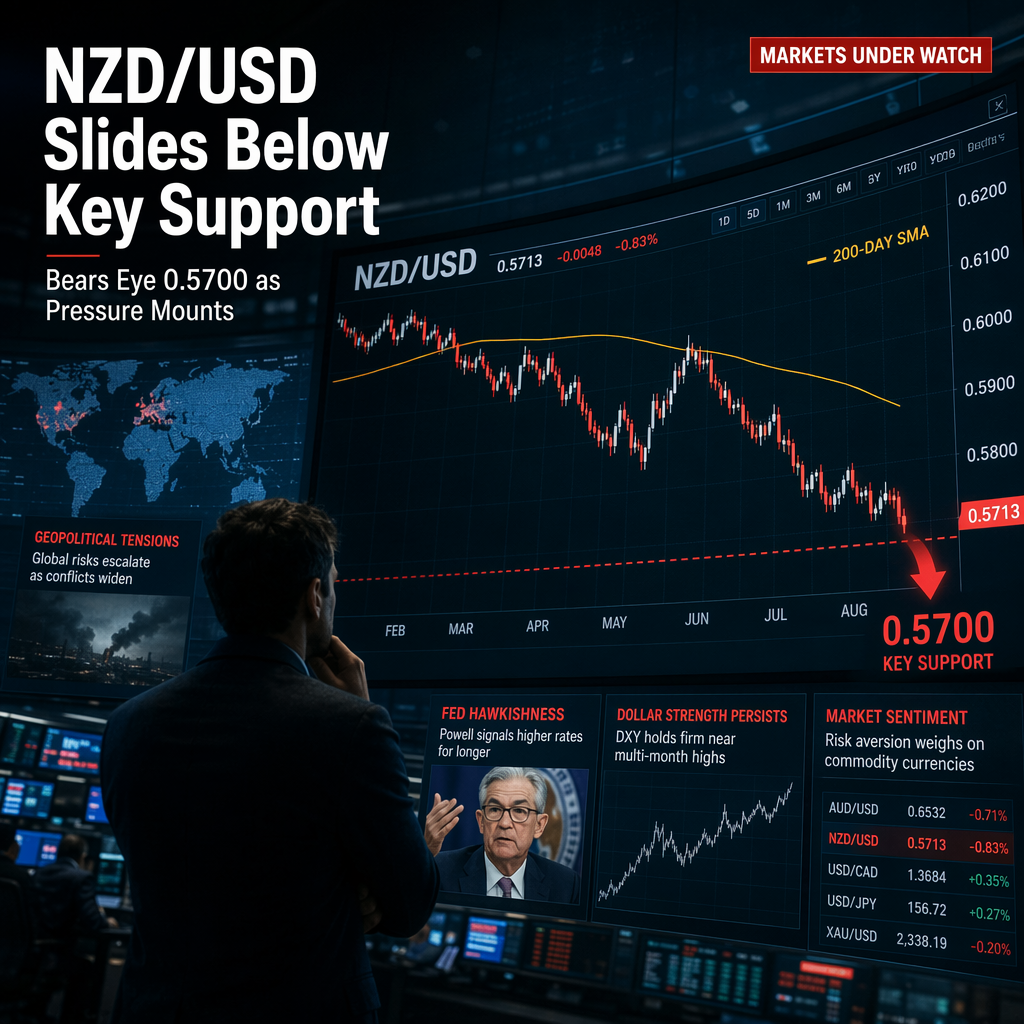
The New Zealand Dollar (NZD) weakened during Monday’s North American session, declining by 0.12% against the US Dollar (USD) as the Greenback strengthened versus most G8 currencies. This move was attributed to rising geopolitical tensions and hawkish remarks from a Federal Reserve Governor, which supported the USD broadly [1]. At the time of reporting, NZD/USD traded at 0.5754, down from its daily high of 0.5789 [1].
Technically, NZD/USD remains in a downward trend, trading below its 200-day Simple Moving Average (SMA) at 0.5819 for the twenty-fifth consecutive trading day, despite the Reserve Bank of New Zealand (RBNZ) having raised rates and signaling openness to further tightening [1]. The Relative Strength Index (RSI) indicates that buyers are present, but also suggests a period of consolidation may be ahead [1].
Key support levels for NZD/USD are identified at the psychological 0.5700 mark, with further downside targets at the July 8 low of 0.5672, then 0.5650, and ultimately 0.5600 if bearish momentum continues [1]. On the upside, resistance is seen at the July 10 high of 0.5794, followed by the 0.5800 level, and a confluence of the 50- and 200-day SMAs around 0.5812-0.5819, with the 100-day SMA at 0.5835 and the 0.5850 mark as further resistance [1].
In terms of broader currency performance, the New Zealand Dollar was the strongest against the Swiss Franc, gaining 0.53%, but lost 0.13% against the US Dollar on the day [1].
CONCLUSION
NZD/USD continues to face downward pressure, remaining below key technical levels despite recent RBNZ rate hikes. The market is closely watching the 0.5700 support, with further downside possible if bearish momentum persists. The overall sentiment remains cautious amid a stronger US Dollar and ongoing geopolitical uncertainties.