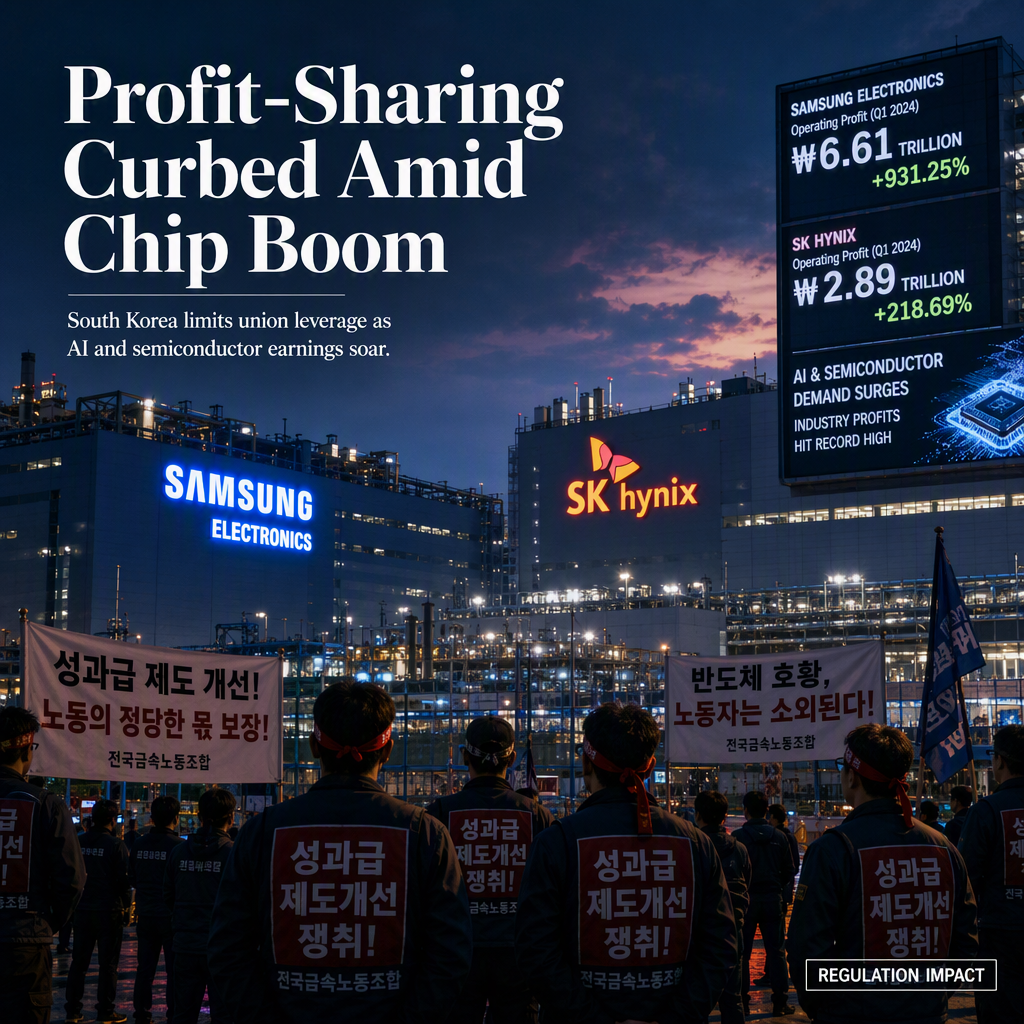
The South Korean government has introduced new guidelines stating that companies are not required to negotiate profit-sharing with workers, a move that could diminish the bargaining power of unions seeking a share of the record profits generated by the country's booming semiconductor and artificial intelligence sectors [1]. This regulatory shift comes at a time when South Korean chipmakers are reporting unprecedented financial results, with Samsung Electronics announcing a record $79 billion shareholder return and SK Hynix unveiling a $28.6 billion buyback plan to support its stock price [1].
The new rules clarify that while companies may voluntarily discuss profit-sharing with unions, there is no legal obligation to do so, potentially impacting ongoing labor negotiations and future compensation models [1]. This development follows recent protests by members of the Samsung Electronics labor union at the company's Pyeongtaek semiconductor plant, underscoring rising tensions between workers and management as the industry benefits from surging demand for advanced chips and AI technologies [1].
Market participants and analysts are closely monitoring the situation, with some suggesting that reduced union leverage could help maintain or improve profit margins at major chipmakers if wage increases are restrained [1]. The regulatory change is also seen as a factor that could influence cost structures in the tech sector, which is under scrutiny as companies like SK Hynix invest in global expansion, including the construction of its first high-bandwidth memory (HBM) chip packaging plant in the US [1].
The South Korean won has recently strengthened, supported by SK Hynix's US listing and the repatriation of corporate funds, while export data shows South Korea and Taiwan surpassing Japan in export performance for the first time, largely driven by the AI boom [1]. Industry observers note that the evolving legal environment may shape future labor disputes and compensation strategies as chipmakers continue to expand and invest in advanced manufacturing capabilities [1].
CONCLUSION
South Korea's new guidelines limiting union leverage over profit-sharing come as the nation's chipmakers post record earnings and expand globally. The regulatory change is expected to impact labor negotiations and could support profit margins by restraining wage-related costs. Investors and analysts are watching closely for further developments in labor relations and their effects on the tech sector's financial performance.