
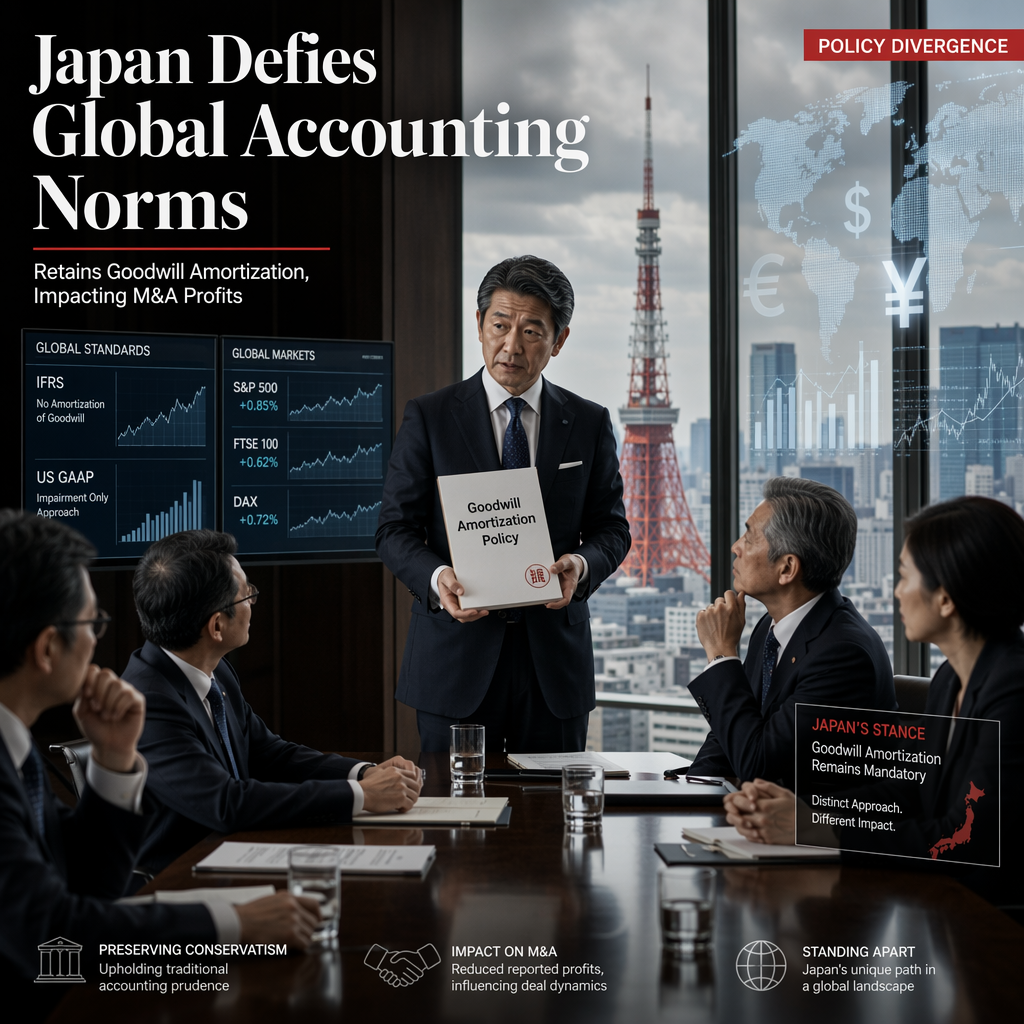
Japan has decided to retain its current accounting rule requiring the systematic amortization of goodwill following mergers and acquisitions, making it a global outlier compared to international standards that favor an impairment-only approach [1]. While most markets in the U.S. and Europe only record impairment losses when goodwill is deemed permanently reduced, Japanese companies must write off goodwill over a set period, which can result in lower reported profits and complicate comparisons with foreign peers [1].
The decision to maintain this rule stems from concerns among market participants that a shift to the international impairment-only model could lead to sudden recognition of large impairment losses, severely impacting earnings and share prices [1]. A senior official at the Financial Services Agency stated, "Maintaining the current rule ensures that any overpayment in M&A deals is gradually recognized," but acknowledged that it also penalizes Japanese companies' earnings relative to overseas rivals [1].
This ongoing adherence to goodwill amortization particularly affects Japanese companies engaged in cross-border M&A, as they must factor in these charges when forecasting future earnings, often resulting in more conservative profit projections than their Western counterparts [1]. Analysts note that this accounting difference can influence stock valuations and investor sentiment, especially during periods of active M&A [1].
Despite ongoing debate among financial regulators, industry groups, and accounting experts, there is no indication that Japan will shift to the impairment-only model in the near term. The current framework is seen by some as offering greater transparency and risk management, while others argue it hinders fair comparison and global competitiveness [1].
CONCLUSION
Japan's decision to maintain goodwill amortization sets it apart from global peers and may continue to affect the comparability and valuation of Japanese companies, especially in the context of M&A activity. While the rule is viewed as conservative and risk-averse, it could dampen earnings and investor sentiment relative to international standards.