
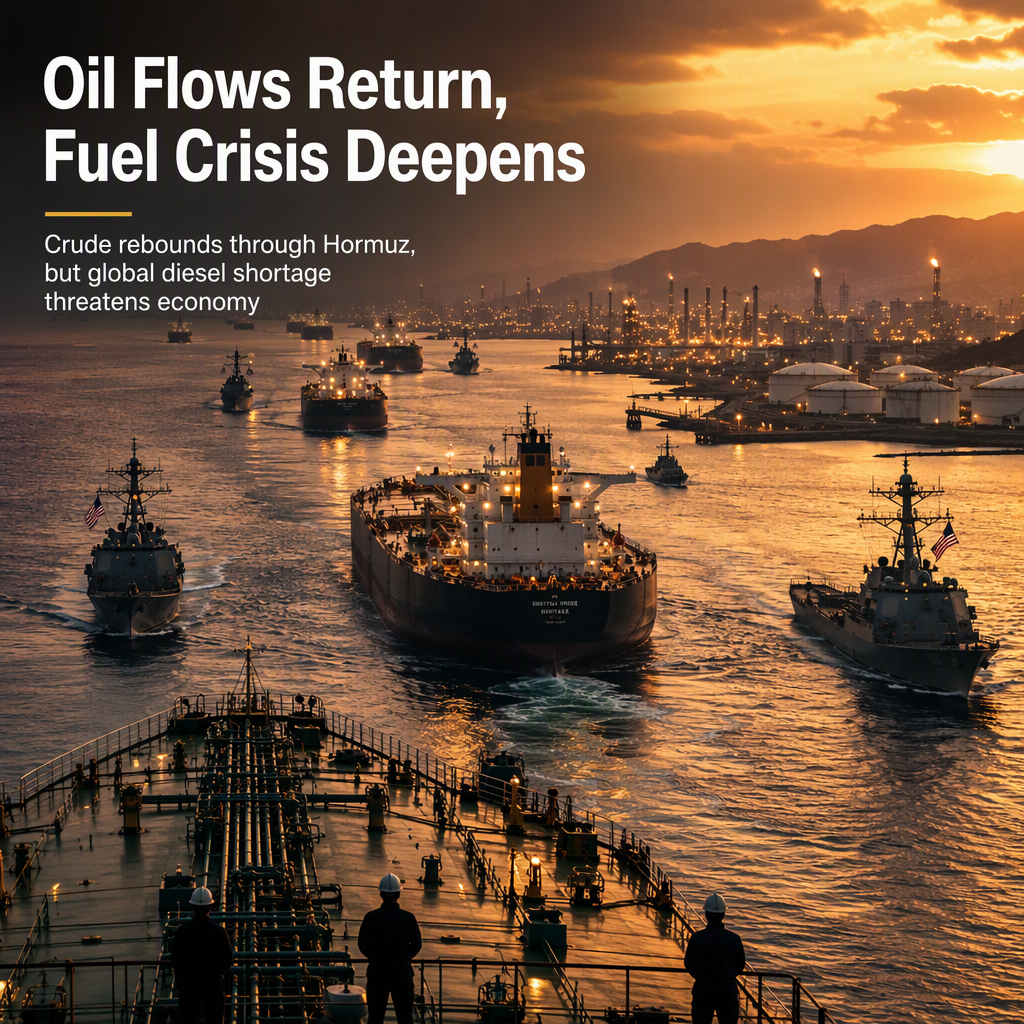
Crude oil exports through the Strait of Hormuz have returned to prewar levels, reaching a seven-day average of 13.5 million barrels per day as of Monday, according to data from Kpler. This matches the prewar baseline for shipments through the strait, aided by U.S. military escorts and redirected pipeline flows [1]. Crude oil shipments from the broader Middle East region, including the Persian Gulf and Red Sea, have even surpassed prewar levels, hitting a seven-day average of 19.5 million bpd compared to a baseline of about 17 million bpd [1].
Despite the normalization of crude flows, refined product shipments remain severely constrained. Refined products shipped through Hormuz are at a seven-day average of 677,000 bpd, a sharp decline from 3.6 million bpd before the war, according to Kpler [1]. As a result, combined crude and product shipments stand at a seven-day average of 14.2 million bpd, which is about 80% of the prewar baseline of 17 million bpd [1].
This shortfall in refined product supply has led to a global fuel crisis, with diesel prices in the U.S. at or near record highs, posing a significant threat to the health of the economy [1]. Francisco Blanch, head of global commodities at Bank of America, identified the diesel market as the biggest source of pain [1]. President Donald Trump is reportedly considering an export ban in response to political pressure from Republican lawmakers ahead of the midterm elections [1].
Iran's crude oil exports have plummeted due to a U.S. Navy blockade and increased sanctions, as the Trump administration seeks to force Tehran into a settlement by targeting its main source of revenue [1]. Kpler data confirms the sharp decline in Iranian exports [1].
CONCLUSION
While crude oil shipments through the Strait of Hormuz have rebounded to prewar levels, the ongoing constraints on refined product flows are fueling a global diesel shortage and economic risks. The market faces high uncertainty as policymakers consider intervention and Iranian exports remain suppressed by U.S. actions.