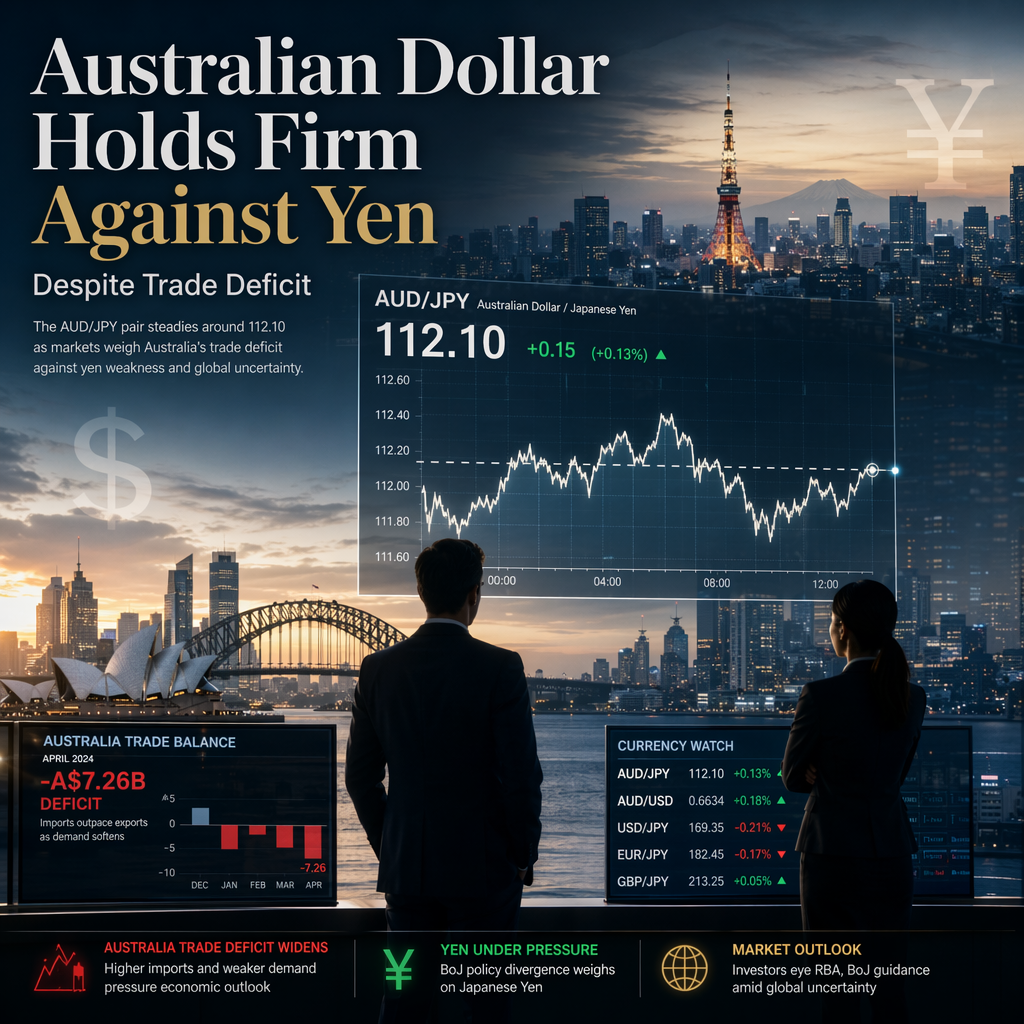
The Australian Dollar (AUD) remained stable against the Japanese Yen (JPY), with the AUD/JPY pair trading around 112.10 during Asian hours on Thursday after recovering earlier losses, despite the release of disappointing Australian trade data for May [1]. According to the Australian Bureau of Statistics, Australia's trade balance unexpectedly swung into a deficit of A$3,018 million in May, a sharp reversal from the previous month's revised surplus of A$1,383 million and well below the market consensus, which had anticipated a surplus of A$2,200 million [1]. This negative result was primarily attributed to a 6.9% month-on-month decline in exports, coupled with a 2.6% increase in imports [1].
Despite the weak trade data, the AUD/JPY cross showed little movement as the Japanese Yen remained under significant pressure. The JPY's weakness persisted even as Japan's Q2 Tankan Large Manufacturing Index rose to 22 from 17 previously, marking its highest level in eight years and strengthening the case for further Bank of Japan (BoJ) interest rate hikes later in the year [1]. The JPY continues to trade near its weakest level against the US Dollar in four decades, keeping traders alert for potential government intervention, especially ahead of a US public holiday when thinner market liquidity could amplify any official action [1].
Japanese Finance Minister Satsuki Katayama reiterated that authorities are prepared to respond appropriately to currency market developments at any time, reinforcing market caution [1]. The combination of a weak Australian trade balance and ongoing JPY weakness has kept the AUD/JPY pair relatively stable, with market participants closely monitoring both central bank actions and potential government interventions [1].
CONCLUSION
Despite a significant and unexpected trade deficit in Australia, the AUD/JPY pair remained steady as the Japanese Yen continued to face downward pressure. Market participants are watching for potential interventions and central bank moves, with the overall sentiment remaining cautious amid ongoing currency volatility.