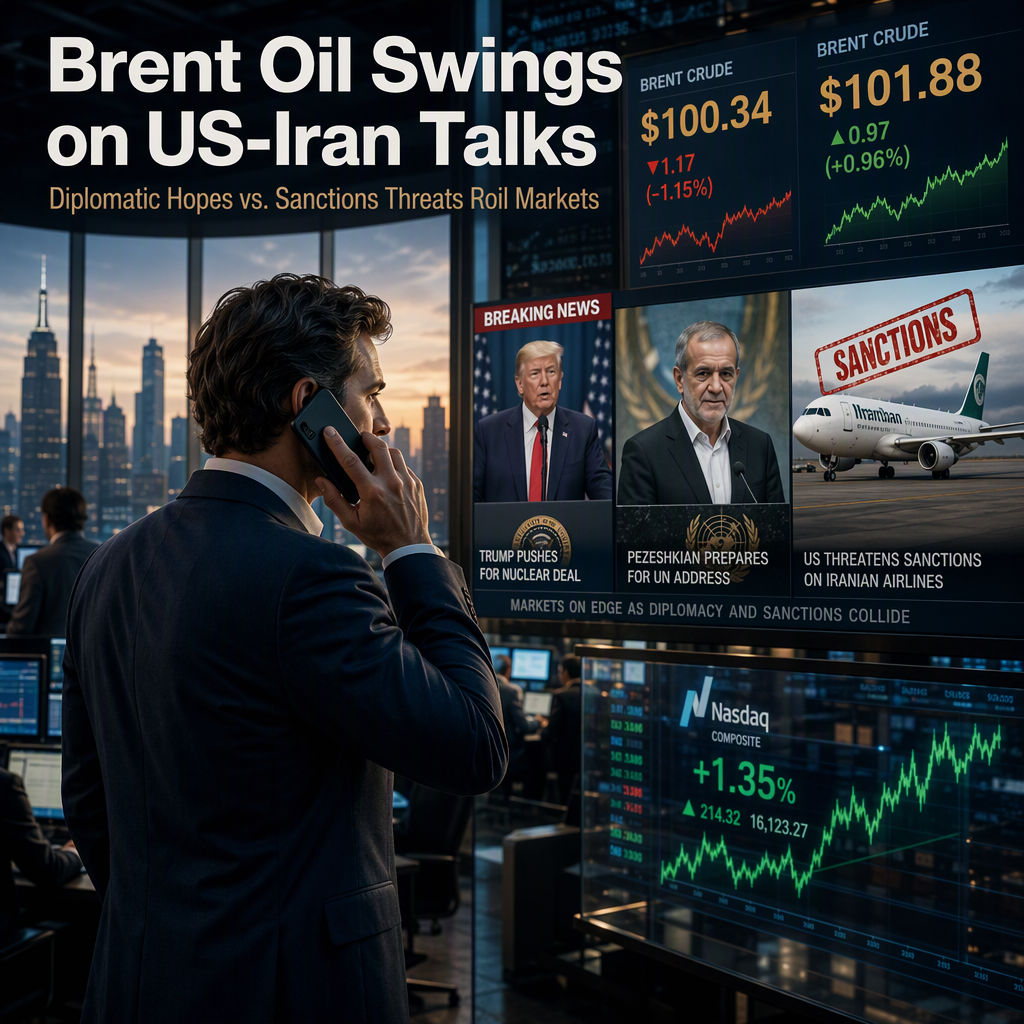
Brent crude oil prices experienced notable volatility as hopes for a diplomatic solution in the Middle East initially drove prices lower, with Brent briefly falling below $100 per barrel for the first time in nine trading sessions before closing at $100.34/bbl [1]. This pullback was attributed to positive headlines, including comments from President Trump expressing openness to meeting Iran’s President at the United Nations, which raised expectations for a potential deal between the US and Iran [1]. However, renewed sanctions risks limited the decline, and Brent rebounded to above $101/bbl, supported by news that US Treasury Secretary Scott Bessent announced all Iranian airlines would be shut down from Wednesday, with restrictions on fuel, landing services, and ticket sales for any entity interacting with Iranian carriers [1][3]. As of 1:37 a.m. ET, Brent crude futures for November delivery were up 1.53% at $101.88 a barrel, while US WTI futures for October rose 1.5% to $97.22 per barrel [3].
The decline in oil prices triggered a broad-based risk-on session in equities, as described by Danske Bank, with cyclicals led by technology outperforming. The Nasdaq reached a record high, and the MSCI World index moved to within 1% of its peak, supported by robust growth and earnings [2]. Lower energy costs eased inflation expectations and pushed central bank pricing more dovishly, improving market confidence [2]. Technology sector earnings estimates for 2026 have been revised almost 45% higher, while health care estimates have been cut by around 5%, making technology relatively cheaper despite outperforming health care by nearly 30% year-to-date [2]. Asian and European markets were also pointing higher following the strong US session, although US markets were more mixed as oil edged higher again [2].
Investors remain focused on diplomatic developments, with Iranian President Masoud Pezeshkian scheduled to address the United Nations and hold talks with various leaders from September 22 to 26 and 28 [3]. Lukman Otunuga, head of market research at FXTM, noted that confirmation of direct talks between Washington and Tehran could place additional selling pressure on oil prices by improving expectations for regional supply. Conversely, renewed escalation could trigger a significant response from Tehran, potentially pushing crude prices higher [3].
According to [1], optimism around diplomacy drove the initial pullback in oil, but [3] reports that the US sanctions threat against Iranian airlines contributed to the rebound in prices. Both sources agree that market attention is likely to remain focused on diplomatic and geopolitical developments in the near term.
CONCLUSION
Brent crude prices have been highly sensitive to diplomatic signals and US-Iran tensions, with initial optimism driving prices lower and subsequent sanctions threats reversing the trend. Equity markets responded positively to lower energy costs, particularly in the technology sector. The market remains alert to upcoming diplomatic events and potential escalation, which could further impact oil prices and broader asset classes.