
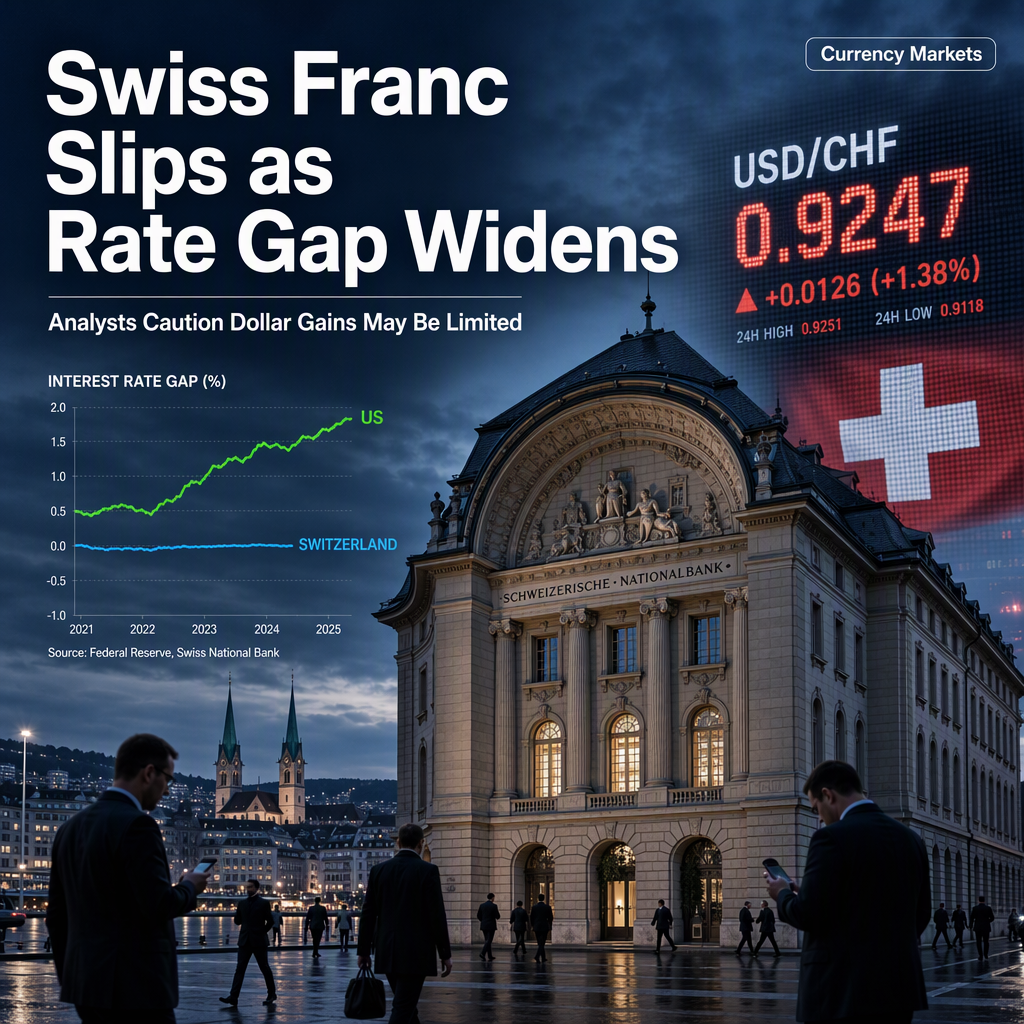
The Swiss franc (CHF) has come under sustained pressure against the US Dollar (USD), with USD/CHF holding firm around 0.8285 on Friday, near levels last seen in May 2025, and on track for a fourth consecutive weekly gain [1]. This weakness is attributed to the widening interest rate gap between the Federal Reserve (Fed) and the Swiss National Bank (SNB). The SNB recently left its policy rate unchanged at 0%, citing an appropriate stance to maintain inflation within a stable range and support economic development, even as it acknowledged a slight increase in medium-term inflationary pressure and raised its inflation forecast [1]. In contrast, the Fed raised its benchmark rate by 25 basis points last week to a range of 3.75%-4.00%, with 16 of 18 policymakers expecting at least one more hike this year. Fed officials, including New York Fed President John Williams, have signaled the possibility of further tightening to bring inflation back to target [1].
The US Dollar Index (DXY) trades around 101 after reaching a two-month high of 101.40, while the 10-year US Treasury yield remains elevated near 5.17%, just below Thursday’s peak of 5.22%, the highest since 2007 [1]. The CME FedWatch Tool indicates a 66% probability of another Fed rate increase at the October meeting, with upcoming US economic data releases such as the PCE inflation report, ISM Manufacturing PMI, and Nonfarm Payrolls (NFP) in focus [1].
Analysts at UOB, Quek Ser Leang and Lee Sue Ann, note that USD/CHF surged over the past two days, reaching a high of 0.8296. While strong momentum points to further USD strength, they caution that deeply overbought conditions are likely to cap gains in the 0.8305–0.8330 area. Short-term support is identified at 0.8270 and 0.8255, with a breach of 0.8255 signaling an easing of upward pressure. UOB revised its outlook from positive to neutral, expecting USD/CHF to trade in a range, with upside risk remaining as long as USD stays above 0.8225 [2].
Additionally, the SNB’s 0% policy rate has increased the franc’s appeal as a funding currency for carry trades, adding to selling pressure [1]. Middle East tensions, particularly US-Iran developments and the closure of the Strait of Hormuz, remain a background risk for markets [1].
Year-to-date, the Swiss franc has underperformed most major currencies, though it has been strongest against the Canadian Dollar [1].
CONCLUSION
The Swiss franc continues to weaken against the US Dollar due to the widening Fed-SNB interest rate gap and the SNB’s unchanged policy stance. However, analysts suggest that further USD/CHF gains may be limited by overbought technical conditions, with resistance seen in the 0.8305–0.8330 area. Market participants are closely watching upcoming US economic data and Fed policy signals for further direction.