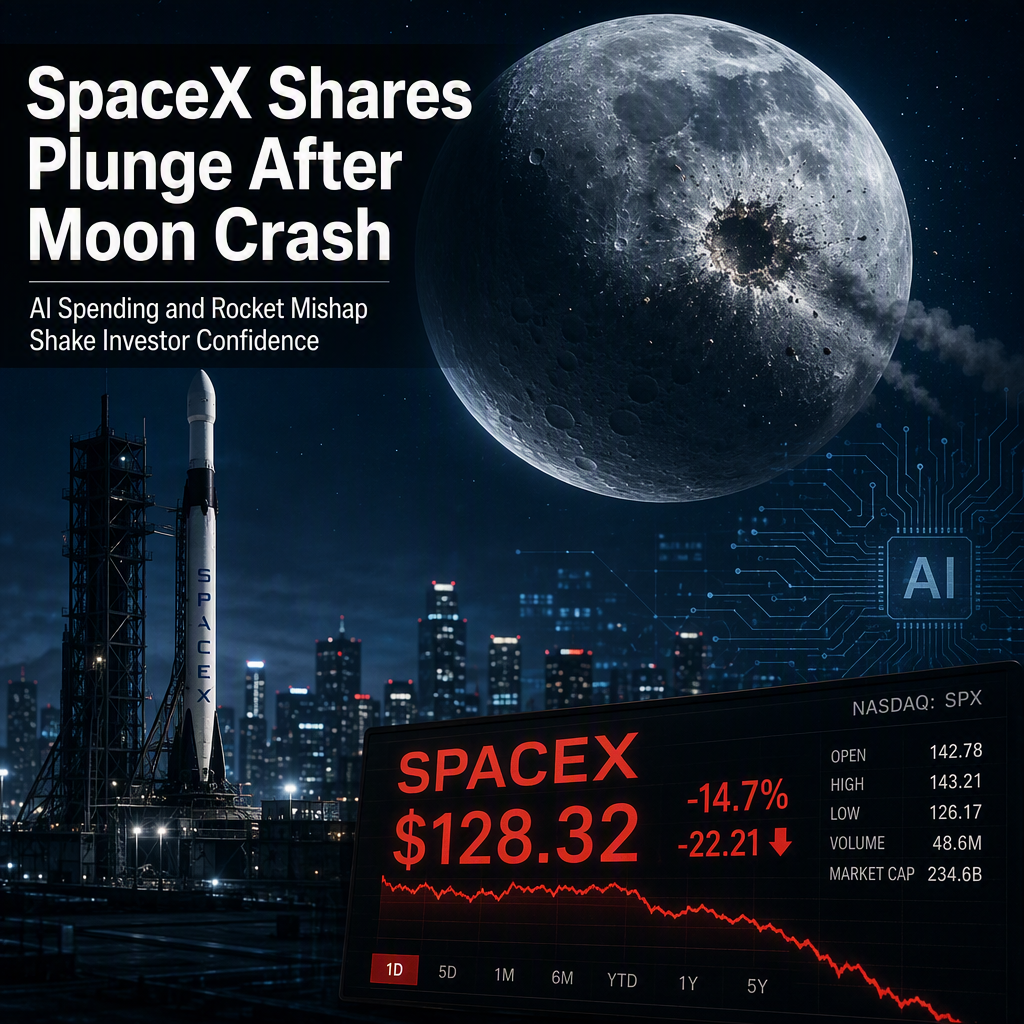
Shares of SpaceX fell sharply by more than 7% in midday trading on Wednesday, coinciding with the reported crash of a four-tonne section of a SpaceX Falcon 9 rocket into the Moon around 2:35 a.m. E.T., though the impact has yet to be confirmed [1]. The rocket part, which was shed after launching Firefly Aerospace's Blue Ghost lunar lander and Japan-based ispace's Resilience lander on January 15, 2025, was traveling at over 5,400 miles per hour when it reportedly struck the lunar surface [1].
The sell-off in SpaceX stock wiped out most of Tuesday's pre-results gains and pushed the price further below the company's $135 IPO price, following its first quarterly earnings report as a public company [1]. Despite reporting a 92% surge in revenue to $7.81 billion—beating consensus estimates of $6.93 billion—and posting narrower losses than forecast, investors were alarmed by a sixfold increase in capital expenditure to $18.4 billion in Q2, with the majority allocated to artificial intelligence initiatives [1].
Analysts described the Moon crash as a "good metaphor" for SpaceX's share price performance, with Chris Beauchamp of IG and Russ Mould of AJ Bell both highlighting the symbolic timing of the incident and the market's negative reaction to the company's aggressive AI spending [1]. Mould noted that the scale of SpaceX's AI outlays, which far exceeded analyst expectations, was a key factor behind the stock's backlash, especially since SpaceX does not yet generate meaningful levels of cash flow [1].
Starlink, SpaceX's satellite internet division, remains the company's primary revenue driver and is currently the only profitable segment, according to Beauchamp [1]. However, further price pressure is expected as investors seek a more secure path to overall profitability [1]. Musk's comments about potentially expanding Starlink into terrestrial networks to compete with T-Mobile, AT&T, and Verizon also "sparked some nervousness" among those companies, according to Mould [1].
CONCLUSION
SpaceX's share price suffered a significant decline as investors reacted to the company's soaring AI capital expenditures and the coincidental Moon crash of a Falcon 9 rocket part. Despite strong revenue growth and Starlink's profitability, concerns over cash flow and the scale of AI investments are weighing heavily on market sentiment. The company faces ongoing pressure to demonstrate a clearer path to sustainable profitability.