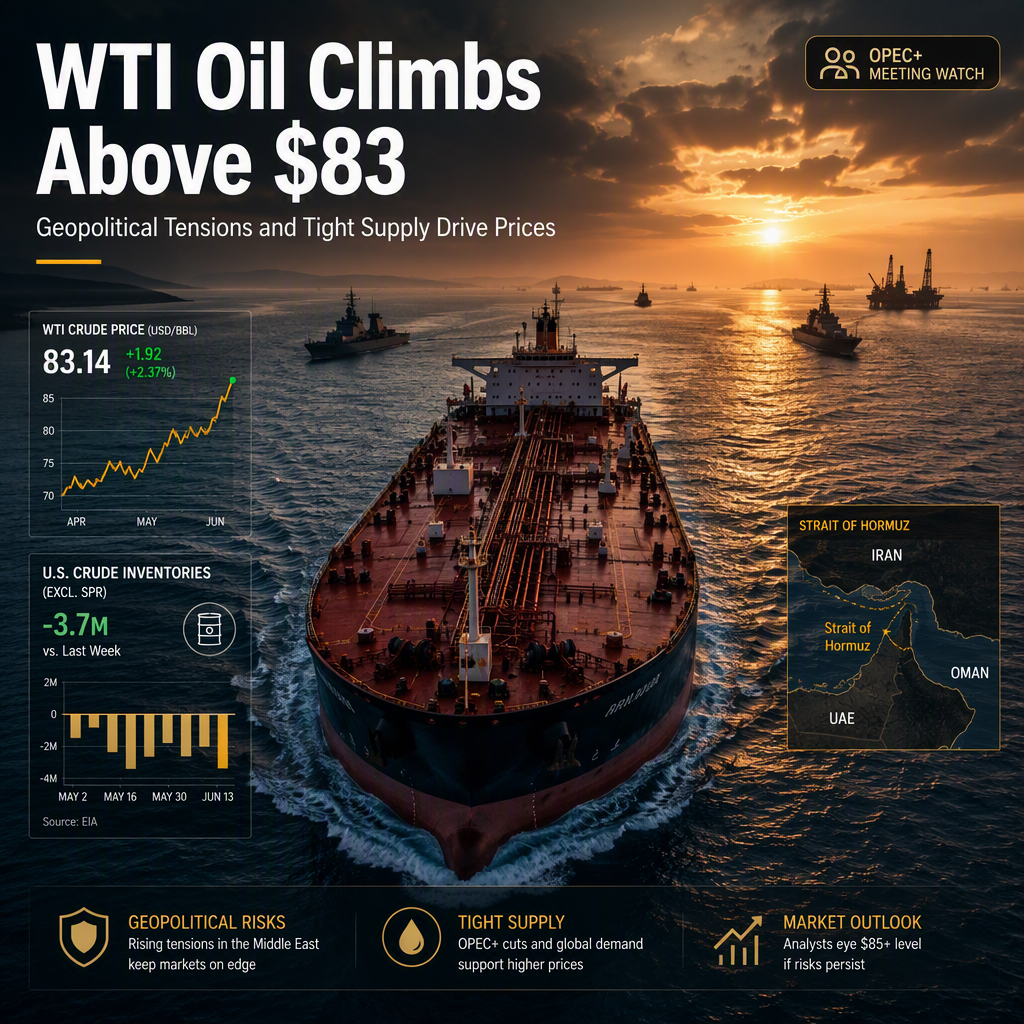
West Texas Intermediate (WTI) US Oil prices climbed 0.76% to approximately $83.30 on Friday, recovering from an intraday low below $80.00 and erasing some of the week's earlier losses. This rebound positions WTI to close the week near its opening levels, following a bearish gap at the start of the week [1]. The improved market sentiment is attributed to a reassessment of shipping disruptions through the Strait of Hormuz, with CommBank reporting that oil tanker traffic has recovered to around 30%-35% of pre-conflict levels. A broader normalization of these flows could alleviate pressure on global supply, contributing to recent market volatility [1].
Despite this partial recovery, geopolitical risks continue to underpin oil prices. Persistent tensions between Iran and the United States, along with threats to energy infrastructure and key shipping routes, are maintaining a geopolitical risk premium in the market [1]. The latest US Energy Information Administration (EIA) data revealed a larger-than-expected decline in US crude oil inventories, underscoring a tight market and relatively low stock levels [1].
Investors are closely watching the upcoming OPEC+ meeting scheduled for this weekend. Several analysts anticipate that the group may approve a modest increase in September production targets. However, they emphasize that the actual implementation of these supply increases will depend on the Strait of Hormuz remaining open and Gulf producers being able to fully restore export flows [1].
TD Securities highlights that supply remains constrained in energy markets, with flows via Hormuz, Bab el-Mandeb, and Russia all materially limited, resulting in global seaborne exports near their lowest levels since the onset of the conflict. This tightening is seen as supportive of further upside in crude oil prices, although market positioning remains mixed. TD notes that CTAs (Commodity Trading Advisors) could become buyers of Brent crude above $91.60 per barrel, while currently selling RBOB gasoline [1]. Commerzbank adds that the ongoing regional escalation in the Middle East continues to pressure the global oil market and is likely to remain a key driver of commodity market sentiment and oil prices in the coming weeks. In the absence of clear de-escalation signals, Commerzbank expects oil prices to remain elevated for the time being [1].
CONCLUSION
WTI oil prices have rebounded above $83, supported by ongoing geopolitical risks, tight supply, and anticipation of the OPEC+ meeting. Analysts expect oil prices to remain elevated due to constrained flows and persistent regional tensions. Market participants are closely monitoring both the outcome of the OPEC+ meeting and developments in the Middle East for further direction.