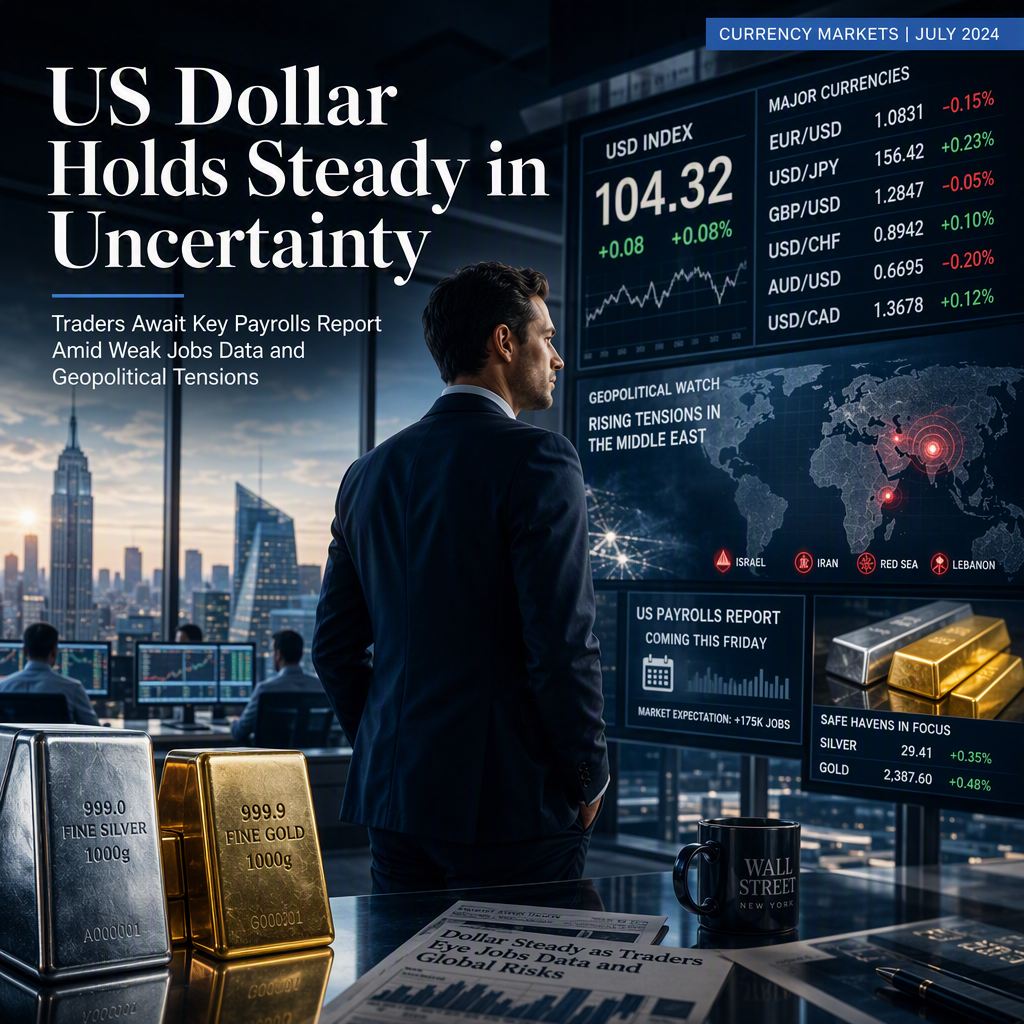
On Thursday, the US Dollar (USD) stabilized after a period of weakness triggered by disappointing US macroeconomic data and renewed geopolitical uncertainty in the Middle East. The ADP Employment Change for July came in at 44,000, significantly below both the previous month's revised figure of 98,000 and the market expectation of 70,000, signaling a slowdown in private sector job creation [1][3][4][5]. The ISM Services PMI registered 54.1, missing the forecast of 54.5 but showing steady momentum compared to June's 54.0 [1][4]. These data releases have led traders to scale back expectations for a Federal Reserve rate hike in September, as evidenced by falling US Treasury yields—10-year yields dropped about 10 basis points from last week's highs, and 2-year yields are 18 basis points below July's peak [6]. Minneapolis Fed President Neel Kashkari also adopted a less aggressive tone, emphasizing the goal of reducing inflation without deliberately slowing the economy and not calling for a dramatic rate increase [1].
Currency markets reflected these developments. The USD Index posted marginal daily gains but remained below 100.00 [1]. Against major currencies, the USD was the weakest versus the Australian Dollar this week, but strongest against the Australian Dollar on Thursday [1][2]. The USD/CHF pair snapped a two-day losing streak, trading around 0.8080–0.8085, up nearly 0.15% for the day, with technical indicators suggesting room for further gains if resistance at 0.8219 is breached [2]. The Australian Dollar retreated from three-week highs, despite a positive trade balance report showing an AUD 1.929 million surplus versus expectations of an AUD 1.1 million deficit [3]. The New Zealand Dollar depreciated for a second day, pressured by safe-haven flows into the USD following an Israeli airstrike in Lebanon and underlying labor market slack despite headline job and wage growth beating expectations [4]. GBP/USD traded marginally lower at 1.3460, with Deutsche Bank forecasting July payrolls to rise by 65,000 and the unemployment rate to remain at 4.2%, though risks are skewed toward 4.3% if participation rebounds [5].
Market participants are now focused on Friday's critical Nonfarm Payrolls (NFP) report, which is expected to be a key catalyst for volatility and could influence Federal Reserve policy expectations [1][3][5][6]. Analysts at ING and Deutsche Bank highlight that while positive headlines regarding US-Iran negotiations and a new maritime agreement between Iran and Oman have kept FX markets in risk-on mode, G10 currency moves have been contained, with traders adopting a wait-and-see stance ahead of the payrolls report [3][4][5].
In commodities, Silver (XAG/USD) consolidated gains at $61.72 after a nearly 7% rally over the past two days, supported by lower oil prices and a weak USD. Technical indicators remain bullish, with resistance at $63.30 and support at $60.70–$60.95 [6]. Lower yields and subdued rate hike expectations have driven investors toward precious metals, with silver benefiting from its safe-haven status [6].
CONCLUSION
The US Dollar has stabilized following weak employment data and geopolitical tensions, with markets adopting a cautious stance ahead of Friday's pivotal Nonfarm Payrolls report. Currency and commodity markets remain range-bound, as traders await clarity on US labor market trends and Federal Reserve policy direction. The outcome of the NFP report is expected to be the primary driver of near-term volatility and market sentiment.