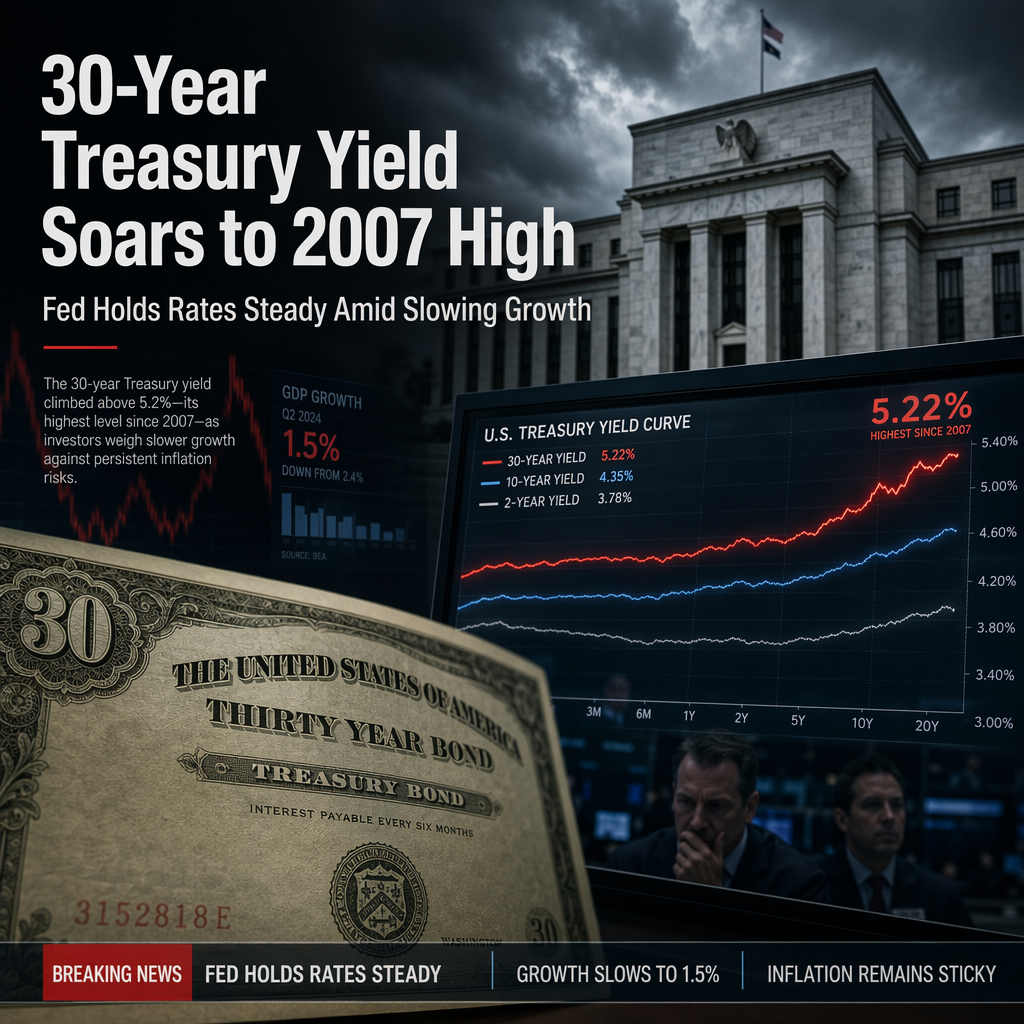
U.S. Treasury yields remained largely unchanged on Thursday following the Federal Reserve's decision to keep its key interest rate steady at a range of 3.5% to 3.75% in a 9-3 vote, marking the second FOMC meeting under Chairman Kevin Warsh's leadership [1]. The 30-year Treasury bond yield hovered near levels not seen since 2007, having surged 6 basis points after regular trading on Wednesday to above 5.2%, while the rest of the yield curve showed little movement [1].
The FOMC statement noted that 'economic activity is expanding at a solid pace despite elevated uncertainty that owes, in part, to the conflict in the Middle East,' and highlighted that job gains have kept pace with the workforce, with the unemployment rate changing little [1]. However, the latest economic data released Thursday indicated that U.S. growth slowed to 1.5% in the second quarter, missing the Dow Jones consensus estimate of 1.8% [1].
Inflation continues to exceed the Fed's target, with core PCE (excluding food and energy) rising 0.1% month-over-month and 3.3% year-over-year, compared to economists' expectations of 0.2% and 3.3%, respectively [1]. Deutsche Bank analysts observed that the Treasury sell-off persisted overnight and projected that the Fed would raise rates by 50 basis points this year, with 25-basis-point hikes anticipated in both September and December [1].
The analysts also cautioned that the FOMC is unlikely to be reassured by the market's reaction, as the increase in long-end rates alongside a decline in forward real yields suggests skepticism about a swift return to price stability [1]. While overall U.S. credit conditions remain supportive, they warned that a steeper yield curve could exert additional pressure on the already weak housing market [1].
CONCLUSION
The Federal Reserve's decision to hold rates steady, coupled with the 30-year Treasury yield reaching its highest level since 2007, reflects ongoing market uncertainty amid slowing economic growth and persistent inflation. Analysts expect further rate hikes this year, and concerns remain about the impact of higher long-term yields on sectors like housing. The market reaction underscores doubts about a quick return to price stability.