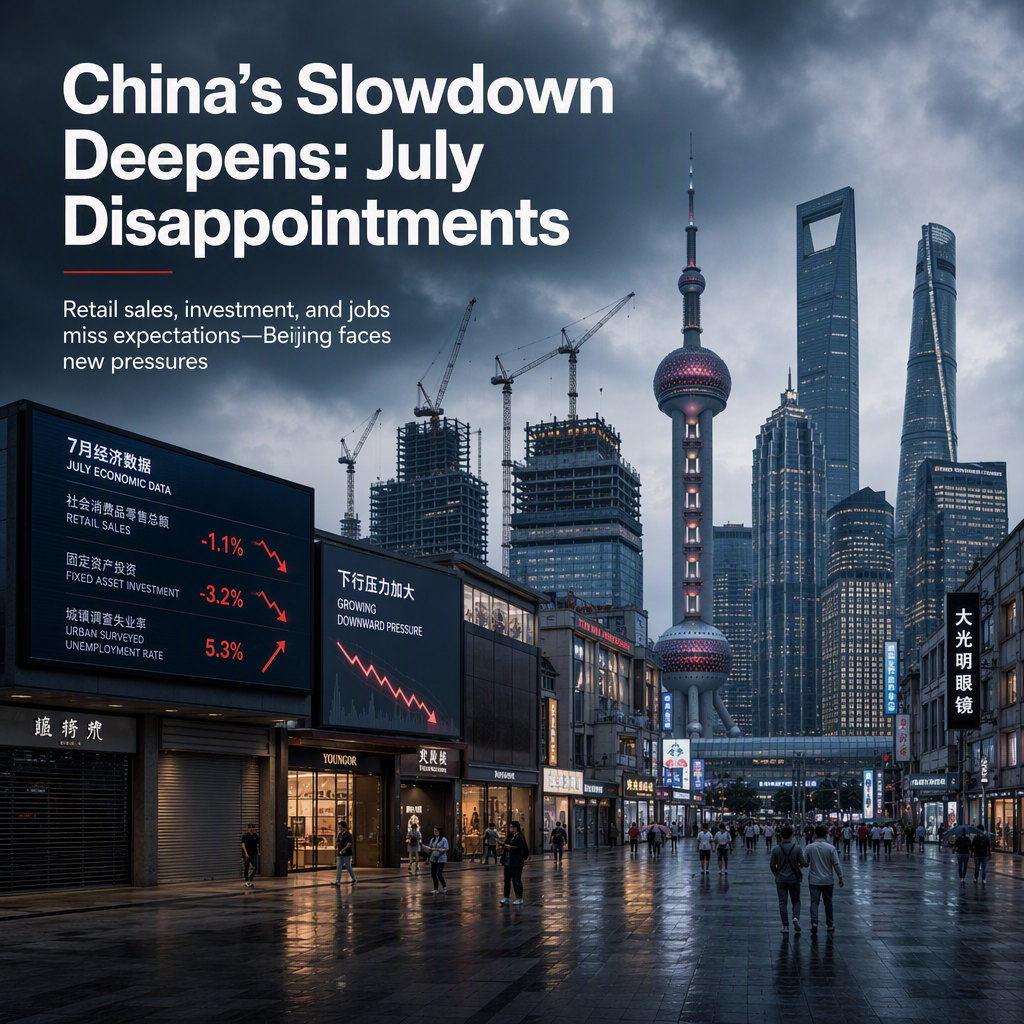
China's economy showed further signs of deceleration in July, with key indicators missing expectations and highlighting mounting challenges for policymakers. Retail sales grew by only 0.6% year-on-year, significantly below the 1.5% increase forecasted in a Reuters poll and slowing from 1% in June, according to the National Bureau of Statistics [1]. Urban fixed-asset investment, which includes real estate and infrastructure, contracted by 6.7% as of end-July compared to a year earlier, a steeper decline than the 6% drop estimated in the poll and worsening from the 5.7% decrease in the first half of the year [1].
Industrial output rose 4.5% in July, missing the estimated 4.8% growth and slowing from a 5.3% increase in June [1]. The urban unemployment rate climbed to 5.2% in July from 5% in June, underscoring labor market pressures [1]. The release of this data was delayed to 3 p.m. from the usual 10 a.m., reinforcing concerns about the health of the world's second-largest economy, which is grappling with a deepening supply-demand imbalance [1].
Despite robust industrial production and exports linked to the global AI investment boom, consumption and private investment have weakened amid a prolonged property downturn and volatile energy prices [1]. The July figures follow the economy's slowest growth since late 2022 in the second quarter, with GDP expanding just 4.3% year-on-year. China's 4.7% GDP growth in the first half of the year keeps it on track to meet Beijing's growth target range of 4.5%-5% [1].
Goldman Sachs noted that retail sales growth has slowed sharply over the past year, with nominal growth at just 1.3% in the first half of 2026 compared to 5% in the same period last year. The bank attributed much of the slowdown to a government trade-in subsidy program that pulled purchases forward, now acting as a drag on consumption. Goldman economists stated, 'Real momentum was likely even weaker given higher CPI inflation,' and forecast that sales growth will likely remain weak in the second half as the fading impact of the trade-in scheme continues to depress consumption, leaving full-year growth at about 1.5% [1].
Further highlighting weak spending, new bank loans issued in July saw their largest monthly decline on record, according to Barclays' calculations of official data [1].
CONCLUSION
China's July economic data points to a broadening slowdown, with retail sales, investment, and industrial output all missing expectations and unemployment rising. Analysts expect continued weakness in consumption and investment, increasing pressure on Beijing to introduce further support measures. The disappointing figures have significant implications for market sentiment and the outlook for China's growth in the second half of the year.