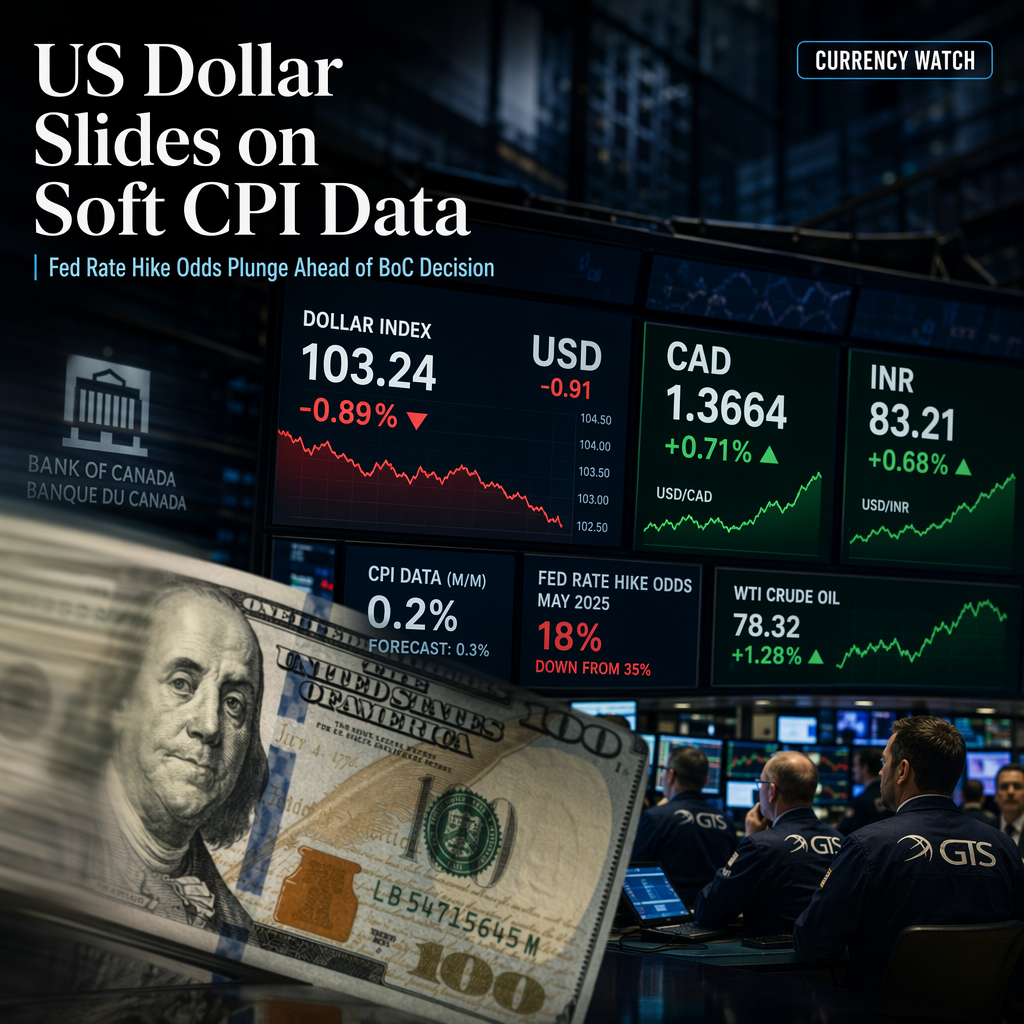
The US Dollar experienced broad-based weakness on Wednesday following the release of softer-than-expected US Consumer Price Index (CPI) data for June, which led traders to trim expectations for imminent Federal Reserve (Fed) interest rate hikes [1][2]. The US CPI rose by 3.5% year-on-year in June, down from 4.2% in May and below the market consensus of 3.8% [1][2]. Core CPI, which excludes food and energy, increased by 2.6% year-on-year in June, also below the previous reading of 2.9% and market expectations of 2.8% [1][2].
As a result, the probability of a quarter-point Fed rate hike at the July 28-29 meeting dropped to 16.6%, compared to 35% before the inflation report according to the CME FedWatch tool [1]. Source 2 reports an even sharper decline in July hike odds, from 41.7% on Monday to 16.6% after the CPI release [2]. The likelihood of a September rate hike also fell to about 60%, down from more than 90% before the data [1]. Fed Chairman Kevin Warsh reiterated the Fed's commitment to price stability, stating, “The Fed has no tolerance for persistently elevated inflation,” and expressing confidence that the inflation surge of the last five years will be resolved if policy is executed correctly [2].
The Canadian Dollar (CAD) edged higher against the US Dollar, with the USD/CAD pair losing traction near 1.4050 during early European trading hours [1]. The Bank of Canada (BoC) is widely expected to keep its benchmark overnight interest rate unchanged at 2.25% for the sixth consecutive meeting at its policy decision later on Wednesday [1]. BoC Governor Tiff Macklem previously indicated the Bank would look through near-term inflation spikes but would act if higher energy prices led to persistent inflation [1]. Pedro Antunes, chief economist at Signal49 Research, noted that the BoC's actions will depend on inflation pressures [1].
Similarly, the Indian Rupee (INR) gained ground against the US Dollar, with the USD/INR pair dropping to near 96.11 as the US Dollar Index (DXY) traded 0.15% lower at around 100.80 [2]. The INR's strength was attributed to the repricing of Fed rate hike expectations following the US CPI data [2]. Meanwhile, Foreign Institutional Investors (FIIs) were net sellers in the Indian stock market for the second consecutive day, selling shares worth Rs. 739.69 crore and Rs. 3,062.27 crore [2]. Technical analysis indicated that USD/INR remained above its 20-day Exponential Moving Average (EMA) at 95.37, with a bullish near-term bias supported by a positive EMA slope and an RSI of 62.1 [2].
Oil prices, which had been rallying for over a week, paused as US President Donald Trump rolled back a proposed 20% toll fee on cargo ships transiting the Strait of Hormuz, though ongoing US-Iran tensions continued to pose risks to energy supply [2].
CONCLUSION
Softer US inflation data has led to a significant repricing of Federal Reserve rate hike expectations, weakening the US Dollar against both the Canadian Dollar and Indian Rupee. Market participants are now focused on the upcoming Bank of Canada rate decision, which is widely expected to result in an unchanged policy rate. The shift in Fed expectations and central bank decisions are likely to continue driving currency and market movements in the near term.